
Florida Stand Your Ground Law Explained
By : saulcrim | Category : Criminal Defense | Comments Off on Florida Stand Your Ground Law Explained
6th Oct 2025

Florida’s Stand Your Ground law gives people the right to use deadly force in self-defense without retreating first. This law has sparked intense debate and confusion across the state.
We at Law Offices of Scott B. Saul see clients who misunderstand when this protection applies. Many people believe the Florida Stand Your Ground law offers broader immunity than it actually provides.
What Does Florida’s Stand Your Ground Law Actually Cover
Florida Statutes Section 776.012 grants legal immunity to individuals who use deadly force when they reasonably believe it prevents imminent death or great bodily harm. The law eliminates the traditional duty to retreat that existed before 2005. People can now stand their ground in any location where they have a legal right to be. This protection extends beyond your home to public spaces, vehicles, and workplaces. The statute provides both criminal immunity and civil liability protection-you cannot face prosecution or lawsuits if your actions meet the legal requirements.
The Reasonable Belief Standard
Courts apply a reasonable person standard when they evaluate Stand Your Ground claims. Your belief in the threat must be objectively reasonable based on the circumstances, not just your subjective fear. The threat must be imminent (immediate and unavoidable). Stand Your Ground laws have significant impact on violent encounters, as evidenced by various studies examining their effects on crime rates.
When Protection Does Not Apply
The law offers zero protection if you initiated the confrontation or committed a crime when the incident occurred. The Love v. State decision in 2019 made this clear by denying Stand Your Ground immunity to defendants who engaged in illegal activities. You also lose protection if you provoke the encounter or if the person you harmed had a legal right to be present. Law enforcement officers who perform their duties are specifically excluded from Stand Your Ground confrontations when properly identified.
Burden of Proof Requirements
The 2017 legislative changes shifted the burden of proof to prosecutors in pretrial immunity hearings. Prosecutors must now prove by clear and convincing evidence that your actions were unjustified. This change makes it significantly easier for defendants to claim immunity. Courts examine video footage, witness statements, and expert testimony to determine if your response was proportional to the threat you faced.
These legal complexities make proper representation essential when Stand Your Ground cases move through the court system.
Common Misconceptions About Stand Your Ground
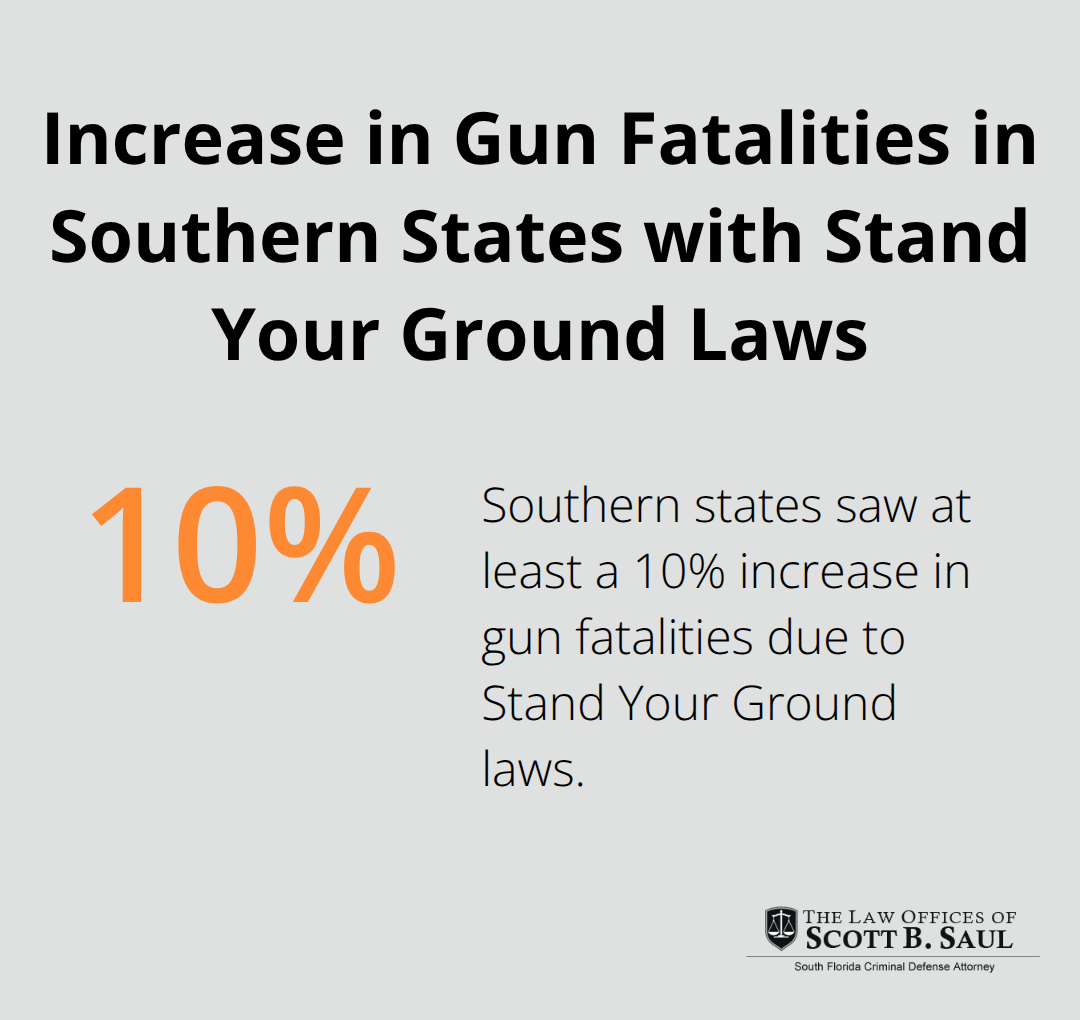
Television shows and news reports create dangerous myths about Florida’s Stand Your Ground law that lead people into serious legal trouble. Several Southern states saw increases of 10% or more in gun fatalities, with Stand Your Ground cases contributing to more than 700 additional deaths. Many defendants wrongly believe they can claim immunity after they start fights, use excessive force, or act while they commit crimes. The law does not grant blanket permission to use deadly force whenever you feel threatened.
Media Fiction vs Legal Reality
Popular media portrays Stand Your Ground as a license to shoot first and ask questions later, but Florida courts demand strict adherence to legal requirements. The American Bar Association’s 2015 National Task Force found that Stand Your Ground laws disproportionately affect communities (particularly marginalized groups), yet media coverage rarely explains the reasonable belief standard that courts actually apply. Your fear must be objectively reasonable to a typical person in your situation, not just subjectively scary to you. Studies show Stand Your Ground laws associate with significant increases in homicide rates of 6 to 11 percent, which contradicts media narratives that these laws reduce violence. Courts examine whether your response was proportional to the actual threat, not the threat you imagined.
What Eliminates Your Protection
Stand Your Ground immunity vanishes completely if you provoke the confrontation, commit any crime during the incident, or act as the initial aggressor. The 2019 Love v. State decision specifically denied protection to defendants who engaged in illegal activities (this precedent guides current court decisions). You cannot claim immunity if the person you harmed had legal rights to be present, such as police officers who perform identified duties or lawful residents. The law also fails to protect you from civil lawsuits in many situations, despite common beliefs that it provides complete legal immunity from all consequences.

These widespread misconceptions about Stand Your Ground protections create serious risks for anyone who faces a violent encounter and must make split-second decisions about self-defense.
How Do Florida Courts Actually Handle Stand Your Ground Cases
High-Profile Cases Shape Legal Precedent
Florida courts have established clear patterns in Stand Your Ground cases through landmark decisions that define the law’s boundaries. The Trayvon Martin case in 2012 demonstrated how public attention affects legal proceedings, though the defense ultimately relied on traditional self-defense rather than Stand Your Ground immunity. The Michael Drejka case in 2018 showed courts reject Stand Your Ground claims when defendants escalate minor disputes into deadly confrontations. Drejka received a 20-year sentence after surveillance footage contradicted his threat perception claims. The Curtis Reeves movie theater case resulted in acquittal in 2022, but only after eight years of legal proceedings that cost hundreds of thousands in defense fees. These cases prove that Stand Your Ground immunity requires meticulous evidence presentation and expert legal strategy.
Statistical Reality Behind Stand Your Ground Defenses
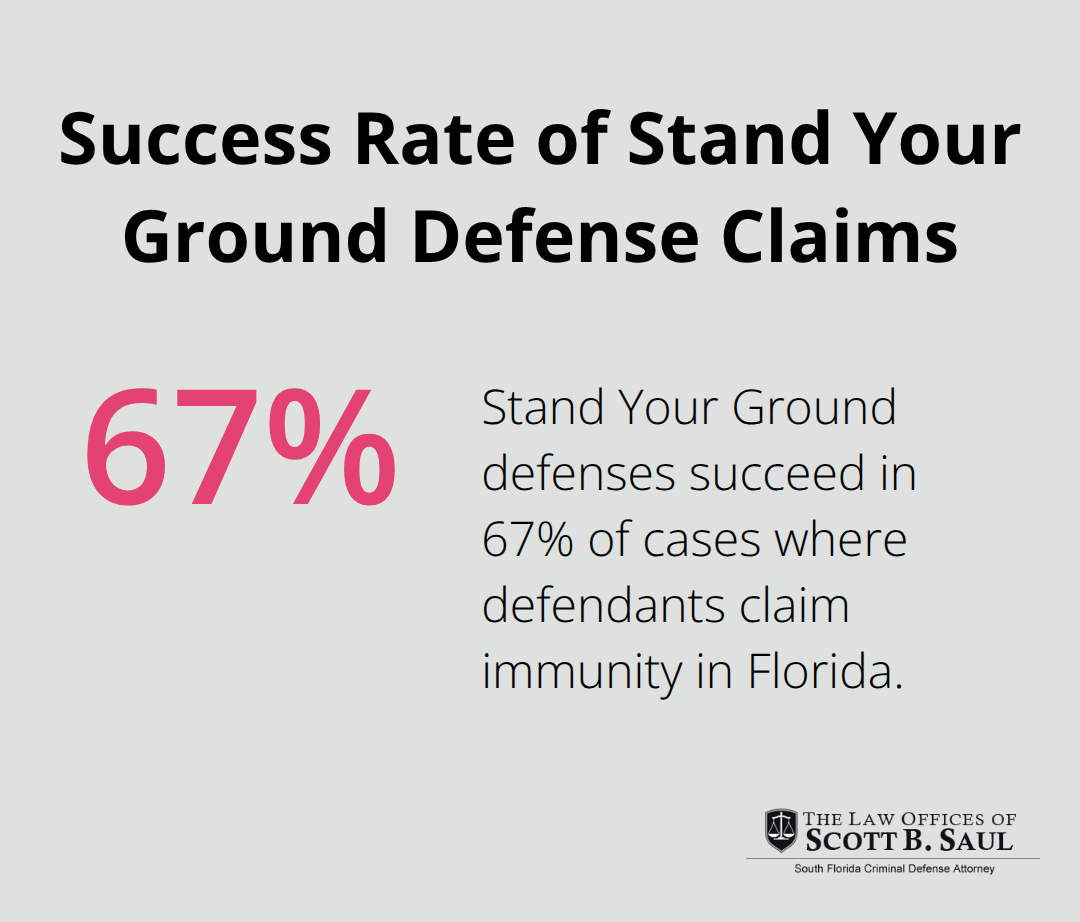
Tampa Bay Times analysis of 2021 data revealed that Stand Your Ground defenses succeed in only 67 percent of cases where defendants claim immunity, which contradicts popular beliefs about automatic protection. Florida prosecutors now face the burden to disprove self-defense claims with clear and convincing evidence since the 2017 legislative changes, yet conviction rates remain substantial. The American Bar Association documented racial disparities in Stand Your Ground outcomes, with white defendants who kill Black victims receiving justified rulings at a 34% rate. Florida experienced a 24 percent increase in justifiable homicide rulings between 2005 and 2020, with Stand Your Ground cases contributing to over 200 additional deaths annually according to state crime statistics. Courts now require pretrial immunity hearings that cost defendants between $15,000 and $50,000 in legal fees.
Court Evaluation Methods and Defense Strategies
Florida judges examine four critical elements when they evaluate Stand Your Ground claims: reasonable fear of imminent harm, proportional response, lawful presence, and absence of criminal activity by the defendant. Courts scrutinize video evidence, witness testimony, and forensic analysis to reconstruct events and determine whether defendants met the reasonable person standard. Successful defenses typically include expert testimony about threat assessment, documented evidence of the aggressor’s violent history, and clear demonstration that retreat was impossible or unnecessary (financial resources often determine the quality of expert witnesses available). Cases involving aggravated assault charges carry severe penalties including up to five years in prison, making proper legal representation crucial for defendants claiming Stand Your Ground immunity.
Final Thoughts
Florida Stand Your Ground law provides real protection for people who face genuine threats, but courts demand strict adherence to legal requirements that many defendants misunderstand. The law protects only those who reasonably believe deadly force prevents imminent death or great bodily harm while lawfully present and not engaged in criminal activity. Courts reject 33 percent of Stand Your Ground claims, which proves that immunity never comes automatically.
The 2017 burden of proof shift helps defendants, but successful cases still require expert legal strategy and substantial financial resources. Pretrial immunity hearings cost between $15,000 and $50,000, which makes quality representation essential from the moment you face charges. Racial disparities in outcomes and the complexity of reasonable belief standards create additional challenges that inexperienced attorneys cannot navigate effectively.
We at Law Offices of Scott B. Saul understand these complexities through decades of trial experience (including more than 300 jury cases). Our background as former federal and state prosecutors provides unique insights into how courts evaluate self-defense claims. If you face charges that involve self-defense in Miami-Dade or Broward County, contact our experienced criminal defense team immediately to protect your rights and build the strongest possible defense strategy.
Archives
- December 2025 (2)
- November 2025 (8)
- October 2025 (8)
- September 2025 (9)
- August 2025 (8)
- July 2025 (8)
- June 2025 (9)
- May 2025 (9)
- April 2025 (8)
- March 2025 (9)
- February 2025 (8)
- January 2025 (9)
- December 2024 (10)
- November 2024 (5)
- July 2024 (2)
- June 2024 (2)
- May 2024 (2)
- April 2024 (2)
- March 2024 (2)
- February 2024 (2)
- January 2024 (2)
- December 2023 (2)
- November 2023 (2)
- October 2023 (2)
- September 2023 (2)
- August 2023 (1)
- July 2023 (2)
- June 2023 (2)
- May 2023 (2)
- April 2023 (2)
- March 2023 (2)
- February 2023 (2)
- January 2023 (2)
- December 2022 (2)
- November 2022 (2)
- October 2022 (2)
- September 2022 (2)
- August 2022 (2)
- July 2022 (2)
- June 2022 (2)
- May 2022 (2)
- April 2022 (2)
- March 2022 (2)
- February 2022 (2)
- January 2022 (2)
- December 2021 (2)
- November 2021 (2)
- October 2021 (2)
- September 2021 (2)
- August 2021 (2)
- July 2021 (2)
- June 2021 (2)
- May 2021 (2)
- April 2021 (2)
- September 2020 (5)
- July 2020 (4)
- June 2020 (4)
- May 2020 (4)
- April 2020 (5)
- March 2020 (4)
- February 2020 (4)
- January 2020 (4)
- December 2019 (1)
- November 2019 (4)
- October 2019 (4)
- September 2019 (4)
- August 2019 (4)
- July 2019 (5)
- June 2019 (4)
- May 2019 (4)
- April 2019 (4)
- March 2019 (4)
- February 2019 (4)
- January 2019 (4)
- December 2018 (4)
- November 2018 (5)
- October 2018 (5)
- September 2018 (4)
- August 2018 (4)
- July 2018 (7)
- June 2018 (4)
- May 2018 (4)
- April 2018 (8)
- March 2018 (4)
- February 2018 (4)
- January 2018 (4)
- November 2017 (4)
- October 2017 (4)
- September 2017 (4)
- August 2017 (7)
- July 2017 (6)
- June 2017 (4)
- May 2017 (4)
- April 2017 (4)
- March 2017 (4)
- February 2017 (7)
- January 2017 (4)
- December 2016 (7)
- November 2016 (4)
- October 2016 (4)
- September 2016 (10)
- August 2016 (4)
- July 2016 (4)
- June 2016 (4)
- May 2016 (4)
- April 2016 (4)
- March 2016 (4)
- February 2016 (7)
- January 2016 (4)
- December 2015 (5)
- November 2015 (4)
- October 2015 (7)
- September 2015 (4)
- August 2015 (4)
- July 2015 (13)
- June 2015 (9)
- May 2015 (8)
- April 2015 (6)
- March 2015 (4)
- February 2015 (4)
- January 2015 (4)
- December 2014 (4)
- November 2014 (4)
- October 2014 (4)
- September 2014 (3)
Categories
- Adjudication (1)
- Bankruptcy (1)
- Burglary Crimes (3)
- calendar call (1)
- Car Accident (1)
- Criminal Defense (374)
- Cyber Crimes (7)
- DNA (1)
- Domestic Violence (9)
- Drug Crimes (5)
- DUI (12)
- Embezzlement (1)
- Environmental Crimes (4)
- Expungement Law (2)
- Federal Sentencing Law (3)
- Firearm (3)
- Forgery (4)
- General (82)
- Healthcare (3)
- Immigration (1)
- Indentity Theft (1)
- Insurance (5)
- judicial sounding (2)
- Juvenile Crimes (4)
- Manslaughter (4)
- Money Laundering (3)
- Organized Crime (1)
- Racketeering (1)
- Reckless Driving (3)
- RICO (3)
- Sealing and Expunging (2)
- Sex Offense (1)
- Shoplifting (1)
- Suspended Driver's License (1)
- Traffic (4)
- Trending Topics (1)
- White-collar Offenses (1)
