
Is Possession of a Machine Gun Illegal?
By : saulcrim | Category : Criminal Defense | Comments Off on Is Possession of a Machine Gun Illegal?
4th Sep 2025

Machine guns have long been a subject of intense legal scrutiny in the United States. The possession of these powerful firearms is heavily regulated at both federal and state levels, with severe consequences for unlawful possession of a machine gun.
At Law Offices of Scott B. Saul, we often field questions about the legality of owning various firearms, including machine guns. This post will explore the complex web of laws governing machine gun ownership, focusing on federal regulations and Florida state laws.
Federal Laws on Machine Gun Possession
The United States government imposes strict regulations on machine gun possession. Federal law defines a machine gun as any weapon that can fire more than one shot automatically, without manual reloading, by a single trigger function. This definition also encompasses any part designed and intended to convert a weapon into a machine gun.
The National Firearms Act and Its Regulations
The National Firearms Act (NFA) of 1934 marked the first federal law to regulate machine guns. It mandated the registration of all machine guns with the Secretary of the Treasury and imposed a tax on their manufacture and transfer. The NFA’s primary goal was to reduce the use of these weapons by criminals during the Prohibition era.
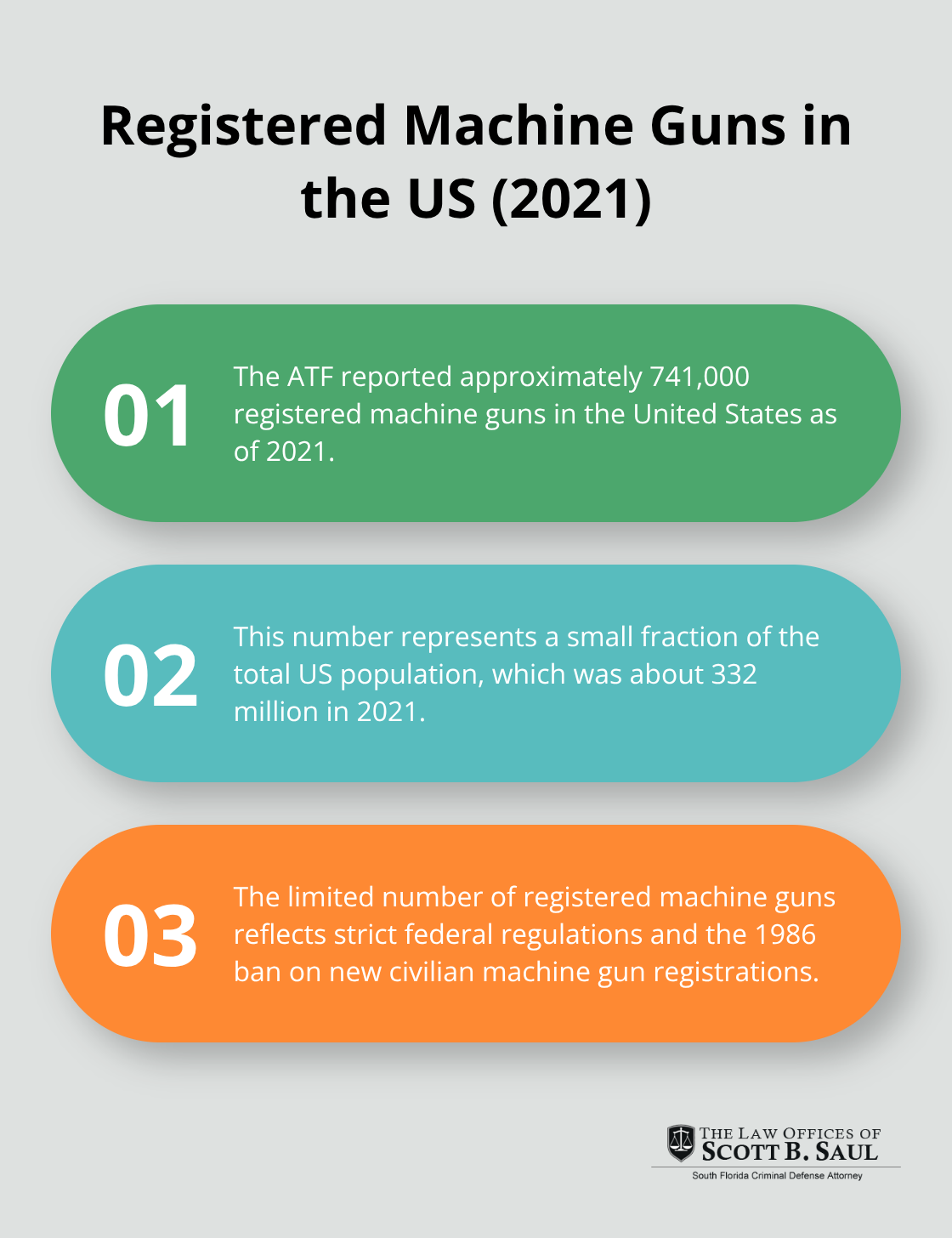
In 1986, the Firearm Owners Protection Act amended the NFA, prohibiting civilians from possessing machine guns manufactured after May 19, 1986. This amendment effectively froze the number of legally owned machine guns in civilian hands. As of 2021, the Bureau of Alcohol, Tobacco, Firearms and Explosives (ATF) reported approximately 741,000 registered machine guns in the United States.
The Gun Control Act’s Impact
The Gun Control Act of 1968 further strengthened restrictions on machine guns. It prohibited the importation of machine guns for civilian use and established stricter licensing requirements for manufacturers, dealers, and importers. The Act also expanded the definition of prohibited persons who cannot legally possess firearms (including machine guns).
Penalties for Illegal Machine Gun Possession
Federal law imposes severe penalties for violations of machine gun regulations. Illegal possession of a machine gun can result in fines up to $250,000 and imprisonment for up to 10 years. If a person uses a machine gun in connection with a violent crime or drug trafficking offense, the penalties increase dramatically, potentially leading to life imprisonment.
The Role of the ATF
The Bureau of Alcohol, Tobacco, Firearms and Explosives (ATF) plays a crucial role in enforcing federal machine gun laws. The ATF oversees the registration process, conducts background checks, and investigates violations of federal firearms laws. They also maintain the National Firearms Registration and Transfer Record, which contains information on all NFA firearms (including machine guns) in the United States.
The complex web of federal laws surrounding machine gun possession underscores the importance of understanding these regulations. As we shift our focus to Florida’s state laws on machine guns, it’s essential to recognize how these federal regulations form the foundation for state-level restrictions and enforcement.
Florida’s Machine Gun Laws
Florida’s approach to machine gun regulation aligns closely with federal law, but includes state-specific nuances. Under Florida Statute 790.001(9), a machine gun is defined as any firearm that can fire more than one shot automatically, without manual reloading, by a single function of the trigger. This definition mirrors the federal one, which ensures consistency in enforcement.
State Regulations on Possession
Florida law prohibits the possession of machine guns unless they are properly registered under federal law. Only machine guns manufactured and registered before May 19, 1986, can be legally owned by civilians in Florida. The state does not maintain a separate registration system, but relies on federal records.
In Florida, it’s illegal to manufacture, transport, offer for sale, or possess any machine gun. However, exceptions exist for law enforcement agencies, military personnel, and properly licensed individuals (these exceptions are narrowly defined and strictly enforced).
Licensing and Special Circumstances
Those who seek to own a machine gun in Florida must obtain a Federal Firearms License (FFL) with a Special Occupational Tax (SOT) classification. This process involves rigorous background checks, fingerprinting, and regular inspections by the ATF. Even with these licenses, individuals can only possess machine guns for specific purposes, such as sales to law enforcement or military agencies.
Florida law also allows for the temporary possession of machine guns by qualified individuals for use in theatrical productions or television filming. This requires explicit written authorization from the Florida Department of Law Enforcement and adherence to strict safety protocols.
Penalties for Violations
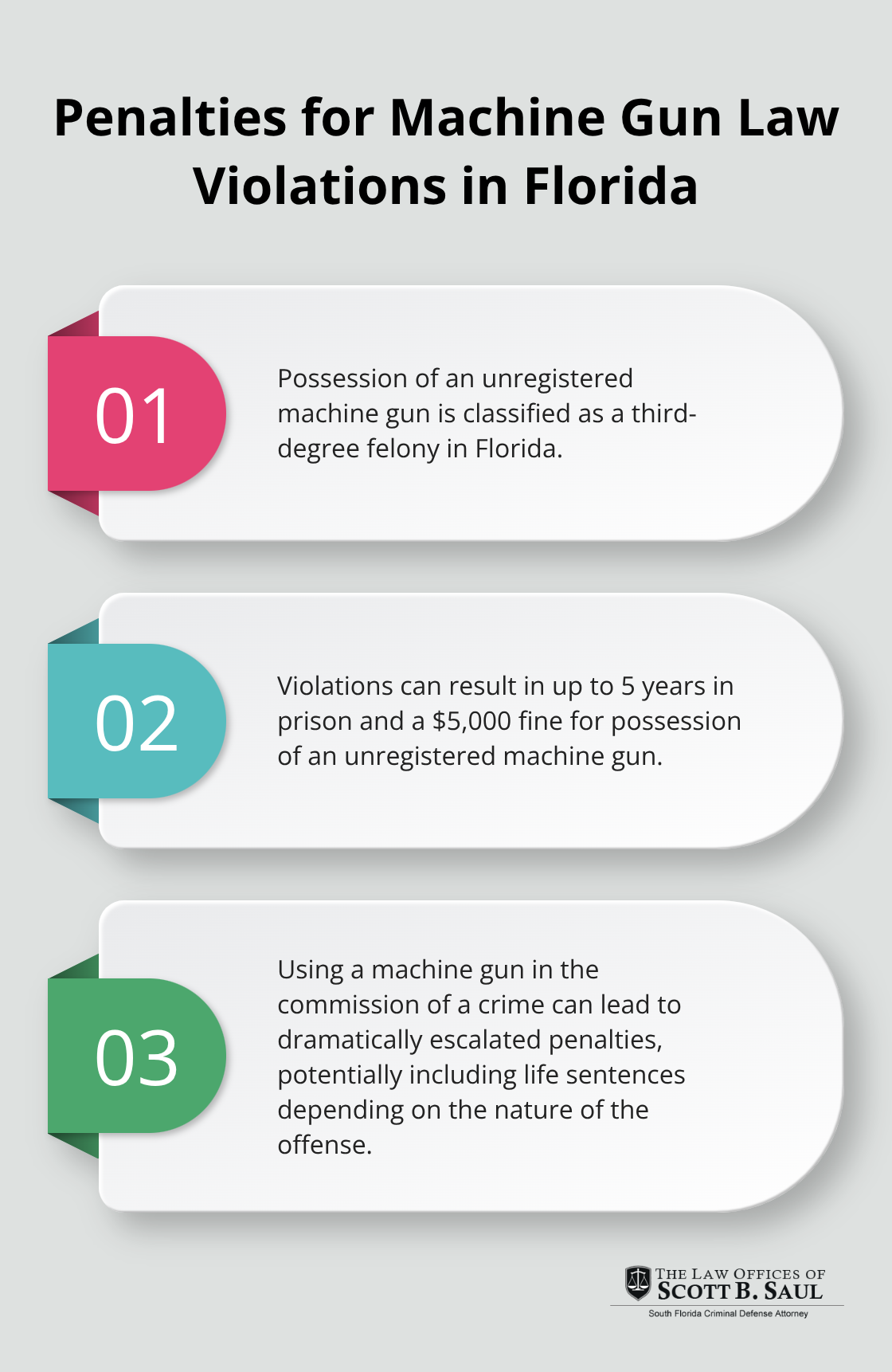
Violations of Florida’s machine gun laws carry severe consequences.
Florida’s stance on machine guns reflects a commitment to public safety while respecting federal regulations. The state’s laws create a challenging environment for civilian ownership, which emphasizes the importance of strict compliance with both state and federal regulations. Those who navigate these complex laws should seek expert legal counsel to ensure full compliance and avoid severe legal consequences. The next section will explore the legal ways to own a machine gun, shedding light on the intricate process and requirements involved.
How to Legally Own a Machine Gun
Pre-1986 Machine Guns
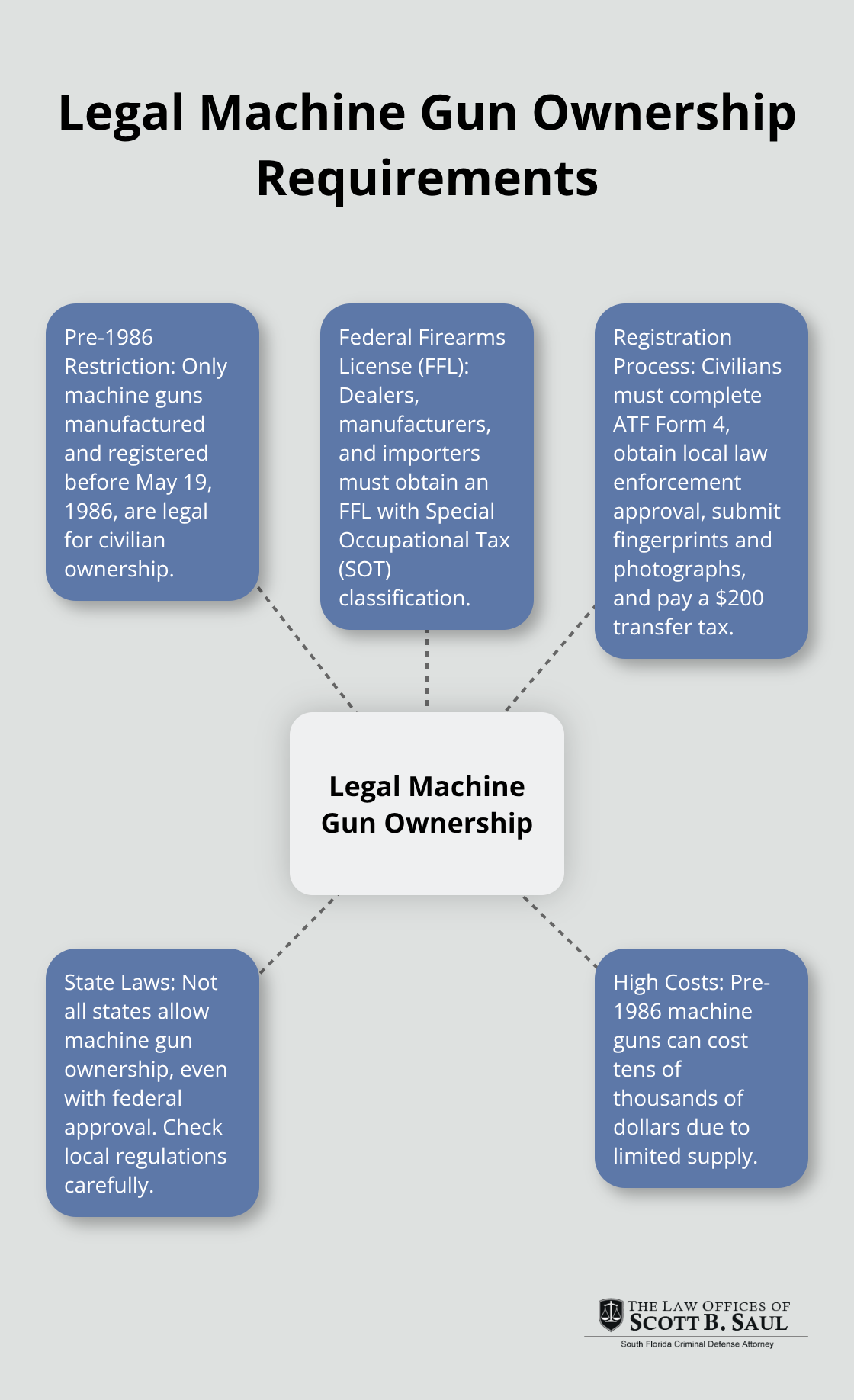
The most common way for civilians to legally own a machine gun involves purchasing one manufactured and registered before May 19, 1986. This date marks the implementation of the Hughes Amendment to the Firearm Owners Protection Act, which prohibited the manufacture of new machine guns for civilian use. This restriction has created a fixed supply of legal machine guns, significantly increasing their prices. Pre-1986 machine guns can cost tens of thousands of dollars, with some models like the Colt SP1 Registered Transferable Machine Gun priced at $28,995.00.
Federal Firearms License and Special Occupational Tax
Another path to machine gun ownership exists for those involved in the firearms business. This option primarily applies to dealers, manufacturers, and importers. The process requires obtaining a Federal Firearms License (FFL) with a Special Occupational Tax (SOT) classification. Steps include:
- Applying for an FFL through the ATF
- Paying required fees ($30 to $3,000, depending on license type)
- Undergoing a thorough background check
- Completing an in-person interview with an ATF agent
After obtaining an FFL, applying for an SOT classification allows for the manufacture, import, or dealing of NFA items, including machine guns. The annual SOT fee ranges from $500 to $1,000 (based on business volume).
Registration and Permit Process
Civilians seeking to own a pre-1986 machine gun must follow a rigorous registration process:
- Locate a transferable machine gun through a licensed dealer
- Complete ATF Form 4, which includes detailed personal information
- Obtain approval from the local Chief Law Enforcement Officer
- Submit fingerprints and photographs
- Pay a $200 transfer tax
- Wait for ATF approval (typically 6-12 months)
It’s important to note that not all states allow machine gun ownership, even with federal approval. Florida, for instance, aligns with federal law but imposes additional restrictions.
Legal Considerations
The landscape of firearms law constantly evolves, and staying informed and compliant requires expert knowledge and attention to detail. Professional legal guidance proves indispensable for anyone navigating these intricate regulations.
The consequences of non-compliance can result in hefty fines and lengthy prison sentences.
National Firearms Act (NFA) restrictions apply to certain firearms, including shotguns and rifles having barrels less than 18 inches in length, and other specific weapons categories.
Final Thoughts
Federal and Florida laws create a complex framework that restricts machine gun possession. The consequences for unlawful possession of a machine gun include substantial fines and lengthy prison sentences. This strict approach reflects the government’s commitment to public safety and the potential dangers associated with these powerful weapons.
The path to legal machine gun ownership involves extensive requirements, including background checks, financial investments, and ongoing compliance with state and federal laws. Professional legal guidance proves indispensable for anyone navigating these intricate regulations. Our team at Law Offices of Scott B. Saul brings over three decades of experience in criminal defense to firearms-related legal issues.
We offer personalized attention and aggressive representation for those facing charges related to machine gun possession or seeking guidance on firearms regulations. Our expertise in both federal and Florida state laws positions us to protect our clients’ rights while navigating the complex legal landscape surrounding firearms ownership and possession. If you encounter firearms-related legal issues in South Florida, we encourage you to seek professional assistance.
Archives
- February 2026 (5)
- January 2026 (9)
- December 2025 (9)
- November 2025 (8)
- October 2025 (8)
- September 2025 (9)
- August 2025 (8)
- July 2025 (8)
- June 2025 (9)
- May 2025 (9)
- April 2025 (8)
- March 2025 (9)
- February 2025 (8)
- January 2025 (9)
- December 2024 (10)
- November 2024 (5)
- July 2024 (2)
- June 2024 (2)
- May 2024 (2)
- April 2024 (2)
- March 2024 (2)
- February 2024 (2)
- January 2024 (2)
- December 2023 (2)
- November 2023 (2)
- October 2023 (2)
- September 2023 (2)
- August 2023 (1)
- July 2023 (2)
- June 2023 (2)
- May 2023 (2)
- April 2023 (2)
- March 2023 (2)
- February 2023 (2)
- January 2023 (2)
- December 2022 (2)
- November 2022 (2)
- October 2022 (2)
- September 2022 (2)
- August 2022 (2)
- July 2022 (2)
- June 2022 (2)
- May 2022 (2)
- April 2022 (2)
- March 2022 (2)
- February 2022 (2)
- January 2022 (2)
- December 2021 (2)
- November 2021 (2)
- October 2021 (2)
- September 2021 (2)
- August 2021 (2)
- July 2021 (2)
- June 2021 (2)
- May 2021 (2)
- April 2021 (2)
- September 2020 (5)
- July 2020 (4)
- June 2020 (4)
- May 2020 (4)
- April 2020 (5)
- March 2020 (4)
- February 2020 (4)
- January 2020 (4)
- December 2019 (1)
- November 2019 (4)
- October 2019 (4)
- September 2019 (4)
- August 2019 (4)
- July 2019 (5)
- June 2019 (4)
- May 2019 (4)
- April 2019 (4)
- March 2019 (4)
- February 2019 (4)
- January 2019 (4)
- December 2018 (4)
- November 2018 (5)
- October 2018 (5)
- September 2018 (4)
- August 2018 (4)
- July 2018 (7)
- June 2018 (4)
- May 2018 (4)
- April 2018 (8)
- March 2018 (4)
- February 2018 (4)
- January 2018 (4)
- November 2017 (4)
- October 2017 (4)
- September 2017 (4)
- August 2017 (7)
- July 2017 (6)
- June 2017 (4)
- May 2017 (4)
- April 2017 (4)
- March 2017 (4)
- February 2017 (7)
- January 2017 (4)
- December 2016 (7)
- November 2016 (4)
- October 2016 (4)
- September 2016 (10)
- August 2016 (4)
- July 2016 (4)
- June 2016 (4)
- May 2016 (4)
- April 2016 (4)
- March 2016 (4)
- February 2016 (7)
- January 2016 (4)
- December 2015 (5)
- November 2015 (4)
- October 2015 (7)
- September 2015 (4)
- August 2015 (4)
- July 2015 (13)
- June 2015 (9)
- May 2015 (8)
- April 2015 (6)
- March 2015 (4)
- February 2015 (4)
- January 2015 (4)
- December 2014 (4)
- November 2014 (4)
- October 2014 (4)
- September 2014 (3)
Categories
- Adjudication (1)
- Bankruptcy (1)
- Burglary Crimes (3)
- calendar call (1)
- Car Accident (1)
- Criminal Defense (395)
- Cyber Crimes (7)
- DNA (1)
- Domestic Violence (9)
- Drug Crimes (5)
- DUI (12)
- Embezzlement (1)
- Environmental Crimes (4)
- Expungement Law (2)
- Federal Sentencing Law (3)
- Firearm (3)
- Forgery (4)
- General (82)
- Healthcare (3)
- Immigration (1)
- Indentity Theft (1)
- Insurance (5)
- judicial sounding (2)
- Juvenile Crimes (4)
- Manslaughter (4)
- Money Laundering (3)
- Organized Crime (1)
- Racketeering (1)
- Reckless Driving (3)
- RICO (3)
- Sealing and Expunging (2)
- Sex Offense (1)
- Shoplifting (1)
- Suspended Driver's License (1)
- Traffic (4)
- Trending Topics (1)
- White-collar Offenses (1)
