
How to Navigate Florida Gun Laws: A Complete Guide
By : saulcrim | Category : Criminal Defense | Comments Off on How to Navigate Florida Gun Laws: A Complete Guide
5th Feb 2026

Florida gun laws are complex, and one mistake can lead to serious legal consequences. We at Law Offices of Scott B. Saul have helped countless gun owners understand their rights and responsibilities under state law.
This guide breaks down what you need to know about owning, carrying, and using firearms in Florida. Whether you’re a first-time buyer or an experienced gun owner, you’ll find practical information to keep yourself on the right side of the law.
Understanding Florida’s Gun Ownership Requirements
Federal law prohibits ten categories of people from purchasing or possessing firearms, including felons, fugitives from justice, and individuals with certain mental health adjudications. Florida adds its own disqualifications on top of federal restrictions. If you were adjudicated as a delinquent for conduct that would constitute a felony as an adult until age 24, or if you received an adjudication withheld on a felony or misdemeanor domestic violence charge within three years of sentencing completion, you cannot legally own a firearm in Florida. Recent arrests for potentially disqualifying crimes that have not been dismissed or disposed of also block your eligibility, even if charges are eventually dropped. Timing matters-your eligibility status can shift depending on case outcomes and how much time has passed since convictions or court orders.
The Background Check and Purchase Process
When you complete the ATF Form 4473 at a licensed dealer, that form triggers Florida’s Firearm Purchase Program, administered by the Florida Department of Law Enforcement. The background check runs under federal law, and the purchase transaction becomes complete the moment the dealer signs that form. You then face a three-day waiting period, excluding weekends and state holidays, before taking possession. Local counties and cities in Florida can extend this to five days, so verify your specific county’s rules before purchasing. Multiple transfers require multiple background checks-even if you buy a second firearm minutes after the first, you will go through the entire process again.
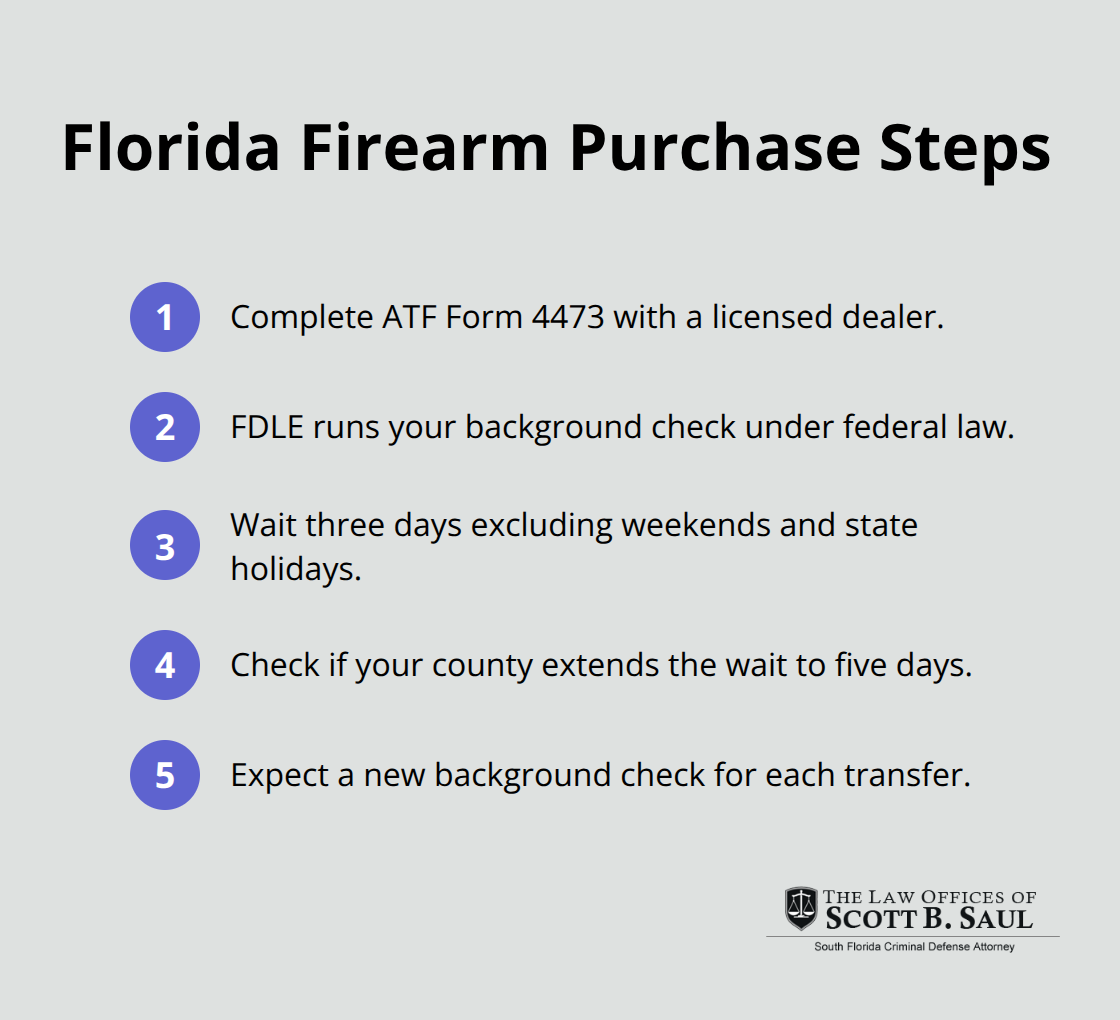
This means you cannot stockpile firearms in a single transaction or bypass checks through repeated purchases.
Age Requirements and Residency Rules
You must be 21 years old to purchase a handgun in Florida. Long guns require only 18 years old, unless you are purchasing a rifle or shotgun and you are under 21-then you must be a law enforcement officer, correctional officer, or active service member. Handgun purchases require Florida residency; you cannot buy a handgun from an out-of-state address. Long guns operate differently-residents of other states can purchase rifles and shotguns in Florida as long as the sale complies with their home state’s laws. If you are a non-resident alien visiting Florida, you need a valid border crossing number and an exception document. Legal permanent resident aliens who live in Florida can purchase firearms with a valid alien registration number. Dealers enforce these residency rules strictly, so bring proper identification and proof of address to avoid delays or complications during your transaction.
Concealed Carry in Florida
Permitless Carry and Your Legal Obligations
Since July 1, 2023, Florida permits permitless carry of a concealed weapon if you meet the same eligibility criteria as obtaining a Concealed Weapon License. This shift fundamentally changed how gun owners operate in the state, but permitless carry does not mean unrestricted carry. You must carry a government-issued ID and display it upon demand by law enforcement.
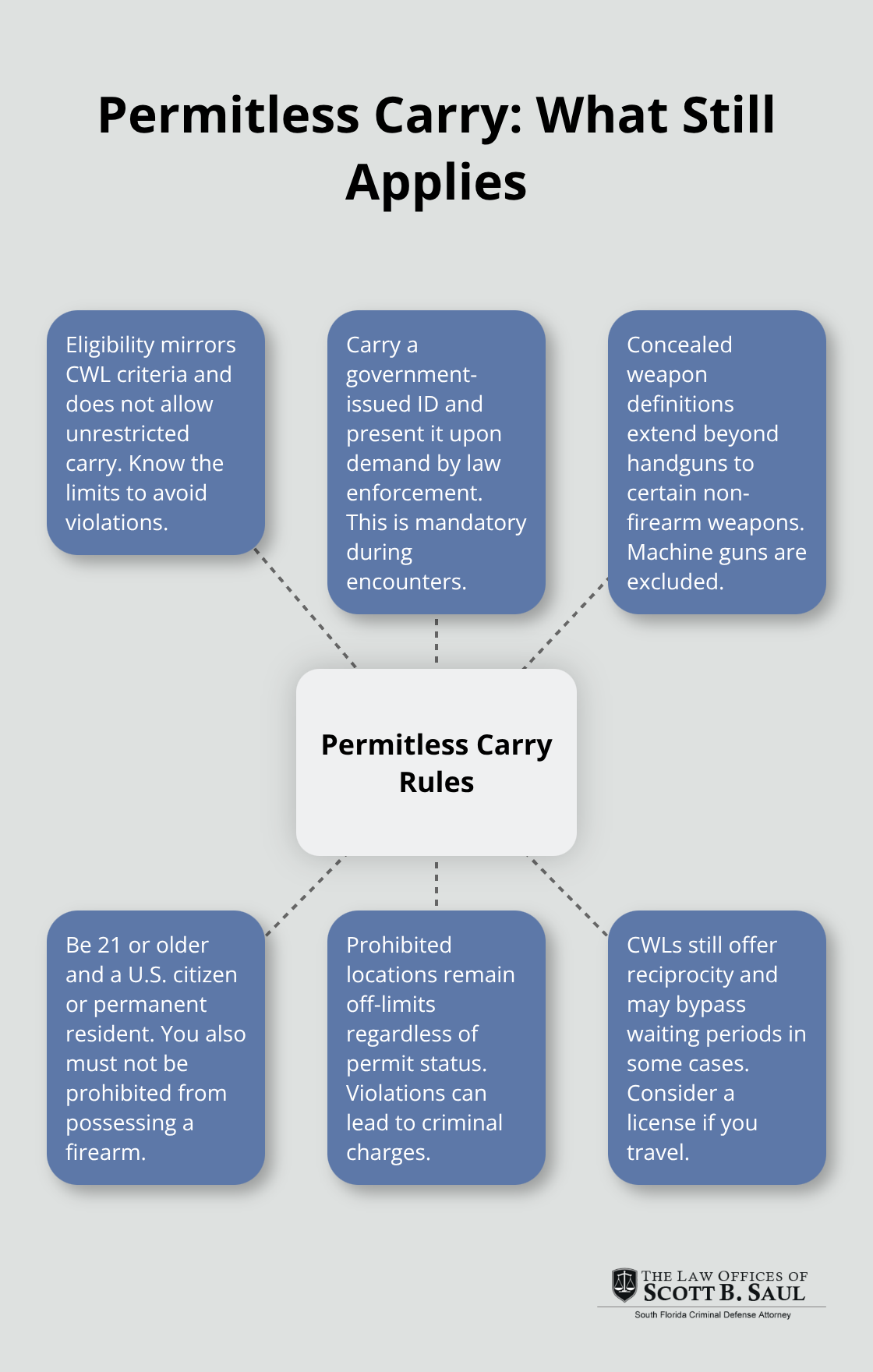
A concealed weapon under Florida law includes a handgun, electronic weapon or device, tear gas gun, knife, or billy-machine guns are excluded. You must be 21 years or older, a U.S. citizen or permanent resident, and not prohibited from purchasing or possessing a firearm.
Disqualifiers include felony convictions, certain violent misdemeanors, mental health adjudications, guardianship orders, and ongoing prohibitions tied to probation or court conditions. The practical reality is this: permitless carry simplified one aspect of gun ownership while maintaining strict eligibility gates. Many gun owners misunderstand the law entirely. According to the Jacksonville Sheriff’s Office, a common myth is that anybody can carry a firearm anywhere under the new rules. The fact is that explicit prohibited locations remain off-limits regardless of permitless carry status.
Prohibited Locations and Criminal Penalties
Carrying a concealed weapon in an unauthorized location is a second-degree misdemeanor in Florida, and the prohibited locations are extensive. You cannot carry in police or sheriff stations, detention facilities, courthouses (with limited exceptions), polling places, K-12 and higher education facilities under certain rules, or venues primarily serving alcohol. Airport terminals and sterile areas are also off-limits, as are other federal-law restricted places. If you carry into a school zone or courthouse without authorization, you face criminal charges that will follow you long after arrest.
Concealed Weapon Licenses and Their Benefits
Concealed Weapon Licenses still exist and offer reciprocity with other states that recognize Florida licenses, plus they allow same-day purchase and delivery of firearms in lieu of the three-day waiting period in some cases. The decision to pursue a CWL depends on whether you travel to other states or want to bypass waiting periods.
Stand Your Ground Protections in Your Home
Florida’s stand your ground law provides robust protections within your dwelling, residence, or occupied vehicle. You can use nondeadly force to defend against imminent unlawful force, and deadly force is justified if reasonably necessary to prevent imminent death or great bodily harm to yourself or another, or to prevent the imminent commission of a forcible felony. A presumption of reasonable fear applies when you use defensive force against someone unlawfully entering your dwelling or forcibly removing you from your residence or vehicle-provided you knew or should have known the unlawful entry was occurring.
Exceptions to Stand Your Ground Protections
This presumption does not apply if the intruder is a lawful resident with no protection order against them, a child under your guardianship, a law enforcement officer performing official duties and properly identified, or if you engage in criminal activity. Understanding these boundaries matters because misapplying stand your ground protections creates significant legal exposure. Violations of concealed carry laws and misuse of self-defense claims can result in felony charges that carry long-term consequences for your freedom and future employment prospects.
What Happens When You Violate Florida’s Gun Laws
Violating Florida’s gun laws creates immediate criminal exposure that most gun owners underestimate. The state treats firearm violations seriously, and the consequences escalate quickly depending on where you carry or possess a weapon. What Happens When You Violate Florida’s Gun Laws can include jail time of up to one year, potential loss of concealed carry privileges, and permanent loss of firearm ownership rights. A criminal record that employers see becomes a permanent part of your background. If you carry into a school zone without authorization, you face felony charges under Florida law. A felony conviction for firearm possession destroys employment prospects in most industries and permanently disqualifies you from certain professional licenses.
Transportation and Storage Violations
Many gun owners fail to transport firearms properly, and that failure becomes criminal liability the moment law enforcement pulls them over. Carrying a loaded handgun in your vehicle without a concealed carry license in Florida is illegal, even if the gun sits in a closed case or bag. The weapon must remain unloaded and secured in a locked container or with a trigger lock engaged. An officer who discovers a loaded handgun during a traffic stop will charge you with felony unlawful possession. The Florida Sheriffs Association emphasizes that unsafe storage practices extend beyond your home-they follow you into your vehicle and determine whether a routine traffic stop becomes a felony arrest.
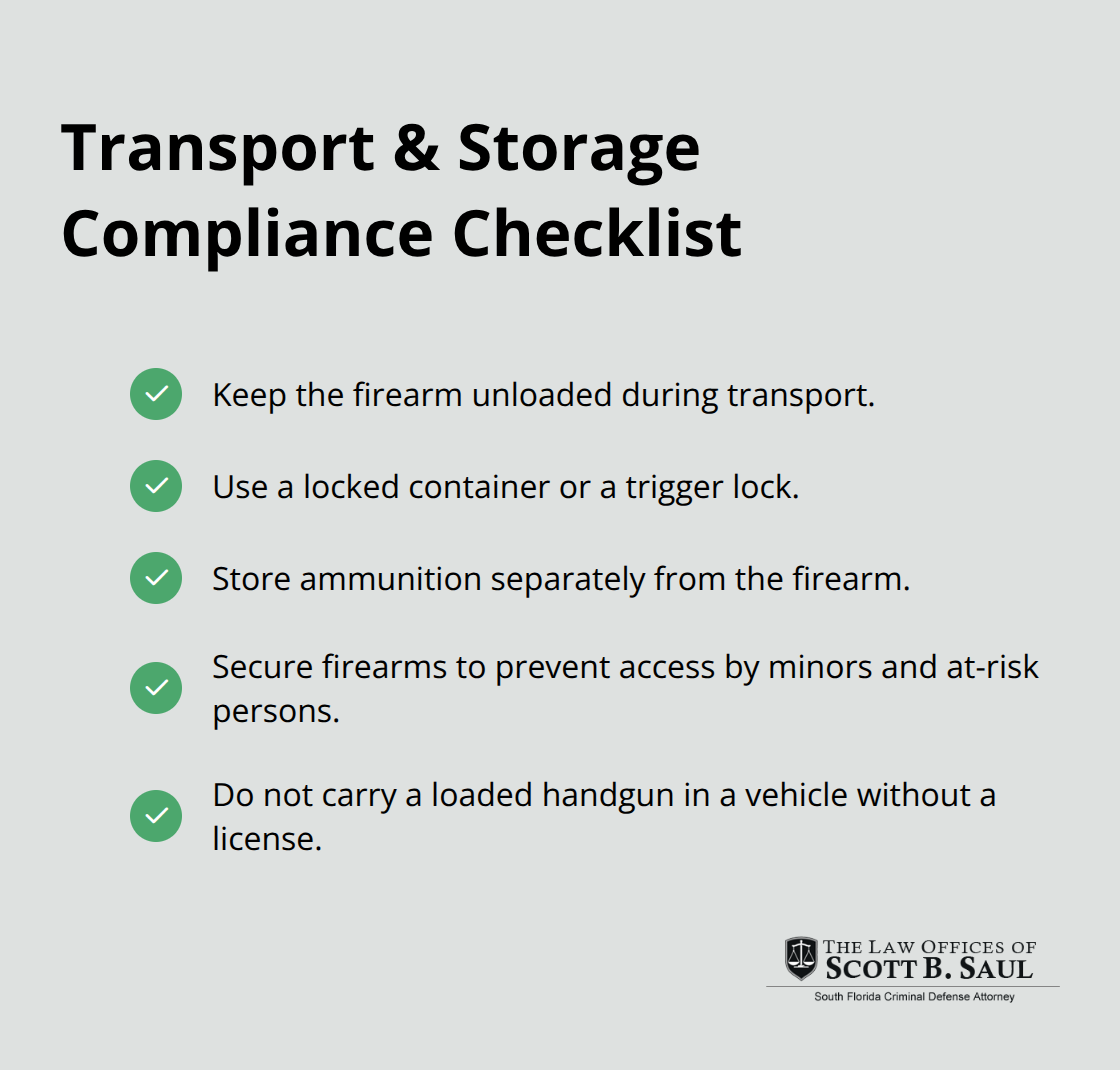
Ammunition stored separately from the firearm demonstrates intent to keep it inoperable, which strengthens your legal position. Florida Statute 790.174 requires secure storage to prevent unauthorized access when minors or others at risk live in your home, and failure to comply creates additional criminal exposure.
Felony Charges and Permanent Rights Loss
A felony conviction for firearm violations carries consequences that extend far beyond jail time and fines. Federal law permanently strips your right to own or possess any firearm once you receive a felony conviction, which means you lose Second Amendment rights indefinitely-even after you complete probation or parole. Employment becomes nearly impossible in fields that require background checks, security clearances, or professional licenses. Housing becomes harder to secure because landlords conduct background checks and reject applicants with felony records. Firearm-related felonies also affect custody rights if you have children, as courts consider criminal convictions when they determine parental fitness. Immigration status faces jeopardy if you are not a U.S. citizen, as firearms convictions trigger deportation proceedings. The financial burden compounds when you factor in legal defense costs, probation fees, and lost income during incarceration or court proceedings.
Final Thoughts
Florida gun laws demand respect and careful attention to detail. One misstep-carrying in a prohibited location, storing a firearm unsafely, or misunderstanding eligibility requirements-can result in felony charges that permanently alter your life. The stakes extend far beyond criminal penalties to employment, housing, custody rights, and your fundamental freedoms.
Permitless carry simplified one aspect of gun ownership, but it did not eliminate the rules. Background checks still apply, waiting periods still exist, and prohibited locations remain off-limits. The Jacksonville Sheriff’s Office myth-versus-fact resource clarifies common misunderstandings, and the Florida Sheriffs Public Safety Institute offers a free six-lesson firearm safety course covering handgun purchase requirements, safe storage, and concealed weapons law.
If you face charges related to Florida gun laws or need guidance on your specific situation, we at Law Offices of Scott B. Saul bring over 30 years of criminal defense experience to firearm cases. Our team has successfully tried over 300 jury cases and includes a former federal and state prosecutor who understands how prosecutors build their cases. Contact us for a comprehensive consultation if you are facing charges or need clarification on your legal obligations.
Archives
- February 2026 (5)
- January 2026 (9)
- December 2025 (9)
- November 2025 (8)
- October 2025 (8)
- September 2025 (9)
- August 2025 (8)
- July 2025 (8)
- June 2025 (9)
- May 2025 (9)
- April 2025 (8)
- March 2025 (9)
- February 2025 (8)
- January 2025 (9)
- December 2024 (10)
- November 2024 (5)
- July 2024 (2)
- June 2024 (2)
- May 2024 (2)
- April 2024 (2)
- March 2024 (2)
- February 2024 (2)
- January 2024 (2)
- December 2023 (2)
- November 2023 (2)
- October 2023 (2)
- September 2023 (2)
- August 2023 (1)
- July 2023 (2)
- June 2023 (2)
- May 2023 (2)
- April 2023 (2)
- March 2023 (2)
- February 2023 (2)
- January 2023 (2)
- December 2022 (2)
- November 2022 (2)
- October 2022 (2)
- September 2022 (2)
- August 2022 (2)
- July 2022 (2)
- June 2022 (2)
- May 2022 (2)
- April 2022 (2)
- March 2022 (2)
- February 2022 (2)
- January 2022 (2)
- December 2021 (2)
- November 2021 (2)
- October 2021 (2)
- September 2021 (2)
- August 2021 (2)
- July 2021 (2)
- June 2021 (2)
- May 2021 (2)
- April 2021 (2)
- September 2020 (5)
- July 2020 (4)
- June 2020 (4)
- May 2020 (4)
- April 2020 (5)
- March 2020 (4)
- February 2020 (4)
- January 2020 (4)
- December 2019 (1)
- November 2019 (4)
- October 2019 (4)
- September 2019 (4)
- August 2019 (4)
- July 2019 (5)
- June 2019 (4)
- May 2019 (4)
- April 2019 (4)
- March 2019 (4)
- February 2019 (4)
- January 2019 (4)
- December 2018 (4)
- November 2018 (5)
- October 2018 (5)
- September 2018 (4)
- August 2018 (4)
- July 2018 (7)
- June 2018 (4)
- May 2018 (4)
- April 2018 (8)
- March 2018 (4)
- February 2018 (4)
- January 2018 (4)
- November 2017 (4)
- October 2017 (4)
- September 2017 (4)
- August 2017 (7)
- July 2017 (6)
- June 2017 (4)
- May 2017 (4)
- April 2017 (4)
- March 2017 (4)
- February 2017 (7)
- January 2017 (4)
- December 2016 (7)
- November 2016 (4)
- October 2016 (4)
- September 2016 (10)
- August 2016 (4)
- July 2016 (4)
- June 2016 (4)
- May 2016 (4)
- April 2016 (4)
- March 2016 (4)
- February 2016 (7)
- January 2016 (4)
- December 2015 (5)
- November 2015 (4)
- October 2015 (7)
- September 2015 (4)
- August 2015 (4)
- July 2015 (13)
- June 2015 (9)
- May 2015 (8)
- April 2015 (6)
- March 2015 (4)
- February 2015 (4)
- January 2015 (4)
- December 2014 (4)
- November 2014 (4)
- October 2014 (4)
- September 2014 (3)
Categories
- Adjudication (1)
- Bankruptcy (1)
- Burglary Crimes (3)
- calendar call (1)
- Car Accident (1)
- Criminal Defense (395)
- Cyber Crimes (7)
- DNA (1)
- Domestic Violence (9)
- Drug Crimes (5)
- DUI (12)
- Embezzlement (1)
- Environmental Crimes (4)
- Expungement Law (2)
- Federal Sentencing Law (3)
- Firearm (3)
- Forgery (4)
- General (82)
- Healthcare (3)
- Immigration (1)
- Indentity Theft (1)
- Insurance (5)
- judicial sounding (2)
- Juvenile Crimes (4)
- Manslaughter (4)
- Money Laundering (3)
- Organized Crime (1)
- Racketeering (1)
- Reckless Driving (3)
- RICO (3)
- Sealing and Expunging (2)
- Sex Offense (1)
- Shoplifting (1)
- Suspended Driver's License (1)
- Traffic (4)
- Trending Topics (1)
- White-collar Offenses (1)
