
Is Possession of a Machine Gun Illegal?
By : saulcrim | Category : Criminal Defense | Comments Off on Is Possession of a Machine Gun Illegal?
2nd Oct 2025

Machine gun possession carries severe federal penalties, with violations potentially resulting in up to 10 years in prison and substantial fines. The penalty for possession of a machine gun varies significantly depending on federal registration status and state jurisdiction.
We at Law Offices of Scott B. Saul regularly handle complex firearms cases involving automatic weapons charges. Understanding these intricate laws can mean the difference between legal ownership and serious criminal charges.
What Federal Laws Control Machine Gun Ownership
The National Firearms Act of 1934 established the foundation for machine gun regulation through a $200 tax and mandatory registration system. This law defined machine guns as weapons capable of automatic fire (more than one round per trigger pull) and required all transfers to go through the Treasury Department. The $200 tax in 1934 equals approximately $4,400 today, which created a significant financial barrier that limited civilian access to automatic weapons.
The 1986 Manufacturing Prohibition Changed Everything
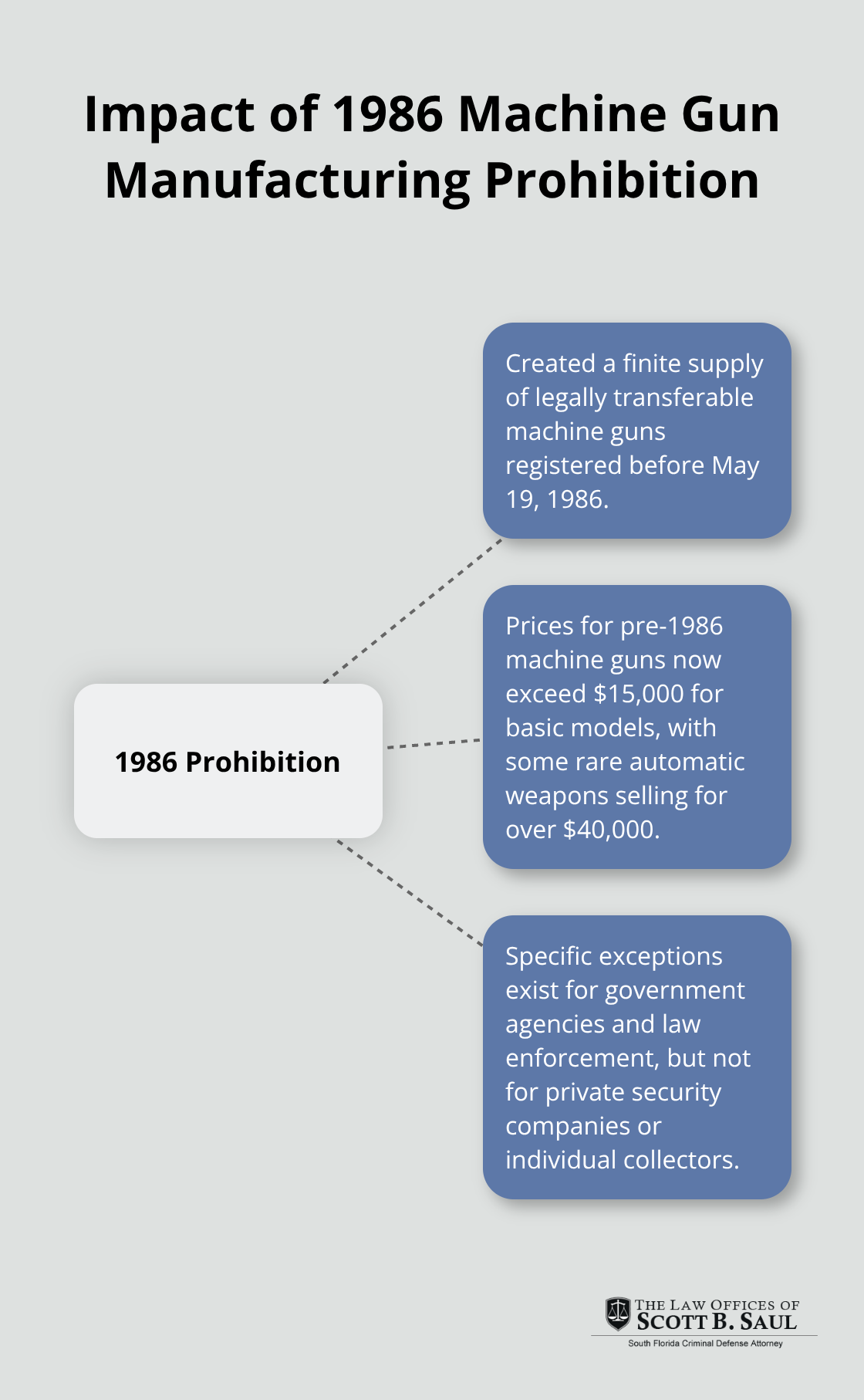
The Firearm Owners Protection Act of 1986 fundamentally altered machine gun ownership when it prohibited civilian possession of any machine gun manufactured after May 19, 1986. This cutoff date created a finite supply of legally transferable machine guns that collectors registered before the deadline. Prices for pre-1986 machine guns now exceed $15,000 for basic models, with some rare automatic weapons that sell for over $40,000. The law includes specific exceptions for government agencies and law enforcement, but these exceptions do not extend to private security companies or individual collectors.
ATF Controls Every Transfer and Registration
The Bureau of Alcohol, Tobacco, Firearms and Explosives requires Form 4 applications for all machine gun transfers, with current wait times that average 9 to 12 months. Applicants must submit fingerprints, photographs, and undergo extensive background checks that include local law enforcement notification. The ATF maintains the National Firearms Registration and Transfer Record, which contains detailed information on every legally registered machine gun. Transfer applications require approval from the ATF before any possession or transportation occurs, and violations carry federal penalties of up to 10 years imprisonment and $250,000 in fines.
State Laws Add Another Layer of Complexity
While federal law sets the baseline for machine gun regulation, individual states impose their own restrictions that often exceed federal requirements. Some states completely prohibit civilian machine gun ownership regardless of federal registration status.
State Laws and Variations Across Jurisdictions
States with Complete Machine Gun Prohibitions
Several states maintain absolute prohibitions on civilian machine gun possession, regardless of federal registration status or pre-1986 manufacture dates. California, Connecticut, Hawaii, Illinois, Iowa, Massachusetts, New Jersey, New York, Rhode Island, Washington, and the District of Columbia enforce complete bans that override federal allowances for registered automatic weapons. These jurisdictions treat any machine gun possession as a felony offense, with penalties that vary significantly depending on the specific state.
States That Allow Pre-1986 Registered Machine Guns
Thirty-nine states permit civilians to own properly registered pre-1986 machine guns that comply with federal NFA requirements. States like Texas, Florida, and Nevada maintain the most permissive approaches and allow transfers with minimal additional state-level restrictions beyond federal requirements. However, states such as Maryland and Delaware impose additional license requirements, mandatory storage regulations, and enhanced background checks that can extend the already lengthy federal approval process.
Some states require local law enforcement sign-off or impose residency requirements that effectively limit out-of-state purchases. These additional state requirements create complex compliance challenges for gun owners who move between jurisdictions or travel with registered weapons.

Enforcement Penalties Vary Dramatically Across States
State penalties for illegal machine gun possession create a patchwork of consequences that can shock defendants. New Jersey imposes penalties for unlawful firearm possession, while states like Montana may treat first-time violations as misdemeanors with fines under $1,000. Federal prosecutors often coordinate with state authorities to pursue the harshest available charges and frequently result in dual prosecutions that compound penalties significantly.
The variation in state enforcement creates particular risks for travelers who may legally possess machine guns in their home state but face serious criminal charges when they cross state lines. These complex jurisdictional issues highlight why certain individuals and organizations receive special exemptions from standard machine gun restrictions.
Who Gets Exemptions From Machine Gun Laws
Federal law creates specific exemptions that allow certain entities to possess machine guns manufactured after 1986, though these exceptions remain tightly controlled and heavily regulated.
Law Enforcement and Military Exemptions
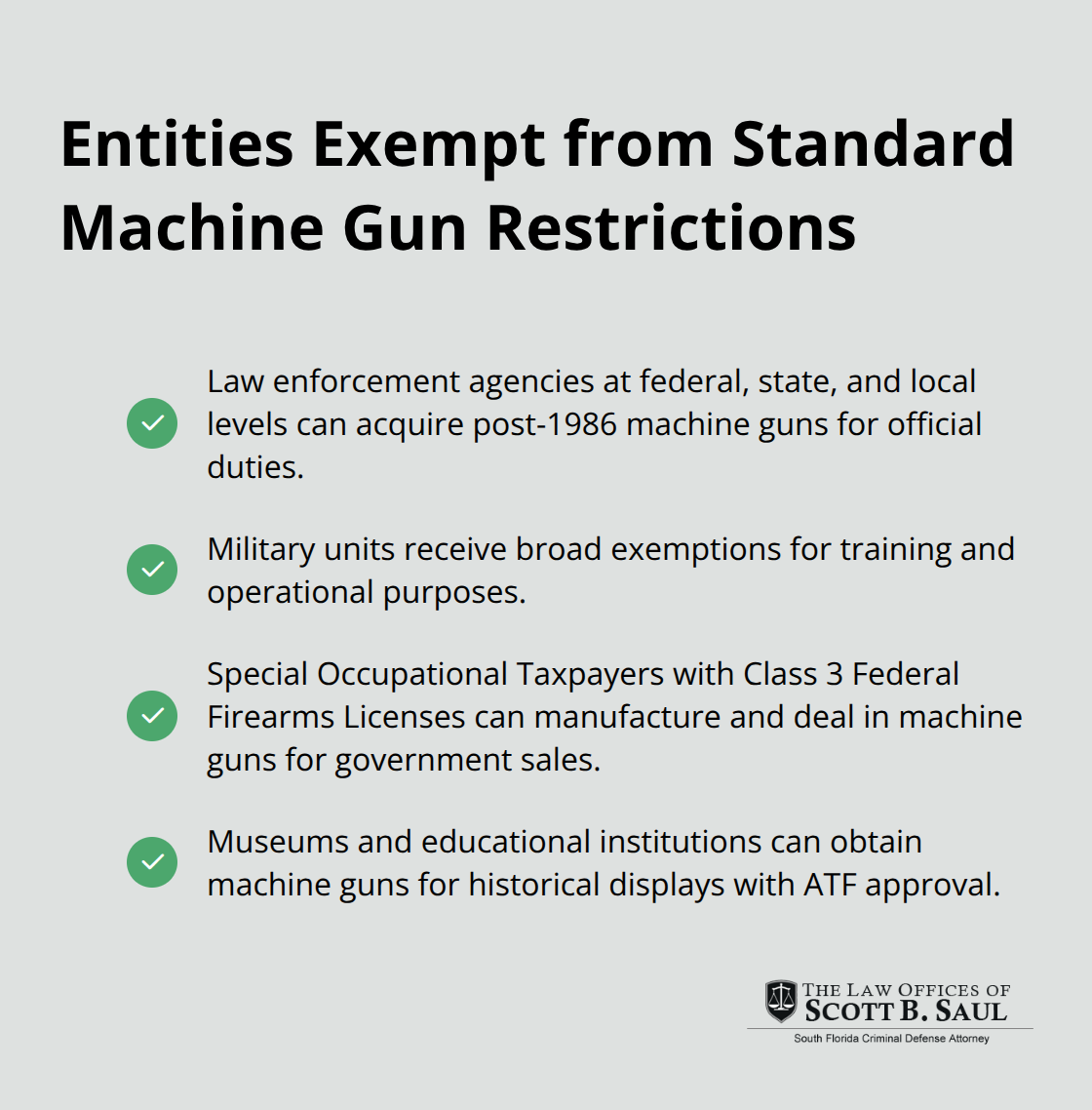
Law enforcement agencies at federal, state, and local levels can acquire post-1986 machine guns for official duties, but departments must demonstrate legitimate need and maintain strict inventory controls. Military units receive broad exemptions for training and operational purposes, though service members face court-martial proceedings for unauthorized possession or transfer of automatic weapons.
The ATF requires detailed documentation for all law enforcement acquisitions, including serial number tracking and annual inventory reports that account for every automatic weapon. Departments must justify each purchase through operational necessity documentation and maintain chain-of-custody records that track weapons from acquisition through disposal.
Federal Firearms License Holders Face Complex Requirements
Special Occupational Taxpayers who hold Class 3 Federal Firearms Licenses can manufacture, import, and deal in machine guns for government sales, but these licenses require annual tax payments of either $500 or $1,000 to the ATF and extensive oversight. SOT dealers cannot sell post-1986 machine guns to civilians under any circumstances, though they may demonstrate weapons to potential law enforcement buyers.
These dealers must maintain detailed records of all transactions, submit to regular ATF inspections, and comply with strict storage requirements that include vault specifications and alarm systems. Violations of SOT requirements result in immediate license revocation and potential federal prosecution.
Educational and Historical Display Purposes
Museums and educational institutions can obtain machine guns for historical displays through ATF approval processes that require detailed security plans, insurance documentation, and regular inspections. The ATF maintains strict standards for legitimate historical displays that include public access requirements and educational programming.
Private collectors who attempt to circumvent these restrictions through fake educational purposes face federal prosecution with penalties up to 10 years imprisonment. Legitimate educational exemptions require proof of nonprofit status, detailed exhibition plans, and compliance with local zoning laws that govern public access facilities.
Final Thoughts
Machine gun possession remains one of the most heavily regulated areas of firearms law, with federal restrictions that date back to 1934 and the complete civilian manufacturing ban since 1986. The penalty for possession of a machine gun can reach 10 years in federal prison, which makes compliance with both federal and state regulations absolutely essential for anyone who considers ownership of these weapons. State laws create additional complexity, with eleven states that maintain complete prohibitions regardless of federal registration status.
The intersection of federal NFA requirements, state prohibitions, and local enforcement creates a legal minefield where even well-intentioned gun owners can face serious criminal charges. The remaining states allow pre-1986 registered machine guns but often impose their own license requirements, storage regulations, and transfer restrictions that extend beyond federal mandates. These complex jurisdictional variations (combined with severe federal penalties) demand experienced legal representation from attorneys who understand both federal firearms law and state-specific regulations.
We at Law Offices of Scott B. Saul handle complex firearms cases that involve automatic weapons charges. Our background as former prosecutors provides unique insights into how these cases develop and the most effective defense strategies. If you face machine gun possession charges or need guidance on firearms compliance, contact our experienced criminal defense team for a comprehensive consultation.
Archives
- February 2026 (5)
- January 2026 (9)
- December 2025 (9)
- November 2025 (8)
- October 2025 (8)
- September 2025 (9)
- August 2025 (8)
- July 2025 (8)
- June 2025 (9)
- May 2025 (9)
- April 2025 (8)
- March 2025 (9)
- February 2025 (8)
- January 2025 (9)
- December 2024 (10)
- November 2024 (5)
- July 2024 (2)
- June 2024 (2)
- May 2024 (2)
- April 2024 (2)
- March 2024 (2)
- February 2024 (2)
- January 2024 (2)
- December 2023 (2)
- November 2023 (2)
- October 2023 (2)
- September 2023 (2)
- August 2023 (1)
- July 2023 (2)
- June 2023 (2)
- May 2023 (2)
- April 2023 (2)
- March 2023 (2)
- February 2023 (2)
- January 2023 (2)
- December 2022 (2)
- November 2022 (2)
- October 2022 (2)
- September 2022 (2)
- August 2022 (2)
- July 2022 (2)
- June 2022 (2)
- May 2022 (2)
- April 2022 (2)
- March 2022 (2)
- February 2022 (2)
- January 2022 (2)
- December 2021 (2)
- November 2021 (2)
- October 2021 (2)
- September 2021 (2)
- August 2021 (2)
- July 2021 (2)
- June 2021 (2)
- May 2021 (2)
- April 2021 (2)
- September 2020 (5)
- July 2020 (4)
- June 2020 (4)
- May 2020 (4)
- April 2020 (5)
- March 2020 (4)
- February 2020 (4)
- January 2020 (4)
- December 2019 (1)
- November 2019 (4)
- October 2019 (4)
- September 2019 (4)
- August 2019 (4)
- July 2019 (5)
- June 2019 (4)
- May 2019 (4)
- April 2019 (4)
- March 2019 (4)
- February 2019 (4)
- January 2019 (4)
- December 2018 (4)
- November 2018 (5)
- October 2018 (5)
- September 2018 (4)
- August 2018 (4)
- July 2018 (7)
- June 2018 (4)
- May 2018 (4)
- April 2018 (8)
- March 2018 (4)
- February 2018 (4)
- January 2018 (4)
- November 2017 (4)
- October 2017 (4)
- September 2017 (4)
- August 2017 (7)
- July 2017 (6)
- June 2017 (4)
- May 2017 (4)
- April 2017 (4)
- March 2017 (4)
- February 2017 (7)
- January 2017 (4)
- December 2016 (7)
- November 2016 (4)
- October 2016 (4)
- September 2016 (10)
- August 2016 (4)
- July 2016 (4)
- June 2016 (4)
- May 2016 (4)
- April 2016 (4)
- March 2016 (4)
- February 2016 (7)
- January 2016 (4)
- December 2015 (5)
- November 2015 (4)
- October 2015 (7)
- September 2015 (4)
- August 2015 (4)
- July 2015 (13)
- June 2015 (9)
- May 2015 (8)
- April 2015 (6)
- March 2015 (4)
- February 2015 (4)
- January 2015 (4)
- December 2014 (4)
- November 2014 (4)
- October 2014 (4)
- September 2014 (3)
Categories
- Adjudication (1)
- Bankruptcy (1)
- Burglary Crimes (3)
- calendar call (1)
- Car Accident (1)
- Criminal Defense (395)
- Cyber Crimes (7)
- DNA (1)
- Domestic Violence (9)
- Drug Crimes (5)
- DUI (12)
- Embezzlement (1)
- Environmental Crimes (4)
- Expungement Law (2)
- Federal Sentencing Law (3)
- Firearm (3)
- Forgery (4)
- General (82)
- Healthcare (3)
- Immigration (1)
- Indentity Theft (1)
- Insurance (5)
- judicial sounding (2)
- Juvenile Crimes (4)
- Manslaughter (4)
- Money Laundering (3)
- Organized Crime (1)
- Racketeering (1)
- Reckless Driving (3)
- RICO (3)
- Sealing and Expunging (2)
- Sex Offense (1)
- Shoplifting (1)
- Suspended Driver's License (1)
- Traffic (4)
- Trending Topics (1)
- White-collar Offenses (1)
