
Conspiracy to Commit Tax Fraud Defense Strategies
By : saulcrim | Category : Criminal Defense | Comments Off on Conspiracy to Commit Tax Fraud Defense Strategies
15th Dec 2025

Conspiracy to commit tax fraud charges carry severe federal penalties that can destroy careers and financial stability. The IRS and Department of Justice prosecute these cases aggressively, often targeting multiple defendants simultaneously.
We at Law Offices of Scott B. Saul understand the complex nature of these charges and the defense strategies that can protect your future.
Understanding Conspiracy to Commit Tax Fraud Charges
Elements Required to Prove Conspiracy
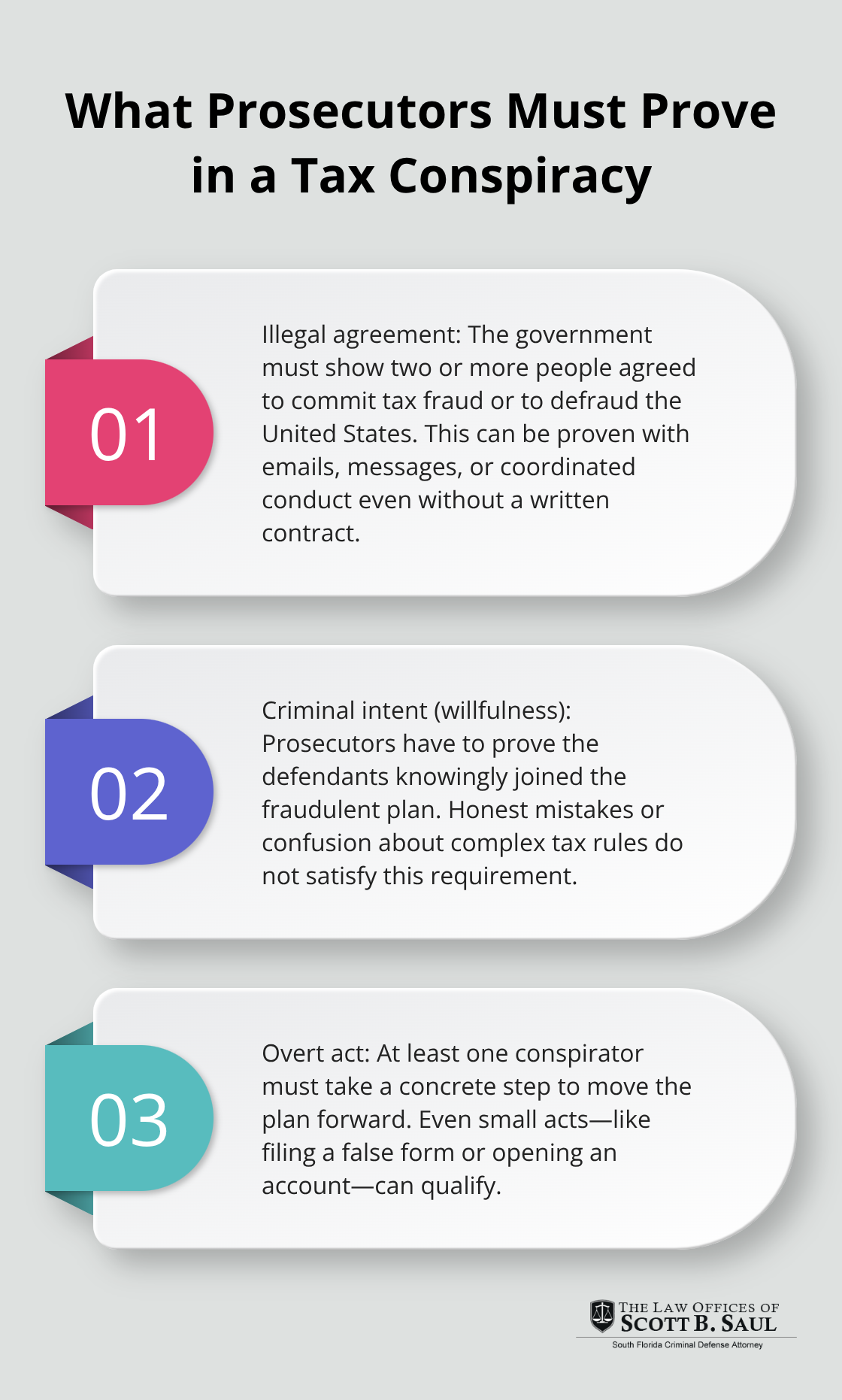
Federal prosecutors must establish three specific elements under 18 U.S.C. Section 371 to secure a conspiracy conviction. First, they need evidence of an illegal agreement between two or more people to commit tax fraud or defraud the United States. Second, prosecutors must prove criminal intent – that defendants knowingly agreed to participate in the fraudulent scheme. Third, they must demonstrate at least one overt act by any conspirator in furtherance of the conspiracy.
The Supreme Court established in Hass v. Henkel that defraud includes both cheating the government out of money and obstructing governmental functions through deceitful practices. Notably, prosecutors don’t need to prove the government suffered actual financial loss – interference with legitimate tax collection functions suffices (United States v. Conover).
Difference Between Tax Evasion and Tax Fraud
Tax fraud under 26 U.S.C. Section 7206 involves making false statements on tax documents, while tax evasion under 26 U.S.C. Section 7201 involves willful attempts to evade or defeat income tax. Tax fraud charges can proceed even when no tax deficiency exists, but tax evasion requires proof that a material amount of tax was actually due.
Tax fraud carries maximum penalties of three years imprisonment, whereas tax evasion can result in five years behind bars. The willfulness standard differs significantly – tax fraud focuses on knowingly making false statements, while tax evasion demands proof of deliberate attempts to avoid paying known tax obligations.
Federal vs State Prosecution Approaches
Federal authorities handle virtually all conspiracy to commit tax fraud cases because tax crimes fall under federal jurisdiction. The Department of Justice dedicates substantial resources to these prosecutions, with specialized teams of attorneys and IRS Criminal Investigation agents. State prosecutors rarely pursue tax conspiracy cases, typically only when state tax laws are violated alongside other state crimes.
Federal prosecutors have extensive investigative tools including grand jury subpoenas, search warrants, and cooperation agreements with other agencies. This federal focus means defendants face the full weight of federal sentencing guidelines and mandatory minimum penalties that state courts cannot impose.
These prosecutorial advantages make it essential to understand the specific defense strategies that can counter federal conspiracy charges and protect your rights throughout the legal process.
Common Defense Strategies Against Conspiracy Charges
Lack of Intent to Defraud
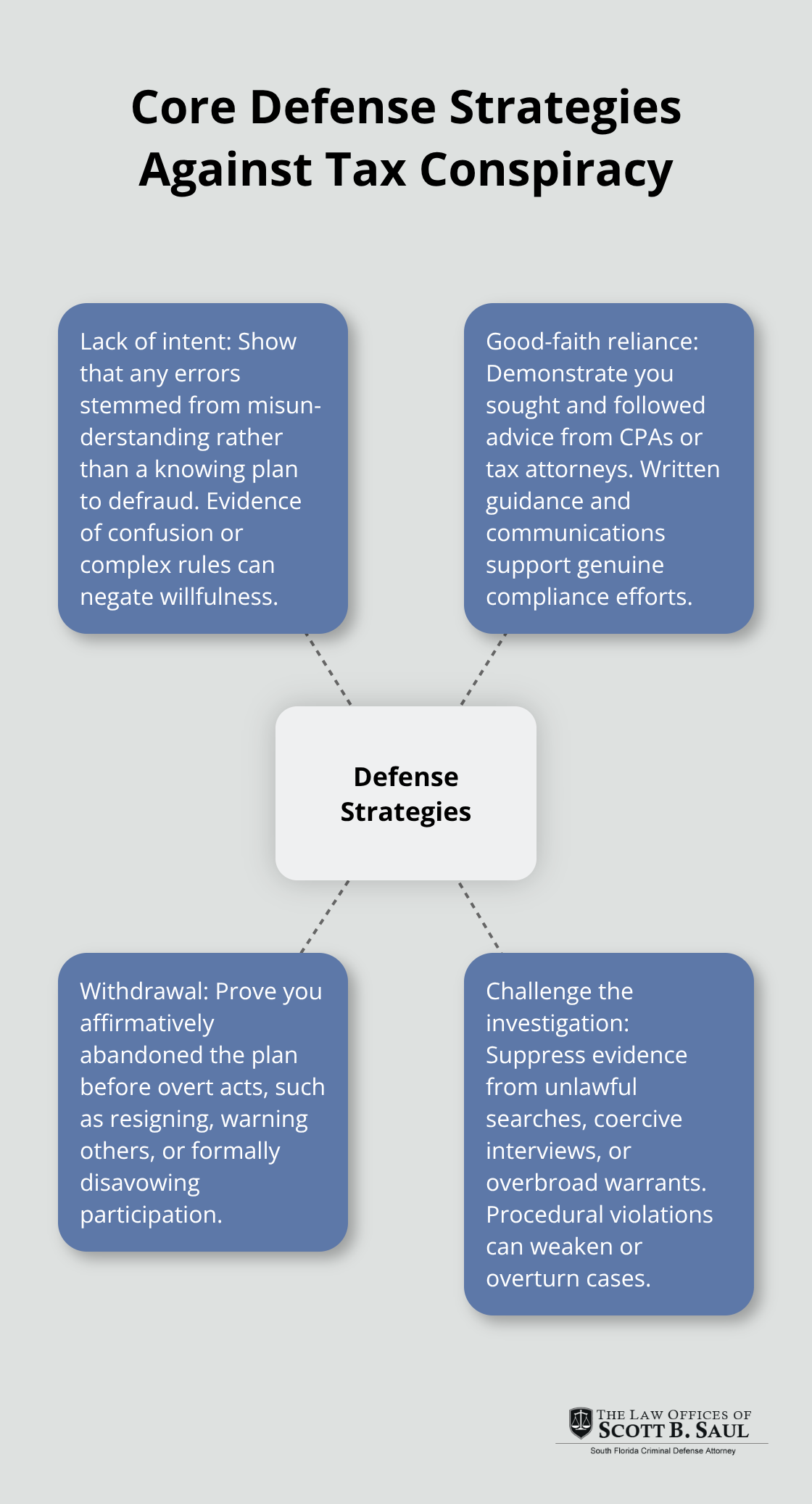
The most effective defense against conspiracy charges focuses on dismantling the intent element that prosecutors must prove. Courts require evidence that defendants knowingly agreed to participate in fraudulent schemes, and confusion about tax laws can negate this requirement. The Supreme Court established that willfulness means voluntary, intentional violation of known legal duties, not mere negligence or misunderstanding.
Documentation becomes your strongest weapon here. Professional tax advice from certified public accountants or tax attorneys creates powerful evidence of good faith compliance attempts. Courts consistently recognize reliance on professional guidance as legitimate defense, particularly when written communications show genuine efforts to follow tax requirements. Financial records that demonstrate consistent patterns over multiple years can contradict government claims of deliberate fraud.
Withdrawal from the Conspiracy
Withdrawal defenses require proof that you abandoned the conspiracy before any overt acts occurred and took affirmative steps to disavow participation. The Department of Justice acknowledges that defendants who withdraw before substantial acts cannot face conspiracy liability for subsequent actions by co-conspirators.
Courts examine whether defendants made reasonable efforts to prevent the conspiracy’s success or warned potential victims. Written communications that show disagreement with proposed schemes, resignation from business positions, or formal notifications to other participants provide concrete evidence of withdrawal. The timing becomes absolutely critical – you must demonstrate cessation of participation before government investigators initiated their probe and before co-conspirators committed substantive criminal acts.
Challenging the Evidence and Investigation Methods
Federal agents frequently overstep constitutional boundaries during tax investigations, which creates opportunities to suppress evidence and weaken prosecution cases. The Fourth Amendment protects against unreasonable searches, and violations can result in complete case dismissals. IRS Criminal Investigation agents must follow strict protocols when they obtain financial records, conduct interviews, and execute search warrants.
Defense attorneys challenge evidence obtained through improper grand jury procedures, violations of attorney-client privilege, or coercive interrogation tactics. Courts have reversed convictions where agents failed to provide Miranda warnings during custodial interrogations or exceeded warrant scope during property searches. Procedural violations can overturn convictions. Expert forensic accountants can identify calculation errors in government financial analyses that undermine damage claims and conspiracy theories.
These defense strategies form the foundation for protecting your rights, but understanding the potential consequences you face helps you make informed decisions about your case strategy and plea negotiations. Early legal representation offers numerous benefits when dealing with federal charges, and prompt action allows for a stronger defense strategy that can make the difference between facing prosecution and having charges dismissed.
Potential Penalties and Consequences
Federal sentencing guidelines treat conspiracy to commit tax fraud as a serious felony with harsh mandatory penalties that judges cannot easily reduce. Under 18 U.S.C. Section 371, defendants face up to five years in federal prison, while related tax fraud charges under 26 U.S.C. Section 7206 add another three years. The Federal Sentencing Commission reports that tax fraud defendants receive average sentences of 15 months, but conspiracy charges often push sentences above 24 months because judges view organized schemes as more serious than individual violations.
Federal Sentencing Guidelines for Tax Conspiracy
Federal judges calculate sentences through point systems that consider offense levels, criminal history, and loss amounts. Tax conspiracy cases start at offense level 6 but increase rapidly based on financial damage to the government. Cases that involve $95,000 to $150,000 in tax loss add 4 levels, while losses that exceed $550,000 add 12 levels. Multiple defendants and leadership roles within conspiracies trigger additional 2-4 level enhancements. First-time offenders with minimal losses might receive probation, but organized conspiracies that involve substantial amounts typically result in prison sentences between 18-36 months.
Financial Penalties and Restitution Requirements
Courts impose restitution equal to 100 percent of tax losses plus interest and penalties calculated from original due dates. The IRS adds failure-to-pay penalties of 0.5 percent monthly and interest rates currently above 7 percent annually.
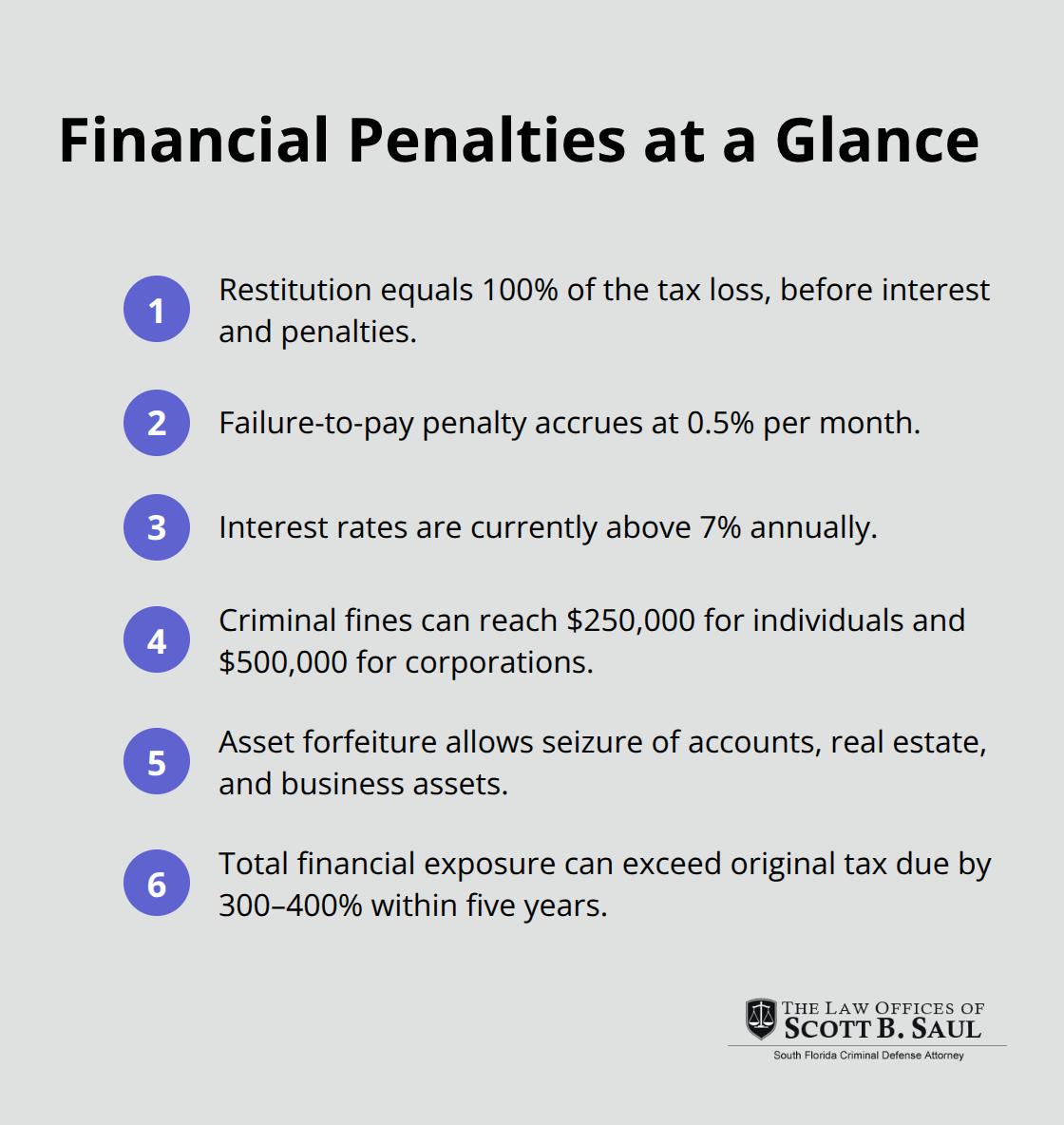
Criminal fines reach $250,000 for individuals and $500,000 for corporations under federal guidelines. Asset forfeiture allows government seizure of property connected to tax crimes (bank accounts, real estate, and business assets). These financial penalties often exceed original tax obligations by 300-400 percent within five years.
Professional License and Career Impact
Professional licenses face automatic suspension or revocation after federal tax crime convictions. State boards for attorneys, accountants, doctors, and financial advisors impose disciplinary actions regardless of prison sentences. Securities licenses through FINRA become permanently unavailable after felony convictions. Federal employment opportunities disappear entirely, while most private employers conduct background checks that reveal criminal records. Security clearances face immediate revocation, which eliminates defense contractor and government positions that often represent the highest-paid opportunities in many fields.
Final Thoughts
Conspiracy to commit tax fraud charges require immediate action from experienced criminal defense attorneys who understand federal prosecution tactics. The government’s extensive resources and aggressive approach make early intervention absolutely essential for your future protection. Prosecutors build stronger cases while your defense options become limited when you wait to seek legal counsel.
We at Law Offices of Scott B. Saul bring decades of trial experience and unique insights from former prosecution backgrounds. Our firm has successfully defended clients against complex conspiracy charges through aggressive representation that challenges government arguments. We understand how federal prosecutors construct these cases and know the specific strategies that can dismantle their evidence.
Your constitutional rights remain protected throughout every stage of the investigation and prosecution process (including interviews and evidence collection). Professional legal representation prevents costly mistakes during government interviews and protects against evidence violations that could strengthen your case. Contact our experienced criminal defense team immediately if you face conspiracy charges or federal tax investigations.
Archives
- February 2026 (5)
- January 2026 (9)
- December 2025 (9)
- November 2025 (8)
- October 2025 (8)
- September 2025 (9)
- August 2025 (8)
- July 2025 (8)
- June 2025 (9)
- May 2025 (9)
- April 2025 (8)
- March 2025 (9)
- February 2025 (8)
- January 2025 (9)
- December 2024 (10)
- November 2024 (5)
- July 2024 (2)
- June 2024 (2)
- May 2024 (2)
- April 2024 (2)
- March 2024 (2)
- February 2024 (2)
- January 2024 (2)
- December 2023 (2)
- November 2023 (2)
- October 2023 (2)
- September 2023 (2)
- August 2023 (1)
- July 2023 (2)
- June 2023 (2)
- May 2023 (2)
- April 2023 (2)
- March 2023 (2)
- February 2023 (2)
- January 2023 (2)
- December 2022 (2)
- November 2022 (2)
- October 2022 (2)
- September 2022 (2)
- August 2022 (2)
- July 2022 (2)
- June 2022 (2)
- May 2022 (2)
- April 2022 (2)
- March 2022 (2)
- February 2022 (2)
- January 2022 (2)
- December 2021 (2)
- November 2021 (2)
- October 2021 (2)
- September 2021 (2)
- August 2021 (2)
- July 2021 (2)
- June 2021 (2)
- May 2021 (2)
- April 2021 (2)
- September 2020 (5)
- July 2020 (4)
- June 2020 (4)
- May 2020 (4)
- April 2020 (5)
- March 2020 (4)
- February 2020 (4)
- January 2020 (4)
- December 2019 (1)
- November 2019 (4)
- October 2019 (4)
- September 2019 (4)
- August 2019 (4)
- July 2019 (5)
- June 2019 (4)
- May 2019 (4)
- April 2019 (4)
- March 2019 (4)
- February 2019 (4)
- January 2019 (4)
- December 2018 (4)
- November 2018 (5)
- October 2018 (5)
- September 2018 (4)
- August 2018 (4)
- July 2018 (7)
- June 2018 (4)
- May 2018 (4)
- April 2018 (8)
- March 2018 (4)
- February 2018 (4)
- January 2018 (4)
- November 2017 (4)
- October 2017 (4)
- September 2017 (4)
- August 2017 (7)
- July 2017 (6)
- June 2017 (4)
- May 2017 (4)
- April 2017 (4)
- March 2017 (4)
- February 2017 (7)
- January 2017 (4)
- December 2016 (7)
- November 2016 (4)
- October 2016 (4)
- September 2016 (10)
- August 2016 (4)
- July 2016 (4)
- June 2016 (4)
- May 2016 (4)
- April 2016 (4)
- March 2016 (4)
- February 2016 (7)
- January 2016 (4)
- December 2015 (5)
- November 2015 (4)
- October 2015 (7)
- September 2015 (4)
- August 2015 (4)
- July 2015 (13)
- June 2015 (9)
- May 2015 (8)
- April 2015 (6)
- March 2015 (4)
- February 2015 (4)
- January 2015 (4)
- December 2014 (4)
- November 2014 (4)
- October 2014 (4)
- September 2014 (3)
Categories
- Adjudication (1)
- Bankruptcy (1)
- Burglary Crimes (3)
- calendar call (1)
- Car Accident (1)
- Criminal Defense (395)
- Cyber Crimes (7)
- DNA (1)
- Domestic Violence (9)
- Drug Crimes (5)
- DUI (12)
- Embezzlement (1)
- Environmental Crimes (4)
- Expungement Law (2)
- Federal Sentencing Law (3)
- Firearm (3)
- Forgery (4)
- General (82)
- Healthcare (3)
- Immigration (1)
- Indentity Theft (1)
- Insurance (5)
- judicial sounding (2)
- Juvenile Crimes (4)
- Manslaughter (4)
- Money Laundering (3)
- Organized Crime (1)
- Racketeering (1)
- Reckless Driving (3)
- RICO (3)
- Sealing and Expunging (2)
- Sex Offense (1)
- Shoplifting (1)
- Suspended Driver's License (1)
- Traffic (4)
- Trending Topics (1)
- White-collar Offenses (1)
