
Florida Resisting Arrest Without Violence Explained
By : saulcrim | Category : Criminal Defense | Comments Off on Florida Resisting Arrest Without Violence Explained
4th Dec 2025

Florida resisting arrest without violence charges can result in serious legal consequences, even when no physical force is involved. Many people don’t realize that simply failing to comply with police commands can lead to criminal charges.
At Law Offices of Scott B. Saul, we see clients facing these charges who were unaware their actions constituted resistance. Understanding your rights and potential defenses is essential for protecting your future.
What Actions Constitute Resisting Arrest Without Violence
Legal Elements Under Florida Statute 843.02
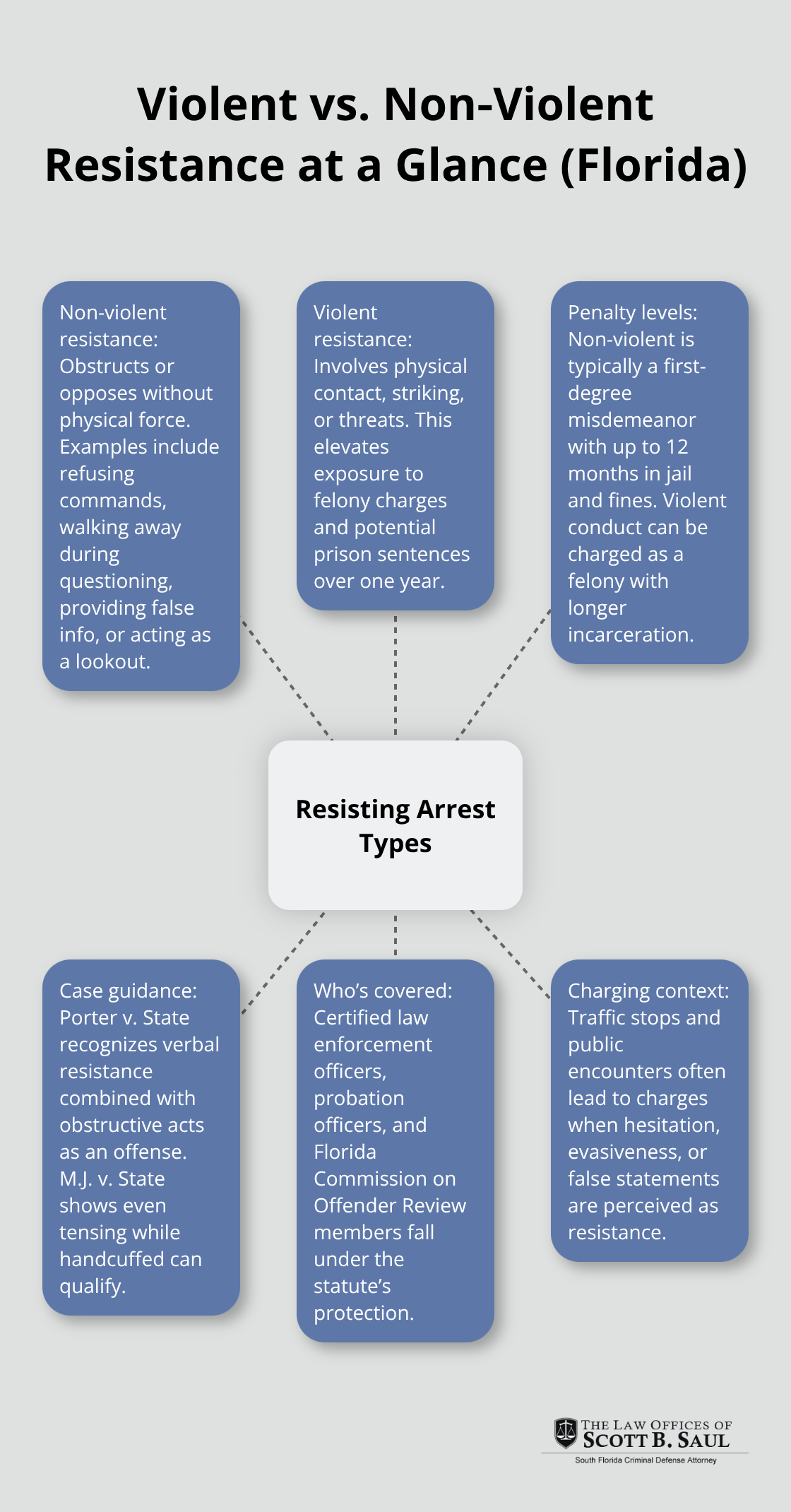
Florida Statute 843.02 defines resisting arrest without violence as any action that obstructs, opposes, or resists a law enforcement officer during lawful duties without physical force. The prosecution must prove four specific elements: you knew the person was a law enforcement officer, the officer engaged in lawful execution of legal duties, your actions constituted resistance or obstruction, and you acted intentionally. Courts have ruled that even tensing your arms while being handcuffed can meet this standard (as seen in M.J. v. State). The statute covers all certified law enforcement officers, probation officers, and Florida Commission on Offender Review members.
Non-Violent vs Violent Resistance Classifications
The distinction between violent and non-violent resistance determines whether you face misdemeanor or felony charges. Non-violent resistance includes refusing verbal commands, walking away from police during questioning, providing false information, or acting as a lookout to prevent arrests. Porter v. State established that verbal resistance combined with obstructive actions constitutes this offense. Violent resistance involves physical contact, striking, or threatening officers, which elevates charges to felony level with potential prison sentences that exceed one year. First-degree misdemeanor charges for non-violent resistance carry maximum penalties of up to 12 months in jail and $500 fines.
Common Traffic Stop Scenarios
Traffic stops generate frequent resistance charges when drivers refuse to exit vehicles, provide false identification, or attempt to leave before officers dismiss them. Officers often interpret hesitation or questioning their authority as resistance. Even minor delays in compliance can result in charges (particularly when combined with other factors like nervousness or evasive answers). These situations escalate quickly, and what seems like a routine traffic violation can become a criminal charge with lasting consequences.
Public Encounters and Questioning Situations
During questioning, walking away or refusing to stop when officers have reasonable suspicion triggers these charges. House parties and public gatherings often result in resistance charges when individuals fail to disperse after police commands or provide false names during investigations. Officers frequently charge multiple people at once during these scenarios, making it difficult to determine who actually resisted and who simply happened to be present.
Understanding these common scenarios helps you recognize when your actions might cross the legal line, but the complexity of these cases often requires professional legal analysis to determine the strength of potential defenses.
What Are the Real Penalties You Face
Immediate Criminal Penalties and Classification
Resisting arrest without violence carries a first-degree misdemeanor classification in Florida, which means you face up to one year in jail and fines that reach $1,000 under Florida Statutes 775.082 and 775.083. First-time offenders typically receive probation terms that range from six to twelve months, but judges impose jail time when circumstances worsen the offense (such as disrespectful conduct toward officers or extensive criminal histories). Court costs add another $300 to $500 to your financial burden, and many counties require completion of anger management or community service programs that cost additional fees.

Long-Term Employment and Housing Consequences
The permanent criminal record creates barriers that extend far beyond initial penalties. Background checks reveal this conviction to employers, landlords, and professional boards for decades. Healthcare workers, teachers, and financial professionals face license suspension or denial based on this misdemeanor conviction. Apartment applications frequently result in rejections, which force you into substandard housing or require cosigners. Clients lose job opportunities months after conviction when employers discover the criminal record through routine checks. Professional licenses in fields like real estate, insurance, and security services become difficult to obtain or maintain. Immigration consequences affect non-citizens, though juvenile court rulings generally do not constitute convictions for immigration purposes.
Financial Impact Beyond Court Penalties
The hidden costs multiply quickly beyond the initial $1,000 fine maximum. Probation supervision fees average $50 monthly for the duration of your sentence. Court-ordered classes cost $200 to $400, while community service programs charge administrative fees. Lost wages from court appearances and potential job termination create substantial financial hardship. Car insurance rates increase when companies discover the criminal conviction through policy renewals.
These penalties make it clear why you need effective defense strategies to fight these charges before they permanently damage your future.
How Can You Successfully Fight These Charges
Challenge the Lawfulness of the Initial Police Contact
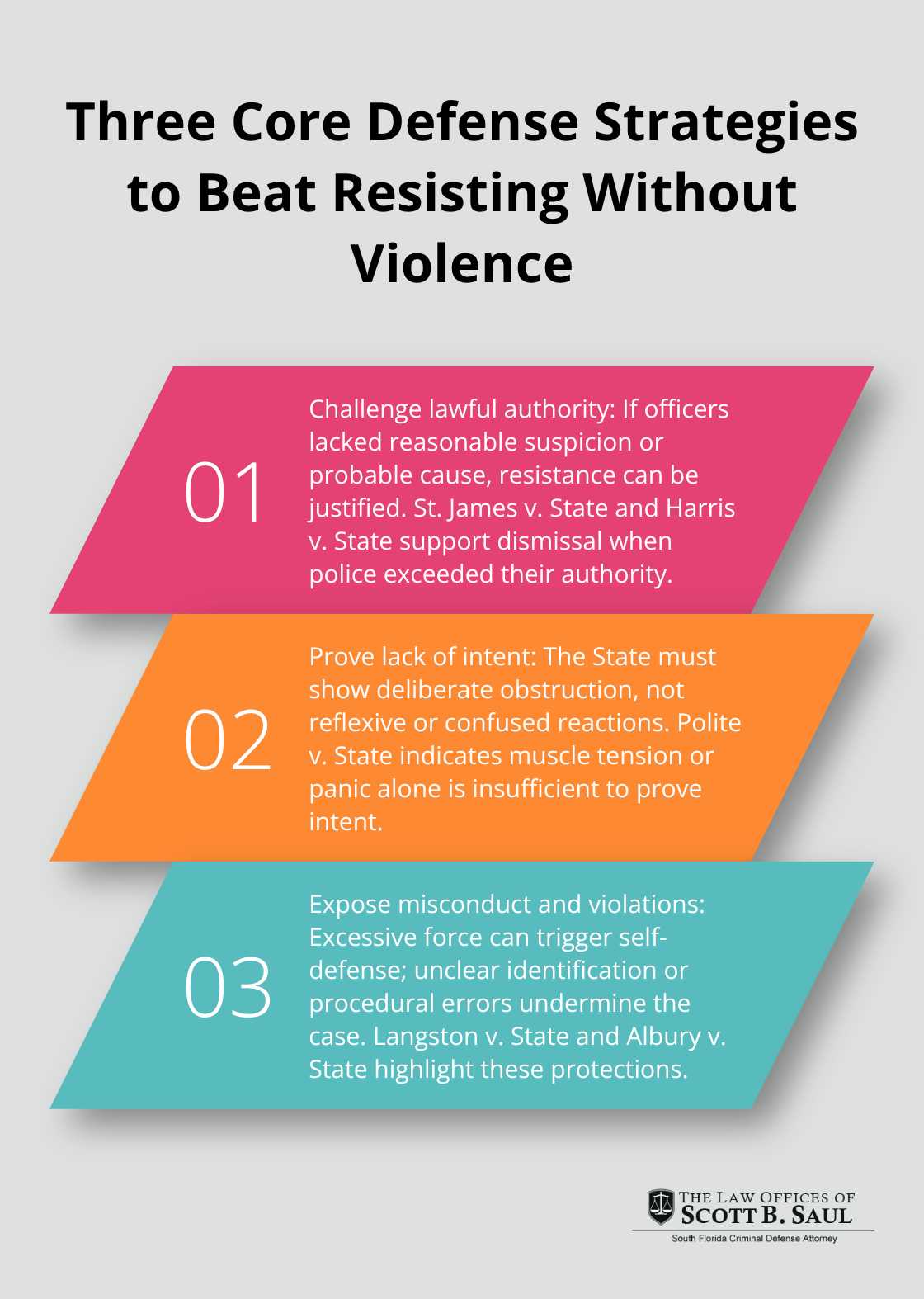
The most effective defense strategy attacks the legality of the initial police contact and arrest. Florida law under St. James v. State establishes that officers must act under lawful authority for resistance charges to stand. When police lack probable cause or reasonable suspicion, any subsequent resistance becomes legally justified. Harris v. State confirms your right to resist unlawful detention without violence.
We examine whether officers had valid reasons for the stop, proper identification as law enforcement, and adherence to constitutional procedures. Traffic stops without reasonable suspicion, searches that exceed legal scope, and arrests based on insufficient evidence create strong grounds for dismissal. Police reports often contain inconsistencies that reveal procedural violations.
Officers frequently fail to articulate specific facts that support their actions, which makes their conduct legally questionable. Courts dismiss cases when prosecutors cannot prove officers acted within their lawful authority.
Prove Lack of Intent to Resist
Courts require proof of intentional resistance, not involuntary reactions. Polite v. State ruled that muscle tension from discomfort or fear does not constitute resistance without deliberate intent to obstruct. Panic responses, medical conditions, language barriers, and confusion about commands provide valid defenses.
Defense attorneys successfully argue that clients misunderstood commands or reacted instinctively to stressful situations. Physical disabilities, hearing impairments, and mental health conditions often explain behavior that officers interpret as resistance. Prosecutors struggle to prove intent when defendants demonstrate legitimate reasons for their actions.
Expose Police Misconduct and Constitutional Violations
Officers who use excessive force trigger self-defense rights under Langston v. State. Documentation of misconduct through witness statements, video evidence, and medical records strengthens your position significantly. Albury v. State shows that officers must explain arrest reasons clearly to suspects.
When police fail to identify themselves properly (especially undercover or off-duty officers), Harris v. State provides grounds for dismissal. Many successful defenses expose officer credibility problems, procedural errors, and constitutional violations that prosecutors cannot overcome at trial.
Body camera footage often contradicts officer testimony, while witness accounts reveal police aggression or improper procedures. These cases frequently result in dropped charges when defense attorneys present compelling evidence of police misconduct.
Final Thoughts
Florida resisting arrest without violence charges create permanent criminal records that damage employment prospects, housing applications, and professional licenses for decades. The prosecution must prove you knew the person was an officer, the officer acted lawfully, you intentionally resisted, and your actions actually obstructed their duties. Courts dismiss cases when officers exceed their authority or fail to follow constitutional procedures.
Defense strategies attack the lawfulness of police contact, demonstrate lack of intent to resist, and expose officer misconduct or constitutional violations. You have the right to resist unlawful arrests, and prosecutors cannot secure convictions when police lack proper authority. Video evidence and witness testimony often reveal police errors that lead to charge dismissals.
Professional legal representation becomes essential given the complexity of these cases and their lasting impact. At Law Offices of Scott B. Saul, we understand the strategies prosecutors use and have extensive trial experience in these matters. Contact us immediately for a comprehensive consultation, as early intervention often leads to better outcomes that protect your future.
Archives
- February 2026 (5)
- January 2026 (9)
- December 2025 (9)
- November 2025 (8)
- October 2025 (8)
- September 2025 (9)
- August 2025 (8)
- July 2025 (8)
- June 2025 (9)
- May 2025 (9)
- April 2025 (8)
- March 2025 (9)
- February 2025 (8)
- January 2025 (9)
- December 2024 (10)
- November 2024 (5)
- July 2024 (2)
- June 2024 (2)
- May 2024 (2)
- April 2024 (2)
- March 2024 (2)
- February 2024 (2)
- January 2024 (2)
- December 2023 (2)
- November 2023 (2)
- October 2023 (2)
- September 2023 (2)
- August 2023 (1)
- July 2023 (2)
- June 2023 (2)
- May 2023 (2)
- April 2023 (2)
- March 2023 (2)
- February 2023 (2)
- January 2023 (2)
- December 2022 (2)
- November 2022 (2)
- October 2022 (2)
- September 2022 (2)
- August 2022 (2)
- July 2022 (2)
- June 2022 (2)
- May 2022 (2)
- April 2022 (2)
- March 2022 (2)
- February 2022 (2)
- January 2022 (2)
- December 2021 (2)
- November 2021 (2)
- October 2021 (2)
- September 2021 (2)
- August 2021 (2)
- July 2021 (2)
- June 2021 (2)
- May 2021 (2)
- April 2021 (2)
- September 2020 (5)
- July 2020 (4)
- June 2020 (4)
- May 2020 (4)
- April 2020 (5)
- March 2020 (4)
- February 2020 (4)
- January 2020 (4)
- December 2019 (1)
- November 2019 (4)
- October 2019 (4)
- September 2019 (4)
- August 2019 (4)
- July 2019 (5)
- June 2019 (4)
- May 2019 (4)
- April 2019 (4)
- March 2019 (4)
- February 2019 (4)
- January 2019 (4)
- December 2018 (4)
- November 2018 (5)
- October 2018 (5)
- September 2018 (4)
- August 2018 (4)
- July 2018 (7)
- June 2018 (4)
- May 2018 (4)
- April 2018 (8)
- March 2018 (4)
- February 2018 (4)
- January 2018 (4)
- November 2017 (4)
- October 2017 (4)
- September 2017 (4)
- August 2017 (7)
- July 2017 (6)
- June 2017 (4)
- May 2017 (4)
- April 2017 (4)
- March 2017 (4)
- February 2017 (7)
- January 2017 (4)
- December 2016 (7)
- November 2016 (4)
- October 2016 (4)
- September 2016 (10)
- August 2016 (4)
- July 2016 (4)
- June 2016 (4)
- May 2016 (4)
- April 2016 (4)
- March 2016 (4)
- February 2016 (7)
- January 2016 (4)
- December 2015 (5)
- November 2015 (4)
- October 2015 (7)
- September 2015 (4)
- August 2015 (4)
- July 2015 (13)
- June 2015 (9)
- May 2015 (8)
- April 2015 (6)
- March 2015 (4)
- February 2015 (4)
- January 2015 (4)
- December 2014 (4)
- November 2014 (4)
- October 2014 (4)
- September 2014 (3)
Categories
- Adjudication (1)
- Bankruptcy (1)
- Burglary Crimes (3)
- calendar call (1)
- Car Accident (1)
- Criminal Defense (395)
- Cyber Crimes (7)
- DNA (1)
- Domestic Violence (9)
- Drug Crimes (5)
- DUI (12)
- Embezzlement (1)
- Environmental Crimes (4)
- Expungement Law (2)
- Federal Sentencing Law (3)
- Firearm (3)
- Forgery (4)
- General (82)
- Healthcare (3)
- Immigration (1)
- Indentity Theft (1)
- Insurance (5)
- judicial sounding (2)
- Juvenile Crimes (4)
- Manslaughter (4)
- Money Laundering (3)
- Organized Crime (1)
- Racketeering (1)
- Reckless Driving (3)
- RICO (3)
- Sealing and Expunging (2)
- Sex Offense (1)
- Shoplifting (1)
- Suspended Driver's License (1)
- Traffic (4)
- Trending Topics (1)
- White-collar Offenses (1)
