
How to Navigate Florida Concealed Carry Gun Laws
By : saulcrim | Category : Criminal Defense | Comments Off on How to Navigate Florida Concealed Carry Gun Laws
26th Jan 2026

Florida concealed carry gun laws are complex, and mistakes can have serious consequences. Understanding your rights and responsibilities as a permit holder is essential to staying on the right side of the law.
At Law Offices of Scott B. Saul, we’ve helped countless clients navigate these regulations. This guide breaks down what you need to know about permits, where you can carry, and what violations to avoid.
Getting Your Florida Concealed Carry Permit
To legally carry a concealed weapon in Florida, you must obtain a Concealed Weapon or Firearm License from the Florida Department of Agriculture and Consumer Services. The FDACS issues these licenses valid for seven years, and the application process is straightforward if you meet the eligibility requirements. You must be at least 21 years old, a U.S. citizen or permanent resident, and a Florida resident. The state disqualifies applicants with felony convictions, certain misdemeanors, domestic violence injunctions, or mental health adjudications. You cannot have chronic alcohol abuse issues or use controlled substances while carrying. The background check is fingerprint-based and thorough, so any hidden criminal history surfaces during review.
Training and Documentation Requirements
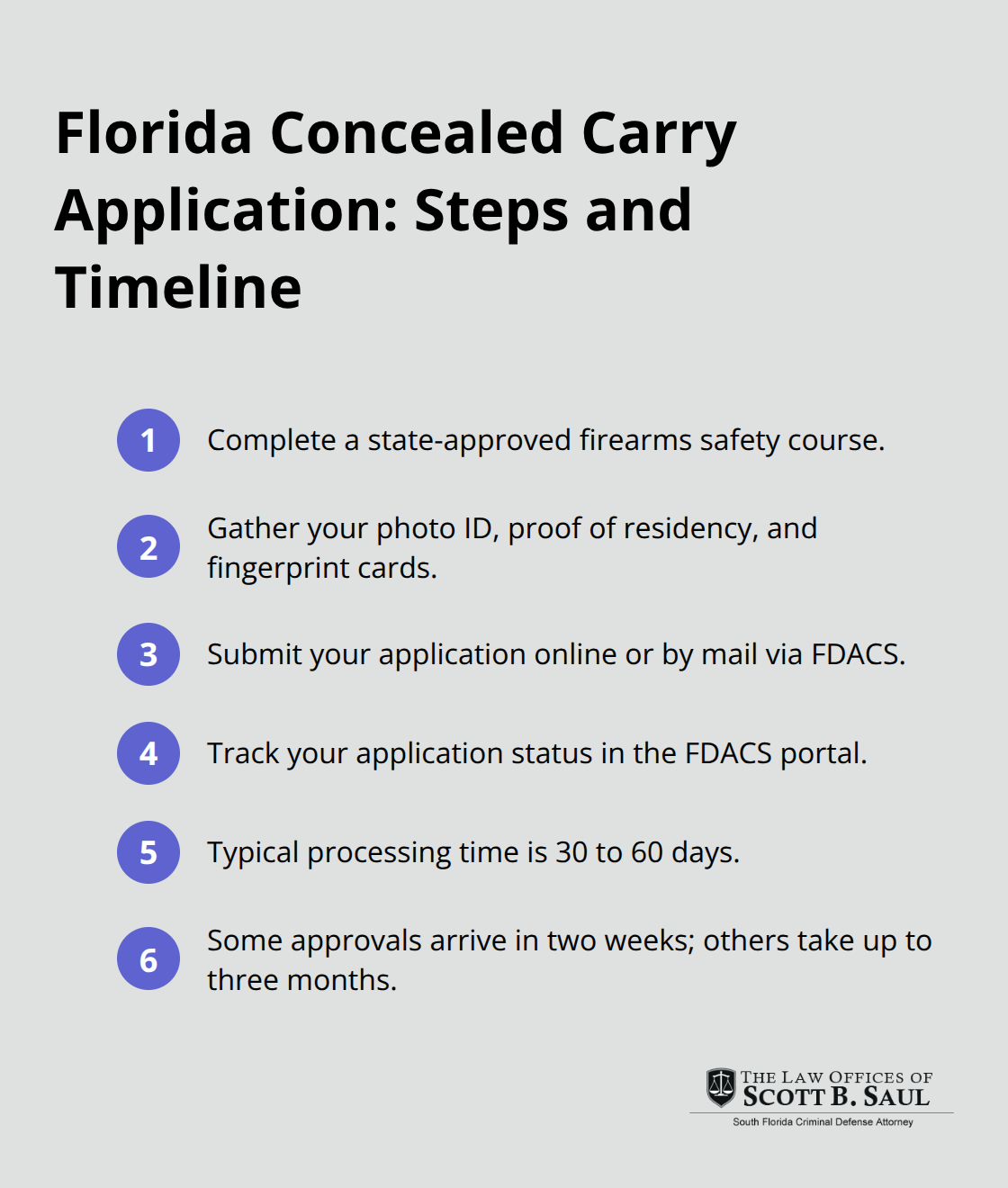
Florida law mandates that you complete a state-approved firearms safety course before you submit your application. You must provide proof of completion with your application materials. Gather your government-issued photo ID, proof of residency, and fingerprint cards as well. The FDACS processes applications through their online portal or by mail, and you can track your status online throughout the review period. Processing typically takes 30 to 60 days, though this varies based on application volume and background check complexity. Some applicants receive approval within two weeks, while others wait closer to three months.
Fees and the Real Cost of Carrying
The initial application fee runs approximately $117, though FDACS fees can change annually, so verify the current amount on their website before submitting. Renewal costs roughly the same amount every seven years. Beyond the state fee, you should factor in the mandatory training course, which typically costs $100 to $300 depending on the instructor and location. You’ll also need a government-issued ID if you don’t already have one. The total upfront investment lands between $250 and $450. This expense matters because it separates serious applicants from casual interest, and it funds the state’s licensing infrastructure. Some people skip the permit entirely and carry without one under Florida’s permitless carry law, but that strategy limits your reciprocity with other states and creates legal complications when traveling.
What Happens After You Apply
Once you submit your application, the FDACS conducts a thorough fingerprint-based background check that examines your criminal history, mental health records, and any protective orders against you. The agency verifies your training certificate and confirms your residency status. You can monitor your application’s progress through the FDACS online portal, which provides real-time updates on where your case stands in the review process. If the FDACS approves your application, you receive your license by mail. If they deny your application, they provide written reasons for the denial, and you have the right to appeal or reapply once you address the disqualifying factors. Understanding where you stand in the process helps you plan accordingly, especially if you need to carry for work or personal protection.
Rights and Restrictions for Concealed Carry Permit Holders
Where You Can and Cannot Carry in Florida
A concealed carry permit does not authorize you to take your weapon everywhere. Florida law establishes a detailed map of prohibited locations, and violations transform a law-abiding permit holder into a criminal. Schools and school property remain completely off-limits, including parking lots and school buses. Courthouses, detention facilities, and police stations prohibit firearms. Government buildings where meetings occur, polling places, and mental health facilities are also restricted. Private businesses can post no-firearms signs, and you must respect those postings or face trespassing charges on top of weapons violations.
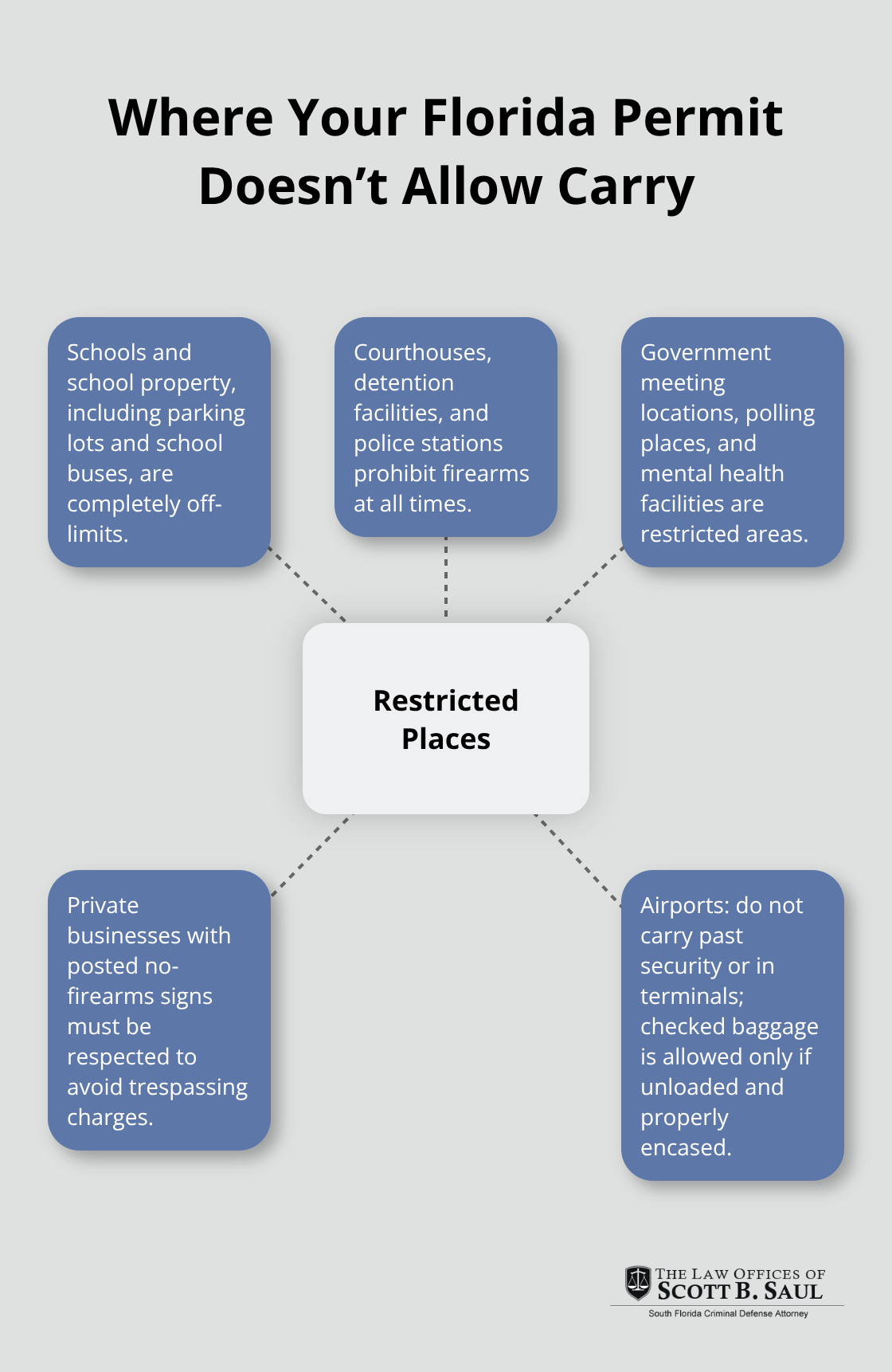
Airports present a particular trap: you cannot carry through security checkpoints or in terminals, though you may transport a firearm as checked baggage if it is unloaded and properly encased.
Carrying in an unauthorized location constitutes a second-degree misdemeanor in Florida, meaning arrest, criminal charges, and potential jail time even for first-time offenders. The consequences extend beyond criminal penalties-a conviction complicates your professional life, housing applications, and future employment. The practical approach involves identifying your regular destinations and verifying their status before you leave home. Check the FDACS website and call ahead to confirm whether a location permits concealed carry. This five-minute verification prevents the nightmare of discovering mid-visit that you violated state law.
Understanding Reciprocity with Other States
Reciprocity with other states requires strategic planning because Florida’s permit does not guarantee carry rights everywhere. Florida maintains reciprocal agreements with approximately 30 states, meaning those states recognize your Florida license. However, many states either do not recognize Florida permits or impose different restrictions on where you can carry. Traveling to California, New York, New Jersey, or Massachusetts with a Florida permit is illegal and results in felony charges. Before any interstate travel, consult the FDACS reciprocity list or contact local law enforcement in your destination state. Some states offer constitutional carry, meaning no permit is required, but that does not mean you can ignore their prohibited location laws.
Your Rights During Police Encounters
During police encounters, your Florida permit does not grant special rights. You must carry your government-issued ID and your concealed carry license at all times. If stopped, inform the officer immediately that you are armed and licensed to carry. Do not reach for your weapon or make sudden movements. Hand over your license and ID when requested. Your permit demonstrates lawful carry status and can prevent misunderstandings, yet violations of storage and transportation rules create additional legal exposure that demands careful attention.
Common Violations and Legal Consequences
Prohibited Locations and What They Actually Mean
Carrying a concealed weapon in Florida’s prohibited locations is the most common violation we encounter, and the consequences are far harsher than most permit holders realize. A second-degree misdemeanor conviction for carrying in a restricted area means jail time, fines up to $500, and a permanent criminal record that follows you through employment background checks and housing applications. Prohibited location map is not intuitive. You cannot carry in schools, courthouses, police stations, or government buildings where official meetings occur, yet many permit holders misjudge what qualifies as a government meeting location.
A city council session in a municipal building is clearly off-limits, but what about a public library hosting a city planning discussion? What about a county office building where you have legitimate business? The safest approach is to leave your weapon at home or in your vehicle before entering any government building unless you are absolutely certain that building permits concealed carry. Call the facility directly-it takes 60 seconds and eliminates the risk entirely.
Private Business Restrictions and Posted Signs
Private businesses post no-firearms signs, and respecting those signs is not optional. Ignoring a posted sign means trespassing charges plus weapons violations, which compounds your legal exposure significantly. Some permit holders argue that the signage is unclear or that they did not see it, but Florida courts reject those defenses consistently. Your responsibility is to notice and comply, not to debate the sign’s visibility or placement.
Transportation and Storage Violations
Transportation and storage violations create a different category of exposure that catches people off guard because they involve your weapon when you are not actively carrying it. Florida law prohibits carrying while intoxicated or under the influence of drugs, which means your firearm must be secured before you drink alcohol or use controlled substances. Safe storage of firearms is required in Florida, and storing a loaded firearm in a vehicle or home where children or unauthorized people can access it violates state law.
The practical standard is a locked container or safe, separate from ammunition, stored where family members cannot reach it. If you transport your weapon in a vehicle, keep it concealed and secured. Some permit holders transport firearms improperly by leaving them visible on a seat or in an unsecured glove compartment, which creates opportunities for theft and invites questions during traffic stops.
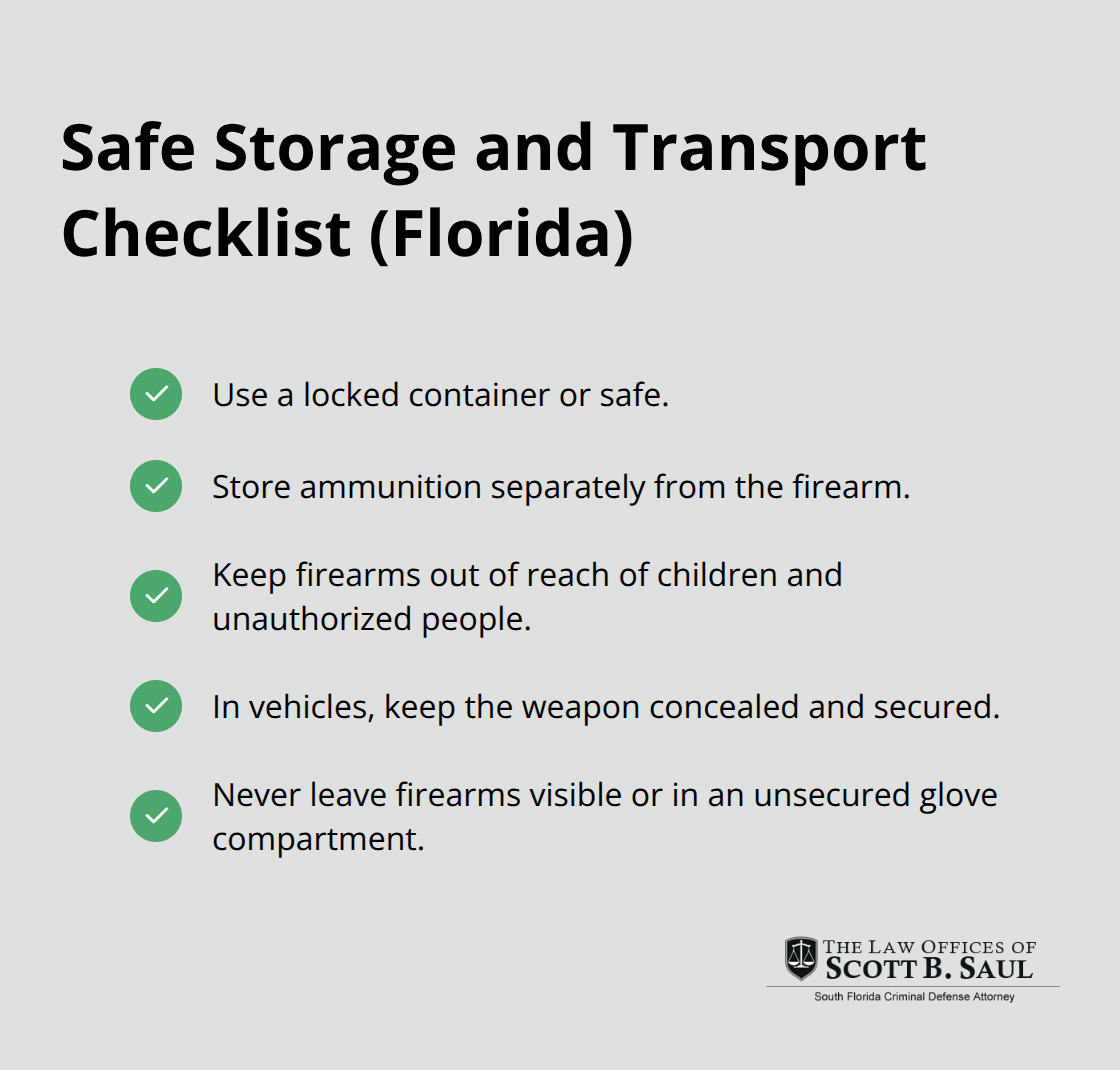
Law enforcement has broad discretion during vehicle searches, and an improperly stored weapon gives officers probable cause to investigate further. A locked case or holster keeps your weapon secure during transport and protects you from unnecessary legal complications.
How Courts Treat Violations
If you are charged with a violation, the specific facts matter enormously. Carrying in a prohibited location with knowledge is treated more severely than unknowing violation, though ignorance is rarely accepted as a complete defense. The distinction between intentional and accidental violations affects sentencing and can influence whether prosecutors offer plea agreements or pursue maximum penalties.
Final Thoughts
Florida concealed carry gun laws demand respect and attention to detail. The permit process itself is manageable if you meet eligibility requirements, complete your training, and submit accurate documentation. The real challenge emerges after you receive your license, when daily decisions about where to carry and how to store your weapon determine whether you stay compliant or face criminal charges.
Your responsibility as a permit holder extends beyond understanding the rules-you must actively verify locations before you arrive, respect posted signage without debate, and secure your weapon properly at all times. Prohibited locations are not suggestions, and private business restrictions are not negotiable. A second-degree misdemeanor conviction for carrying in a restricted area creates permanent consequences that affect employment, housing, and your professional reputation.
If you face charges related to concealed carry violations, contact an experienced criminal defense attorney immediately. We at Law Offices of Scott B. Saul have defended countless clients facing weapons charges, and early legal intervention often determines case outcomes.
Archives
- February 2026 (5)
- January 2026 (9)
- December 2025 (9)
- November 2025 (8)
- October 2025 (8)
- September 2025 (9)
- August 2025 (8)
- July 2025 (8)
- June 2025 (9)
- May 2025 (9)
- April 2025 (8)
- March 2025 (9)
- February 2025 (8)
- January 2025 (9)
- December 2024 (10)
- November 2024 (5)
- July 2024 (2)
- June 2024 (2)
- May 2024 (2)
- April 2024 (2)
- March 2024 (2)
- February 2024 (2)
- January 2024 (2)
- December 2023 (2)
- November 2023 (2)
- October 2023 (2)
- September 2023 (2)
- August 2023 (1)
- July 2023 (2)
- June 2023 (2)
- May 2023 (2)
- April 2023 (2)
- March 2023 (2)
- February 2023 (2)
- January 2023 (2)
- December 2022 (2)
- November 2022 (2)
- October 2022 (2)
- September 2022 (2)
- August 2022 (2)
- July 2022 (2)
- June 2022 (2)
- May 2022 (2)
- April 2022 (2)
- March 2022 (2)
- February 2022 (2)
- January 2022 (2)
- December 2021 (2)
- November 2021 (2)
- October 2021 (2)
- September 2021 (2)
- August 2021 (2)
- July 2021 (2)
- June 2021 (2)
- May 2021 (2)
- April 2021 (2)
- September 2020 (5)
- July 2020 (4)
- June 2020 (4)
- May 2020 (4)
- April 2020 (5)
- March 2020 (4)
- February 2020 (4)
- January 2020 (4)
- December 2019 (1)
- November 2019 (4)
- October 2019 (4)
- September 2019 (4)
- August 2019 (4)
- July 2019 (5)
- June 2019 (4)
- May 2019 (4)
- April 2019 (4)
- March 2019 (4)
- February 2019 (4)
- January 2019 (4)
- December 2018 (4)
- November 2018 (5)
- October 2018 (5)
- September 2018 (4)
- August 2018 (4)
- July 2018 (7)
- June 2018 (4)
- May 2018 (4)
- April 2018 (8)
- March 2018 (4)
- February 2018 (4)
- January 2018 (4)
- November 2017 (4)
- October 2017 (4)
- September 2017 (4)
- August 2017 (7)
- July 2017 (6)
- June 2017 (4)
- May 2017 (4)
- April 2017 (4)
- March 2017 (4)
- February 2017 (7)
- January 2017 (4)
- December 2016 (7)
- November 2016 (4)
- October 2016 (4)
- September 2016 (10)
- August 2016 (4)
- July 2016 (4)
- June 2016 (4)
- May 2016 (4)
- April 2016 (4)
- March 2016 (4)
- February 2016 (7)
- January 2016 (4)
- December 2015 (5)
- November 2015 (4)
- October 2015 (7)
- September 2015 (4)
- August 2015 (4)
- July 2015 (13)
- June 2015 (9)
- May 2015 (8)
- April 2015 (6)
- March 2015 (4)
- February 2015 (4)
- January 2015 (4)
- December 2014 (4)
- November 2014 (4)
- October 2014 (4)
- September 2014 (3)
Categories
- Adjudication (1)
- Bankruptcy (1)
- Burglary Crimes (3)
- calendar call (1)
- Car Accident (1)
- Criminal Defense (395)
- Cyber Crimes (7)
- DNA (1)
- Domestic Violence (9)
- Drug Crimes (5)
- DUI (12)
- Embezzlement (1)
- Environmental Crimes (4)
- Expungement Law (2)
- Federal Sentencing Law (3)
- Firearm (3)
- Forgery (4)
- General (82)
- Healthcare (3)
- Immigration (1)
- Indentity Theft (1)
- Insurance (5)
- judicial sounding (2)
- Juvenile Crimes (4)
- Manslaughter (4)
- Money Laundering (3)
- Organized Crime (1)
- Racketeering (1)
- Reckless Driving (3)
- RICO (3)
- Sealing and Expunging (2)
- Sex Offense (1)
- Shoplifting (1)
- Suspended Driver's License (1)
- Traffic (4)
- Trending Topics (1)
- White-collar Offenses (1)
