
Can You Be Charged with Drug Possession After the Fact?
By : saulcrim | Category : Criminal Defense | Comments Off on Can You Be Charged with Drug Possession After the Fact?
14th Aug 2025

Drug possession charges can have serious consequences, even if they’re brought up after the alleged incident. At Law Offices of Scott B. Saul, we often encounter clients wondering: Can you be charged with drug possession after the fact?
This blog post explores the complexities of drug possession charges, factors that influence after-the-fact accusations, and potential legal defenses. Understanding these aspects is vital for anyone facing such charges or concerned about past actions.
What Is Drug Possession?
Drug possession is a serious offense that can lead to severe legal consequences. It refers to having control over illegal substances, whether they’re on your person, in your home, or in your vehicle.
Simple Possession vs. Possession with Intent
Two main types of drug possession charges exist: simple possession and possession with intent to distribute. Simple possession typically involves smaller amounts of drugs intended for personal use. Possession with intent to distribute is a more serious charge, often based on larger quantities of drugs or evidence suggesting plans to sell or share the substances.
Actual vs. Constructive Possession
Law enforcement and courts recognize two forms of possession: actual and constructive. Actual possession means the drugs were found directly on your person (e.g., in your pocket or hand). Constructive possession is legal possession of an object not in direct control, requiring knowledge and ability to control it.
Elements of a Drug Possession Charge
For a drug possession charge to stick, prosecutors must prove several key elements:
- The substance in question is illegal under state or federal law (typically proven through lab testing).
- You knowingly possessed the drug (you were aware of its presence and nature as an illegal substance).
- You had control over the drug, whether through actual or constructive possession.
In a drug crimes case, the prosecution must prove the defendant actually possessed an illegal controlled substance.

The Importance of Scrutinizing Charge Elements
Each element of a drug possession charge requires careful examination. In some cases, these elements aren’t adequately proven, which can lead to dismissed charges or reduced sentences. A thorough understanding of how the law defines and approaches drug possession can help you make informed decisions about your situation.
The complexities of drug possession charges don’t end with these definitions and elements. Next, we’ll explore the factors that influence after-the-fact drug possession charges, which can significantly impact the legal landscape of a case.
Can Drug Possession Charges Be Filed After the Fact?
Statute of Limitations
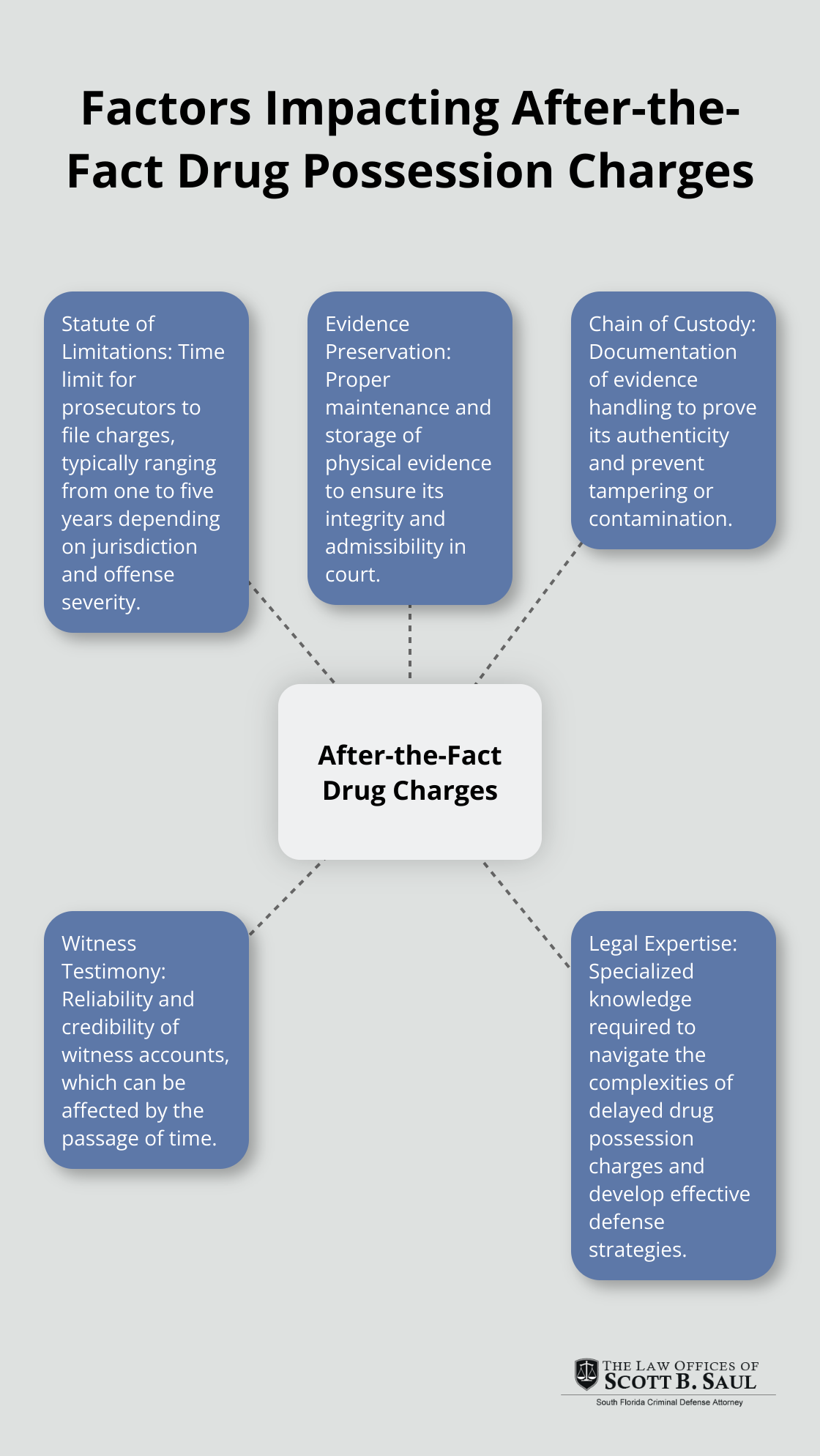
The statute of limitations significantly impacts after-the-fact drug possession charges. Most states impose a time limit for prosecutors to file charges after an alleged offense. For drug offenses, this period typically ranges from one to five years, depending on the jurisdiction and offense severity.
In Florida, for instance, federal laws for drug trafficking offenses can result in mandatory sentences of at least 15 years and fines up to $250,000 for amounts exceeding 400 grams. However, certain circumstances can pause the statute of limitations (e.g., if the accused leaves the state).
Evidence Preservation and Chain of Custody
Evidence preservation and proper chain of custody maintenance are critical in drug possession cases, especially those filed after the fact. The chain of custody is crucial for ensuring the authenticity of evidence presented in court. Time can degrade, lose, or contaminate evidence, which weakens the prosecution’s case.
Law enforcement must prove that the evidence presented in court matches the evidence collected at the time of the alleged offense. Any breaks in the chain of custody can cast doubt on the evidence’s integrity. For example, improper storage or handling of a drug sample could lead to questions about its reliability as evidence.
Witness Testimony and Credibility
Witness testimony often becomes crucial in after-the-fact drug possession cases. However, time can affect the reliability and credibility of witness accounts. Memories fade, details blur, and witnesses may become unavailable.
Courts and juries scrutinize witness testimony in these cases closely. Inconsistencies in statements or changes in accounts over time can significantly impact the prosecution’s case strength. Defense attorneys may challenge witness credibility, especially if a significant delay exists between the alleged offense and charge filing.
Impact of Delayed Charges
The filing of drug possession charges after the fact can present unique challenges for both the prosecution and defense. Delayed charges may result in:
- Difficulty in gathering fresh evidence
- Potential loss of key witnesses
- Increased scrutiny of the reasons for delay
These factors can influence the overall strength of the case and may provide opportunities for defense strategies.
Legal Expertise in After-the-Fact Cases
Navigating the complexities of after-the-fact drug possession charges requires specialized legal knowledge. An experienced attorney can analyze the specific circumstances of a case, including the timeline, evidence handling, and witness reliability. This expertise allows for the development of effective defense strategies tailored to the unique aspects of delayed drug possession charges.
The intricacies of after-the-fact drug possession charges extend beyond these factors. The next section will explore potential legal defenses against such charges, providing insight into how individuals can protect their rights when facing delayed accusations.
Defending Against Delayed Drug Possession Charges
Scrutinizing the Evidence
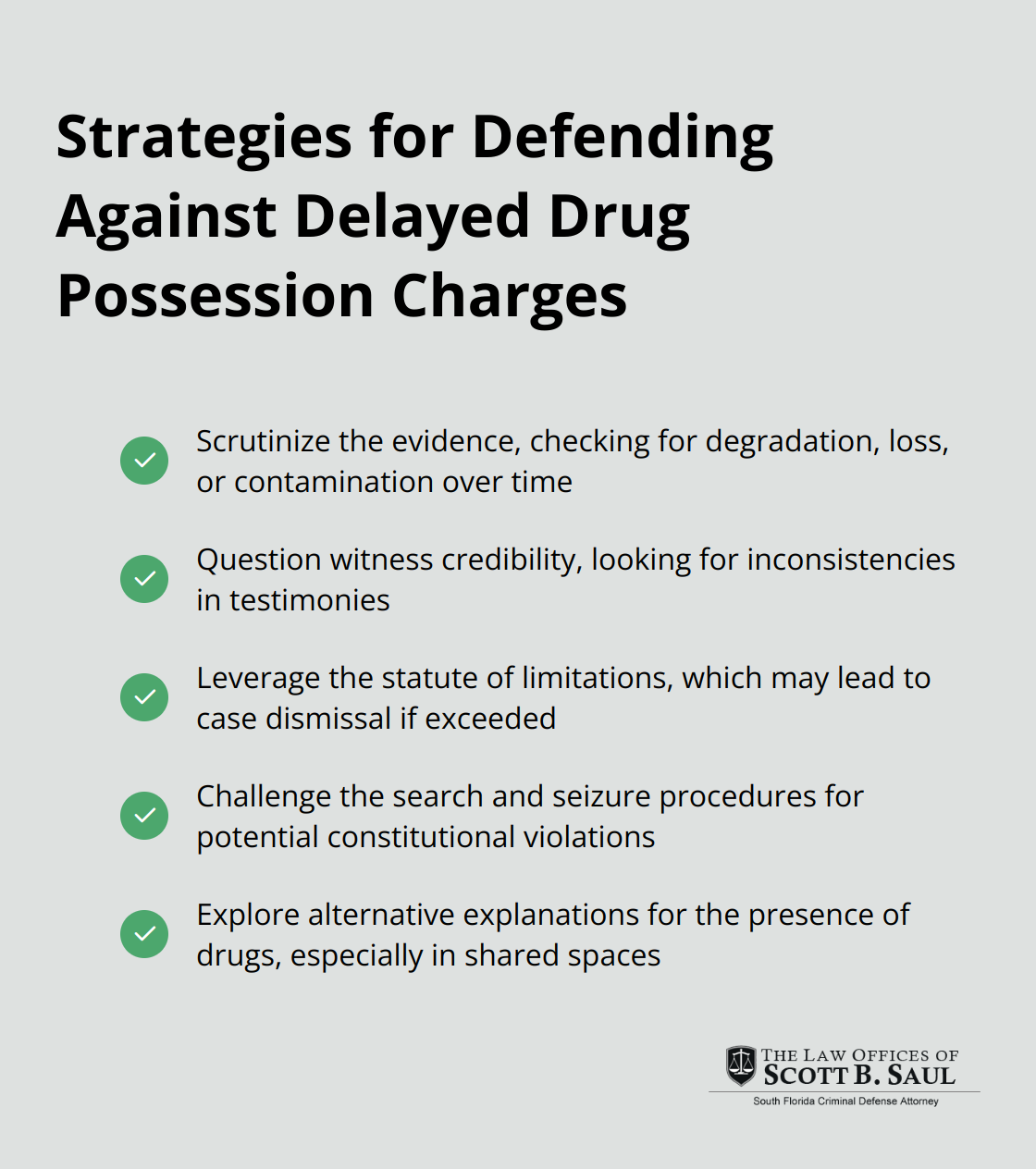
One of the most effective strategies in these cases is to challenge the evidence itself. Over time, physical evidence can degrade, get lost, or become contaminated. In a recent Florida case, charges were dismissed when drug samples had been improperly stored, leading to potential contamination. We always request a full inventory of evidence and demand to see the chain of custody records.
Questioning Witness Credibility
Witness testimony becomes less reliable as time passes. A 2022 study examined how time and repetition might influence the relationship between retrieval effort and memory accuracy. If your case relies heavily on witness accounts, we scrutinize these testimonies. We look for inconsistencies or changes in their story over time.
Leveraging the Statute of Limitations
The statute of limitations can be a powerful tool in your defense. In Florida, most drug possession charges must be filed within three years of the alleged offense. If prosecutors have exceeded this timeframe, you may have grounds for dismissal. However, certain circumstances can “toll” or pause the statute of limitations.
Challenging the Search and Seizure
Constitutional violations often occur in drug cases, especially those filed after the fact. As of August 2024, Florida courts have generally agreed that the plain smell of marijuana is sufficient for police officers to conduct a search of a person or their vehicle. However, this is an evolving area of law, and challenges to such searches may still be possible depending on the specific circumstances of your case.
Exploring Alternative Explanations
With the passage of time, alternative explanations for the presence of drugs become more plausible. For instance, if drugs were found in a shared living space or vehicle, it may be harder for prosecutors to prove beyond a reasonable doubt that they belonged to you specifically. Your defense strategy should explore all possible scenarios that could create reasonable doubt.
Final Thoughts
Drug possession charges filed after the fact present unique challenges. The statute of limitations, evidence preservation, and witness credibility all impact the strength of such cases. Understanding these factors will help anyone who faces delayed drug possession charges.
Legal defenses against after-the-fact drug possession charges can be highly effective when properly executed. Challenging evidence, questioning timelines, and asserting constitutional rights violations can significantly impact case outcomes. The question “Can you be charged with drug possession after the fact?” does not always have a straightforward answer.
Professional legal representation becomes invaluable in these complex situations. At Law Offices of Scott B. Saul, we specialize in defending clients against drug charges, including those filed after the fact. If you face drug possession charges, especially those filed after the alleged incident, seek legal help immediately.
Archives
- February 2026 (5)
- January 2026 (9)
- December 2025 (9)
- November 2025 (8)
- October 2025 (8)
- September 2025 (9)
- August 2025 (8)
- July 2025 (8)
- June 2025 (9)
- May 2025 (9)
- April 2025 (8)
- March 2025 (9)
- February 2025 (8)
- January 2025 (9)
- December 2024 (10)
- November 2024 (5)
- July 2024 (2)
- June 2024 (2)
- May 2024 (2)
- April 2024 (2)
- March 2024 (2)
- February 2024 (2)
- January 2024 (2)
- December 2023 (2)
- November 2023 (2)
- October 2023 (2)
- September 2023 (2)
- August 2023 (1)
- July 2023 (2)
- June 2023 (2)
- May 2023 (2)
- April 2023 (2)
- March 2023 (2)
- February 2023 (2)
- January 2023 (2)
- December 2022 (2)
- November 2022 (2)
- October 2022 (2)
- September 2022 (2)
- August 2022 (2)
- July 2022 (2)
- June 2022 (2)
- May 2022 (2)
- April 2022 (2)
- March 2022 (2)
- February 2022 (2)
- January 2022 (2)
- December 2021 (2)
- November 2021 (2)
- October 2021 (2)
- September 2021 (2)
- August 2021 (2)
- July 2021 (2)
- June 2021 (2)
- May 2021 (2)
- April 2021 (2)
- September 2020 (5)
- July 2020 (4)
- June 2020 (4)
- May 2020 (4)
- April 2020 (5)
- March 2020 (4)
- February 2020 (4)
- January 2020 (4)
- December 2019 (1)
- November 2019 (4)
- October 2019 (4)
- September 2019 (4)
- August 2019 (4)
- July 2019 (5)
- June 2019 (4)
- May 2019 (4)
- April 2019 (4)
- March 2019 (4)
- February 2019 (4)
- January 2019 (4)
- December 2018 (4)
- November 2018 (5)
- October 2018 (5)
- September 2018 (4)
- August 2018 (4)
- July 2018 (7)
- June 2018 (4)
- May 2018 (4)
- April 2018 (8)
- March 2018 (4)
- February 2018 (4)
- January 2018 (4)
- November 2017 (4)
- October 2017 (4)
- September 2017 (4)
- August 2017 (7)
- July 2017 (6)
- June 2017 (4)
- May 2017 (4)
- April 2017 (4)
- March 2017 (4)
- February 2017 (7)
- January 2017 (4)
- December 2016 (7)
- November 2016 (4)
- October 2016 (4)
- September 2016 (10)
- August 2016 (4)
- July 2016 (4)
- June 2016 (4)
- May 2016 (4)
- April 2016 (4)
- March 2016 (4)
- February 2016 (7)
- January 2016 (4)
- December 2015 (5)
- November 2015 (4)
- October 2015 (7)
- September 2015 (4)
- August 2015 (4)
- July 2015 (13)
- June 2015 (9)
- May 2015 (8)
- April 2015 (6)
- March 2015 (4)
- February 2015 (4)
- January 2015 (4)
- December 2014 (4)
- November 2014 (4)
- October 2014 (4)
- September 2014 (3)
Categories
- Adjudication (1)
- Bankruptcy (1)
- Burglary Crimes (3)
- calendar call (1)
- Car Accident (1)
- Criminal Defense (395)
- Cyber Crimes (7)
- DNA (1)
- Domestic Violence (9)
- Drug Crimes (5)
- DUI (12)
- Embezzlement (1)
- Environmental Crimes (4)
- Expungement Law (2)
- Federal Sentencing Law (3)
- Firearm (3)
- Forgery (4)
- General (82)
- Healthcare (3)
- Immigration (1)
- Indentity Theft (1)
- Insurance (5)
- judicial sounding (2)
- Juvenile Crimes (4)
- Manslaughter (4)
- Money Laundering (3)
- Organized Crime (1)
- Racketeering (1)
- Reckless Driving (3)
- RICO (3)
- Sealing and Expunging (2)
- Sex Offense (1)
- Shoplifting (1)
- Suspended Driver's License (1)
- Traffic (4)
- Trending Topics (1)
- White-collar Offenses (1)
