
Florida Concealed Gun Laws Explained
By : saulcrim | Category : Criminal Defense | Comments Off on Florida Concealed Gun Laws Explained
25th Dec 2025
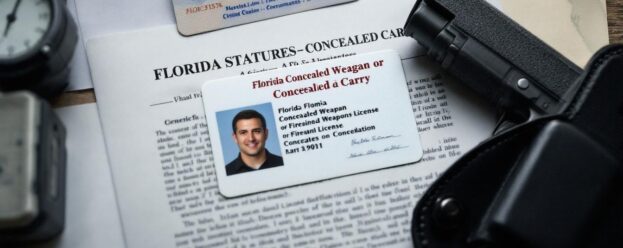
Florida concealed gun laws give you the right to carry a firearm discreetly, but only if you follow strict rules. Many permit holders make costly mistakes that put them at legal risk.
We at Law Offices of Scott B. Saul have seen firsthand how confusion about these laws leads to serious consequences. This guide breaks down what you need to know to stay compliant.
Florida Concealed Carry License Eligibility and Requirements
Who Can Get a Florida Concealed Carry License
Florida’s concealed carry license sits behind a straightforward eligibility wall that stops certain people cold. You must be at least 21 years old, a U.S. citizen or permanent resident, and have no felony convictions or domestic violence-related disqualifications on your record. The Florida Department of Agriculture and Consumer Services administers the program and will reject your application if you’re subject to a risk protection order, have an active substance abuse problem, or face certain mental health adjudications. These aren’t suggestions-they’re hard stops. Many applicants discover disqualifying issues only after submitting paperwork, wasting time and the $97 license fee. Run a background check on yourself first through the Florida Crime Information Center or consult an attorney if you’re uncertain about past arrests or convictions, especially if records were sealed or expunged.
Proving You Know How to Handle a Gun
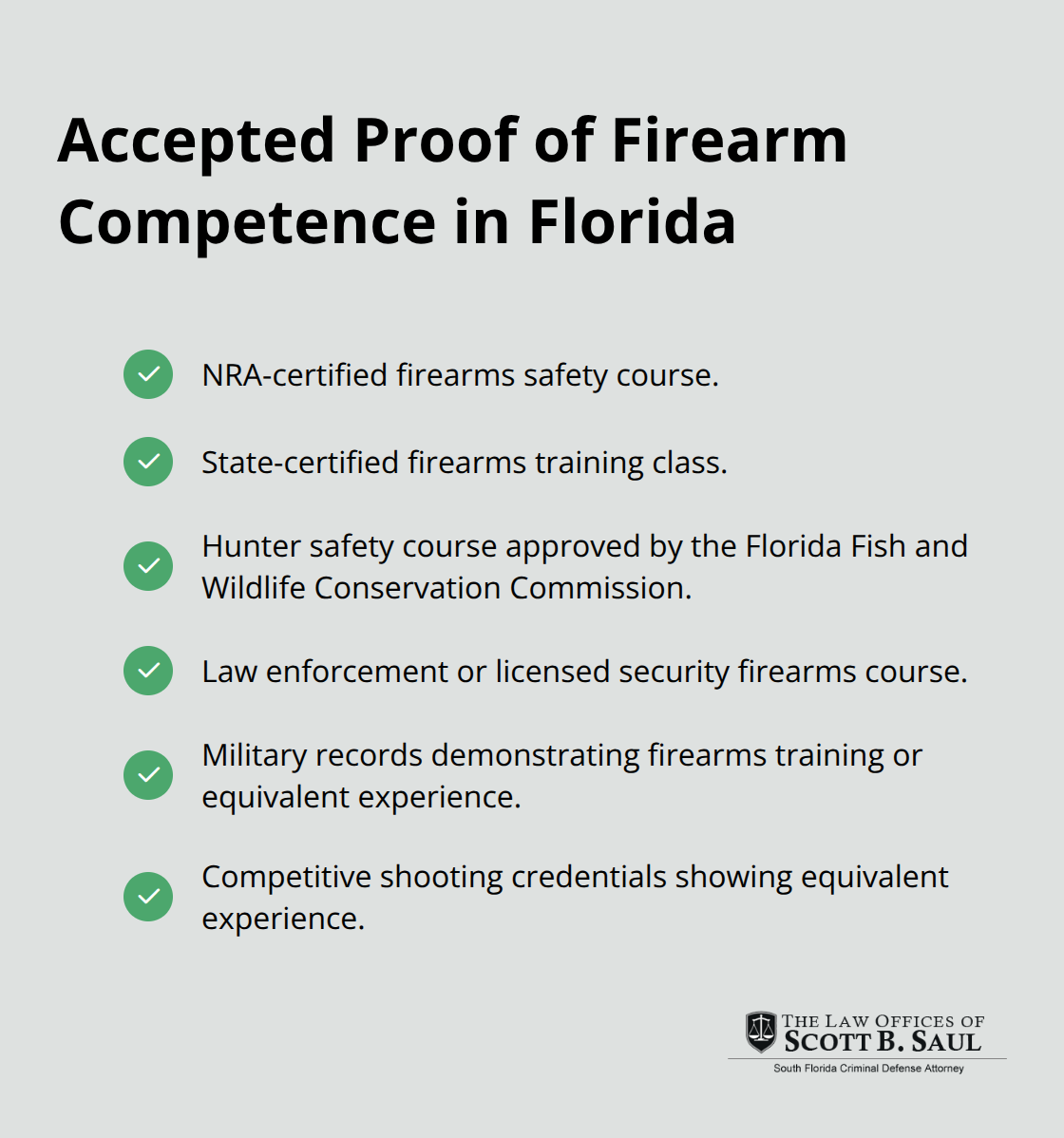
Florida requires proof of firearm competence before issuing your license, and the state offers multiple acceptable paths. You can complete an NRA-certified course, take a state-certified firearms training class, finish a hunter safety course approved by the Florida Fish and Wildlife Conservation Commission, attend a law enforcement or security firearms course, or submit military records or competition credentials demonstrating equivalent experience. Live-fire training is mandatory-online courses alone won’t cut it. Complete your training within one year of applying, and keep your certificate.
The processing window runs 90 days from submission of a complete application, though this timeline pauses if your criminal history records lack a final disposition. Processing costs roughly $97 for residents; non-residents pay $87 plus fingerprint fees.
License Validity and Renewal Requirements
Your concealed carry license remains valid for seven years from issuance, and the state mails renewal notices at least 90 days before expiration. This matters because expired licenses provide zero legal protection-carrying with an expired license exposes you to criminal liability. Renewal costs $45 for residents and $87 for non-residents, and you don’t need fresh training to renew. If your license expires permanently without renewal, you must reapply as a new applicant, completing the full background check and training requirements again. Address changes are simple to process and critical to handle immediately after moving. Update your contact information with the state within 10 days of any address change, as failure to do so creates compliance problems down the road. Once you hold your license, the next step involves understanding exactly where Florida law permits you to carry and where it strictly prohibits weapons.
Where You Can Legally Carry in Florida
Public Spaces and Permitted Locations
Florida’s concealed carry rules draw hard lines around specific locations, and violating them carries serious consequences. You can carry in most public spaces, restaurants that serve alcohol (but not bar areas), state parks, national forests, and Wildlife Management Areas with your license. The statute lists these permissions in Florida Statutes 790.06(12)(a), and the specificity matters because ignorance provides no legal defense.
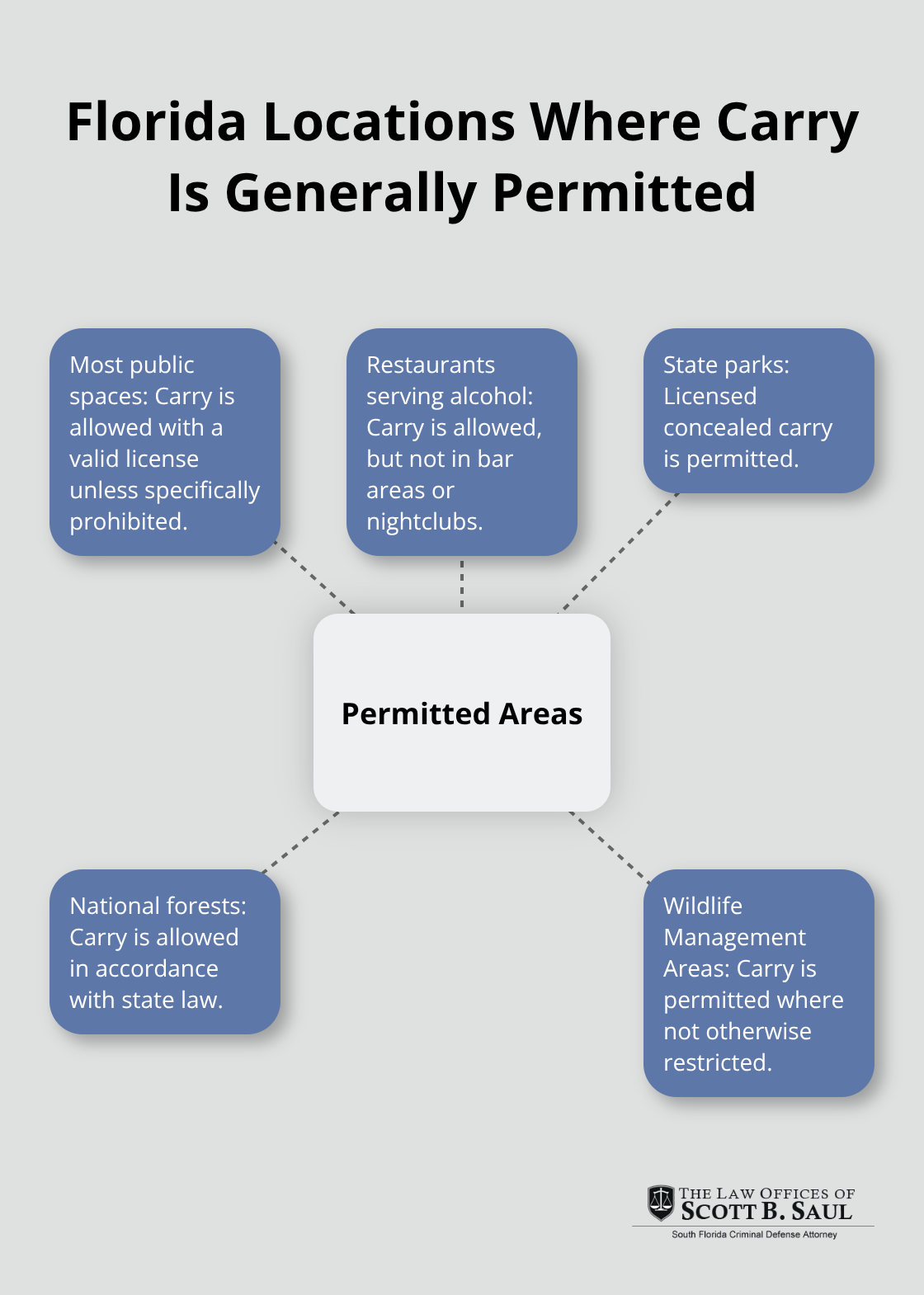
Many permit holders make the mistake of assuming that because they can carry in a restaurant, they can carry in any venue serving drinks. The distinction is sharp: you can carry in the restaurant portion where food is the primary focus, but the moment you step into a bar area or a nightclub, you cross the legal line.
Prohibited Locations and Legal Penalties
You cannot carry in police stations, sheriff’s offices, detention facilities, courthouses, elementary or secondary schools, college and university facilities (with narrow exceptions for registered students, employees, or faculty carrying nonlethal devices), airports or their passenger terminals, or areas primarily devoted to alcohol consumption. Carrying in an unauthorized location is a second-degree misdemeanor, which means potential jail time and a criminal record. Federal law adds its own restrictions on airports and federal buildings, which layer on top of state prohibitions. Before entering any government building, ask security or call ahead to confirm the rules specific to that location.
Vehicle Carry and Workplace Protections
Your vehicle presents a different legal landscape that trips up many permit holders. With a valid concealed carry license or a reciprocal license from another state, you can carry a loaded firearm in your vehicle, and employers cannot prevent you from keeping a locked, unloaded firearm in your vehicle’s parking lot with limited exceptions for certain sensitive workplaces. This protection under Florida Statutes 790.251(7) is powerful, but the weapon must remain secured and inaccessible while parked at work.
Reciprocity Across State Lines
Florida operates as a “shall-issue” state for concealed carry permits, meaning the state must issue you a permit if you meet the legal requirements. Florida honors resident concealed carry licenses from other states, meaning your Florida permit works in those jurisdictions, and Florida recognizes permits from reciprocal states. The reciprocity benefit makes your Florida license valuable even if you travel or relocate, though you must verify current reciprocity lists before crossing state lines because agreements change. Non-residents can obtain Florida licenses specifically for reciprocity purposes, paying $87 plus fingerprint fees. If you move out of Florida, your seven-year license remains valid until expiration provided you update your address with the Florida Department of Agriculture and Consumer Services. This flexibility distinguishes Florida from many states with stricter residence requirements, giving you legal carry rights across multiple jurisdictions without obtaining multiple licenses.
Understanding where you can carry protects you from criminal liability, but knowing how to use force legally protects you from civil and criminal exposure when confrontation occurs.
What Permit Holders Get Wrong About Florida Carry Laws
Most concealed carry permit holders believe they understand Florida law until a single mistake lands them in criminal court. Permit holders who violate these laws lose their freedom, jobs, and savings over oversights that seemed minor at the time. Address changes, prohibited location violations, and misunderstandings about when force becomes legal are the three mistakes that appear most frequently in criminal cases. These aren’t theoretical errors-they carry real criminal penalties that destroy lives. The Florida Department of Agriculture and Consumer Services processes applications within roughly 90 days, yet many holders never invest two hours to understand the restrictions that govern their licenses.
Address Changes and Legal Protection
Failing to update your address within 10 days of moving violates Florida law and strips you of legal protection if police stop you. An expired address on file signals to law enforcement that something is wrong, and officers may treat you as unlicensed even if your permit remains active. Courts have upheld convictions where permit holders couldn’t prove current residency documentation. This single oversight creates immediate legal exposure that most people overlook until it’s too late.
Carrying Into Prohibited Locations
Carrying into a prohibited location results in a noncriminal violation with a penalty of $25, payable to the clerk of the court. The statute lists specific prohibited zones (police stations, courthouses, schools, college campuses, airports, and areas primarily devoted to alcohol consumption), yet permit holders regularly carry into these locations because they assume their license provides blanket protection everywhere. One permit holder entered a courthouse to handle a traffic citation and carried his weapon because he thought Florida permit holders had blanket authority. He faced two years of criminal proceedings before resolution. The consequences extend far beyond the initial charge.
Stand Your Ground and Lawful Presence
Florida’s Stand Your Ground statute lets you use deadly force to prevent imminent death or great bodily harm, and you have no legal duty to retreat. However, Stand Your Ground only applies if you’re in a place where you have a right to be. Carrying in a prohibited location means you forfeit Stand Your Ground protection-if you’re forced to use force defensively while illegally carrying, prosecutors will charge you with both the carry violation and the force itself. This compounds your criminal exposure exponentially. The statute distinguishes between force that stops a threat and force that constitutes aggression, and the distinction hinges on whether you reasonably believed death or serious injury was imminent. Courts examine your actions before, during, and after the confrontation to determine reasonableness. Self-defense claims fail regularly because permit holders misread the legal threshold for justified force.
Three Steps to Stay Compliant
Update your address with the Florida Department of Agriculture and Consumer Services within 10 days of any move-do this online or by mail before anything else. Print the list of prohibited locations from Florida Statutes 790.06(12)(a) and review it before entering any government building, school property, or venue that primarily serves alcohol. Understand that Stand Your Ground only protects you if you’re lawfully in that location and face imminent threat of death or serious bodily harm. If a confrontation occurs and you’re uncertain whether your use of force was justified, contact an attorney immediately-do not speak to police without representation.
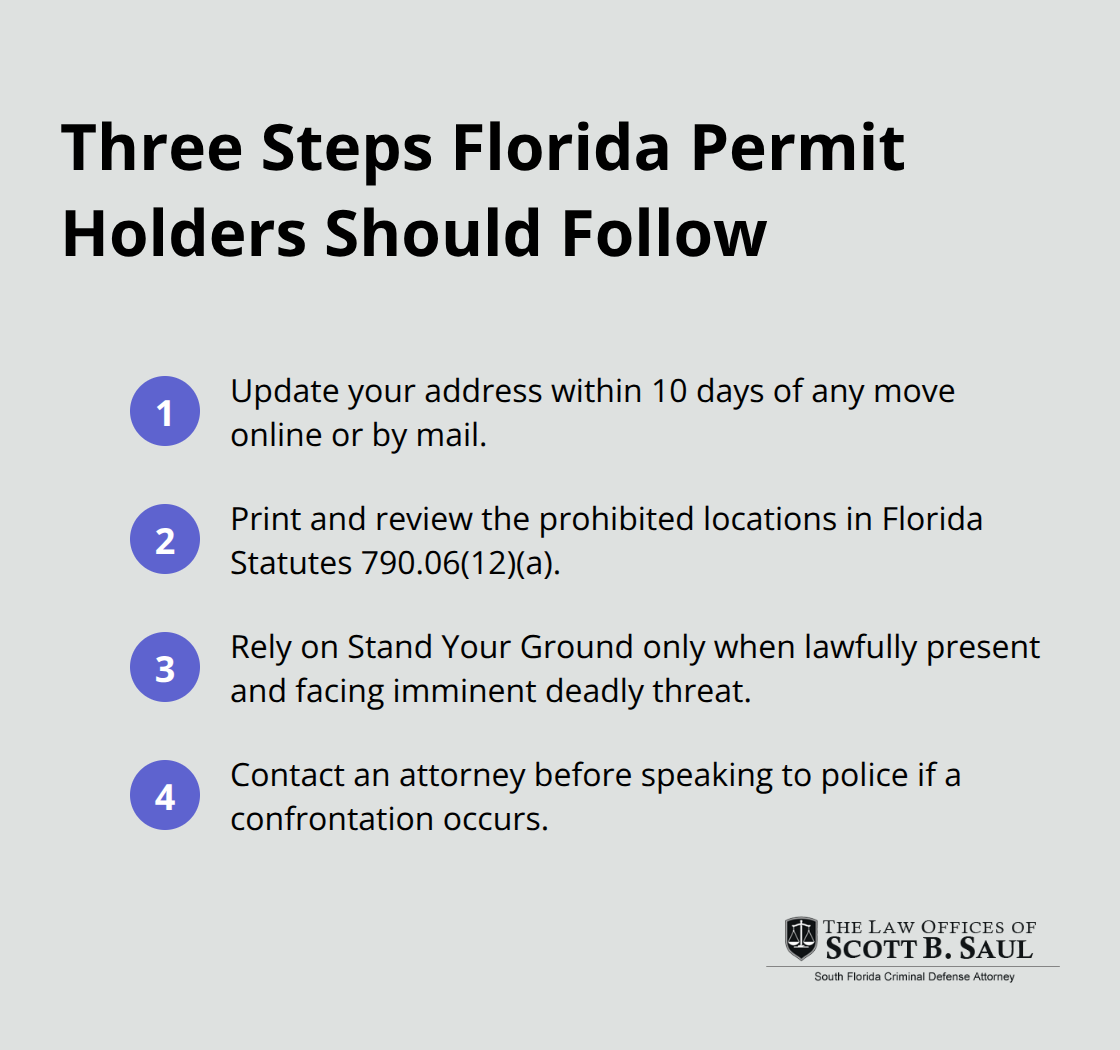
These three actions eliminate the mistakes that create criminal liability for thousands of Florida permit holders annually.
Conclusion
Florida concealed gun laws demand constant attention because the rules shift and your circumstances change. Compliance isn’t optional, and ignorance of the law provides zero protection in court. Address changes, location restrictions, and Stand Your Ground limitations are the three areas where permit holders stumble most frequently, turning routine situations into criminal charges.
Staying informed means reviewing the Florida Department of Agriculture and Consumer Services website annually and confirming your address remains current. Many permit holders assume their license grants blanket authority everywhere, then face second-degree misdemeanor charges when reality contradicts that assumption. The cost of a single mistake extends far beyond fines-it includes jail time, a criminal record, lost employment, and years of legal proceedings.
If you face charges related to Florida concealed gun laws or any firearms offense, contact a criminal defense attorney who understands Florida’s complex firearms statutes immediately. We at Law Offices of Scott B. Saul provide personalized attention and comprehensive consultations to protect your rights when the stakes are highest.
Archives
- February 2026 (5)
- January 2026 (9)
- December 2025 (9)
- November 2025 (8)
- October 2025 (8)
- September 2025 (9)
- August 2025 (8)
- July 2025 (8)
- June 2025 (9)
- May 2025 (9)
- April 2025 (8)
- March 2025 (9)
- February 2025 (8)
- January 2025 (9)
- December 2024 (10)
- November 2024 (5)
- July 2024 (2)
- June 2024 (2)
- May 2024 (2)
- April 2024 (2)
- March 2024 (2)
- February 2024 (2)
- January 2024 (2)
- December 2023 (2)
- November 2023 (2)
- October 2023 (2)
- September 2023 (2)
- August 2023 (1)
- July 2023 (2)
- June 2023 (2)
- May 2023 (2)
- April 2023 (2)
- March 2023 (2)
- February 2023 (2)
- January 2023 (2)
- December 2022 (2)
- November 2022 (2)
- October 2022 (2)
- September 2022 (2)
- August 2022 (2)
- July 2022 (2)
- June 2022 (2)
- May 2022 (2)
- April 2022 (2)
- March 2022 (2)
- February 2022 (2)
- January 2022 (2)
- December 2021 (2)
- November 2021 (2)
- October 2021 (2)
- September 2021 (2)
- August 2021 (2)
- July 2021 (2)
- June 2021 (2)
- May 2021 (2)
- April 2021 (2)
- September 2020 (5)
- July 2020 (4)
- June 2020 (4)
- May 2020 (4)
- April 2020 (5)
- March 2020 (4)
- February 2020 (4)
- January 2020 (4)
- December 2019 (1)
- November 2019 (4)
- October 2019 (4)
- September 2019 (4)
- August 2019 (4)
- July 2019 (5)
- June 2019 (4)
- May 2019 (4)
- April 2019 (4)
- March 2019 (4)
- February 2019 (4)
- January 2019 (4)
- December 2018 (4)
- November 2018 (5)
- October 2018 (5)
- September 2018 (4)
- August 2018 (4)
- July 2018 (7)
- June 2018 (4)
- May 2018 (4)
- April 2018 (8)
- March 2018 (4)
- February 2018 (4)
- January 2018 (4)
- November 2017 (4)
- October 2017 (4)
- September 2017 (4)
- August 2017 (7)
- July 2017 (6)
- June 2017 (4)
- May 2017 (4)
- April 2017 (4)
- March 2017 (4)
- February 2017 (7)
- January 2017 (4)
- December 2016 (7)
- November 2016 (4)
- October 2016 (4)
- September 2016 (10)
- August 2016 (4)
- July 2016 (4)
- June 2016 (4)
- May 2016 (4)
- April 2016 (4)
- March 2016 (4)
- February 2016 (7)
- January 2016 (4)
- December 2015 (5)
- November 2015 (4)
- October 2015 (7)
- September 2015 (4)
- August 2015 (4)
- July 2015 (13)
- June 2015 (9)
- May 2015 (8)
- April 2015 (6)
- March 2015 (4)
- February 2015 (4)
- January 2015 (4)
- December 2014 (4)
- November 2014 (4)
- October 2014 (4)
- September 2014 (3)
Categories
- Adjudication (1)
- Bankruptcy (1)
- Burglary Crimes (3)
- calendar call (1)
- Car Accident (1)
- Criminal Defense (395)
- Cyber Crimes (7)
- DNA (1)
- Domestic Violence (9)
- Drug Crimes (5)
- DUI (12)
- Embezzlement (1)
- Environmental Crimes (4)
- Expungement Law (2)
- Federal Sentencing Law (3)
- Firearm (3)
- Forgery (4)
- General (82)
- Healthcare (3)
- Immigration (1)
- Indentity Theft (1)
- Insurance (5)
- judicial sounding (2)
- Juvenile Crimes (4)
- Manslaughter (4)
- Money Laundering (3)
- Organized Crime (1)
- Racketeering (1)
- Reckless Driving (3)
- RICO (3)
- Sealing and Expunging (2)
- Sex Offense (1)
- Shoplifting (1)
- Suspended Driver's License (1)
- Traffic (4)
- Trending Topics (1)
- White-collar Offenses (1)
