
Tax Fraud in Florida What are the Consequences?
By : saulcrim | Category : Criminal Defense | Comments Off on Tax Fraud in Florida What are the Consequences?
20th Oct 2025

Tax fraud Florida cases carry severe penalties that can destroy your financial future and freedom. The state prosecutes these crimes aggressively, with consequences ranging from hefty fines to years in prison.
We at Law Offices of Scott B. Saul see firsthand how tax fraud charges devastate lives and careers. Understanding the potential penalties helps you grasp the seriousness of these allegations.
What Exactly Constitutes Tax Fraud in Florida
Tax fraud and tax evasion represent distinct criminal offenses with different legal thresholds and penalties. Tax fraud involves intentional false return filings or fraudulent statements to reduce tax liability, while tax evasion focuses on willful avoidance of tax payments owed. Florida prosecutors treat both crimes seriously, but fraud charges require proof of deliberate deception rather than simple non-payment. The Florida Department of Revenue investigates sales tax fraud cases with amounts as low as $301, which can trigger third-degree felony charges that carry up to five years in prison and $5,000 in fines.
Sales Tax Fraud Dominates Florida Cases
Sales tax fraud represents the most prosecuted tax crime in Florida since the state lacks personal income tax. Common schemes include fraudulent tax record submissions, failure to report taxable sales, and claims of excessive exempt sales. The Florida Department of Revenue flags businesses that report higher exempt sales than actual taxable sales for criminal investigation.
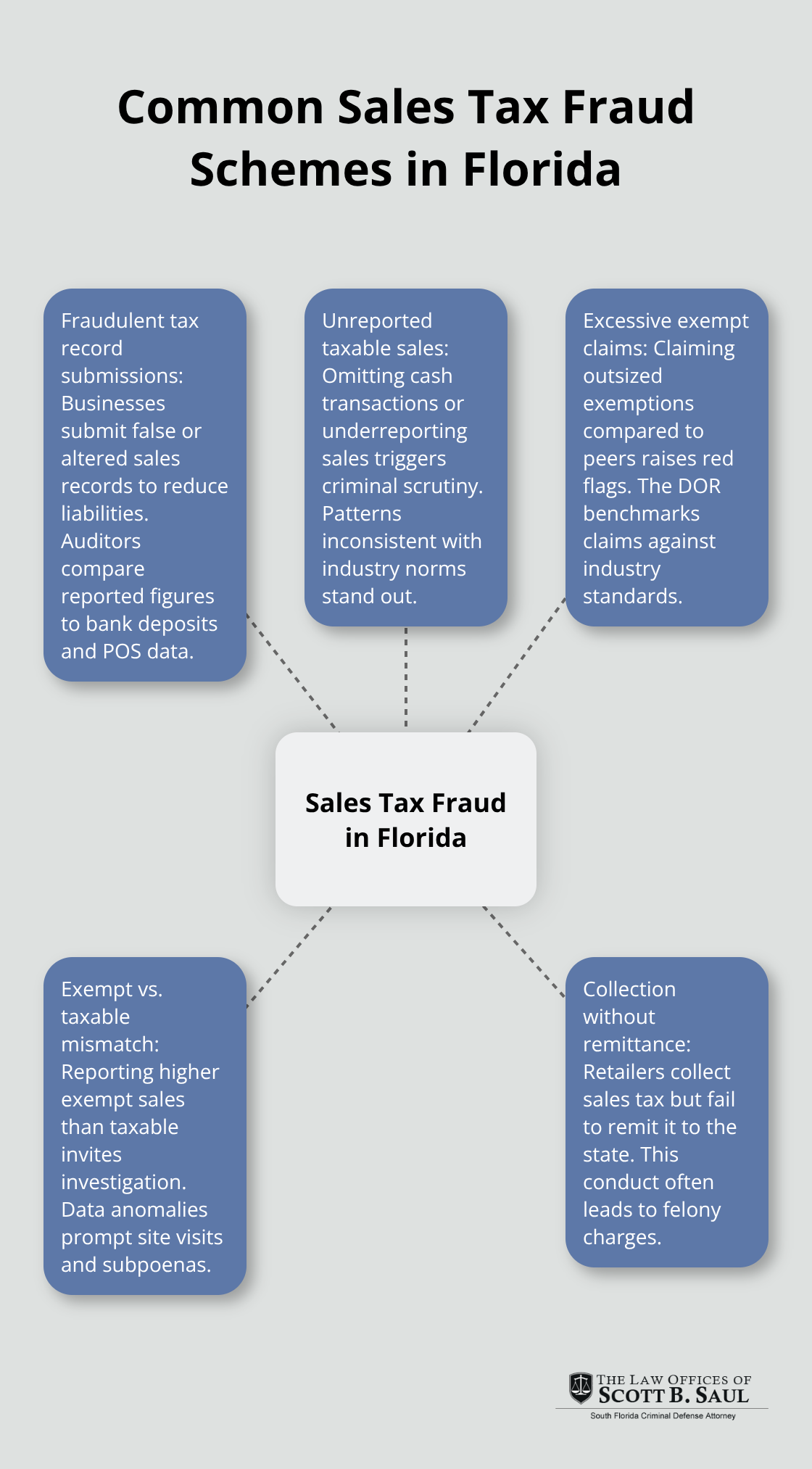
Restaurant owners frequently face charges for cash transaction underreports, while retail businesses get prosecuted for sales tax collection without state payment remittance.
Federal Charges Carry Harsher Penalties
Federal tax fraud prosecutions involve income tax violations and carry maximum penalties of $250,000 in fines plus five years in prison per count. The IRS Criminal Investigation division pursues cases with sophisticated schemes like nominee use to hide assets or false returns that understate income by millions. David Albert Fletcher received 30 months in federal prison for tax concealment of $1.7 million through nominee purchases of luxury vehicles (including Rolls Royces). Federal prosecutors often add money laundering and wire fraud charges to amplify penalties.
Investigation Triggers and Warning Signs
The Florida Department of Revenue initiates criminal investigations through regular audit red flags and fraud indicators. Businesses face scrutiny when they report inconsistent sales patterns or claim unusually high exempt transactions compared to industry standards. Accountants must disclose potentially damaging client information during criminal investigations (due to mandatory disclosure rules), while attorney-client privilege protects communications with legal counsel. These dual investigation tracks make experienced defense representation essential when authorities pursue both state and federal charges simultaneously, especially when cases involve identity fraud documentation.
How Much Will Tax Fraud Cost You
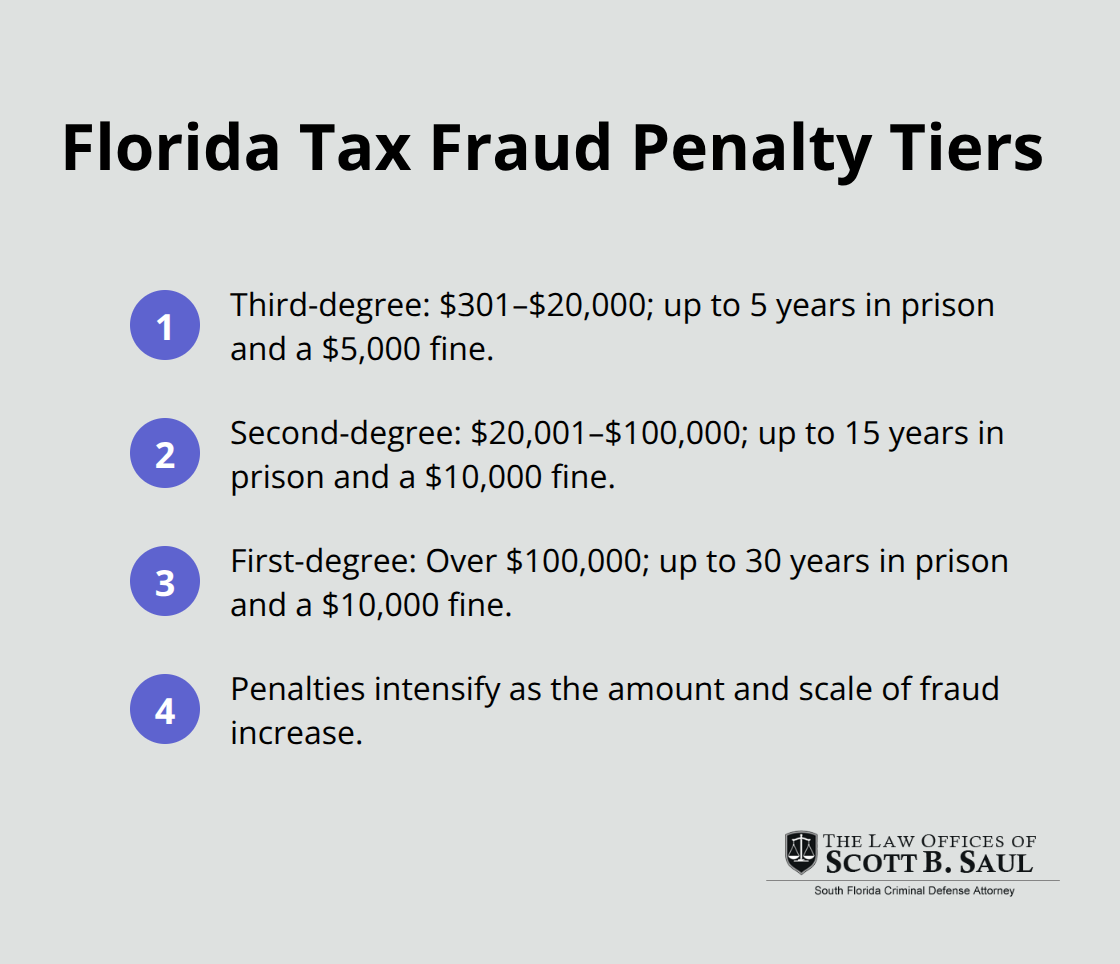
Florida tax fraud penalties escalate dramatically based on the amount involved, with prison sentences that vary depending on the fraud’s scale. Third-degree felony charges apply to amounts between $301 and $20,000, and courts impose up to five years in prison and $5,000 in fines. Second-degree felonies cover amounts from $20,001 to $100,000, with penalties that reach 15 years in prison and $10,000 in fines. First-degree felonies apply when fraud exceeds $100,000, and judges sentence defendants to up to 30 years in prison and $10,000 in fines.
Federal Penalties Stack Additional Punishment
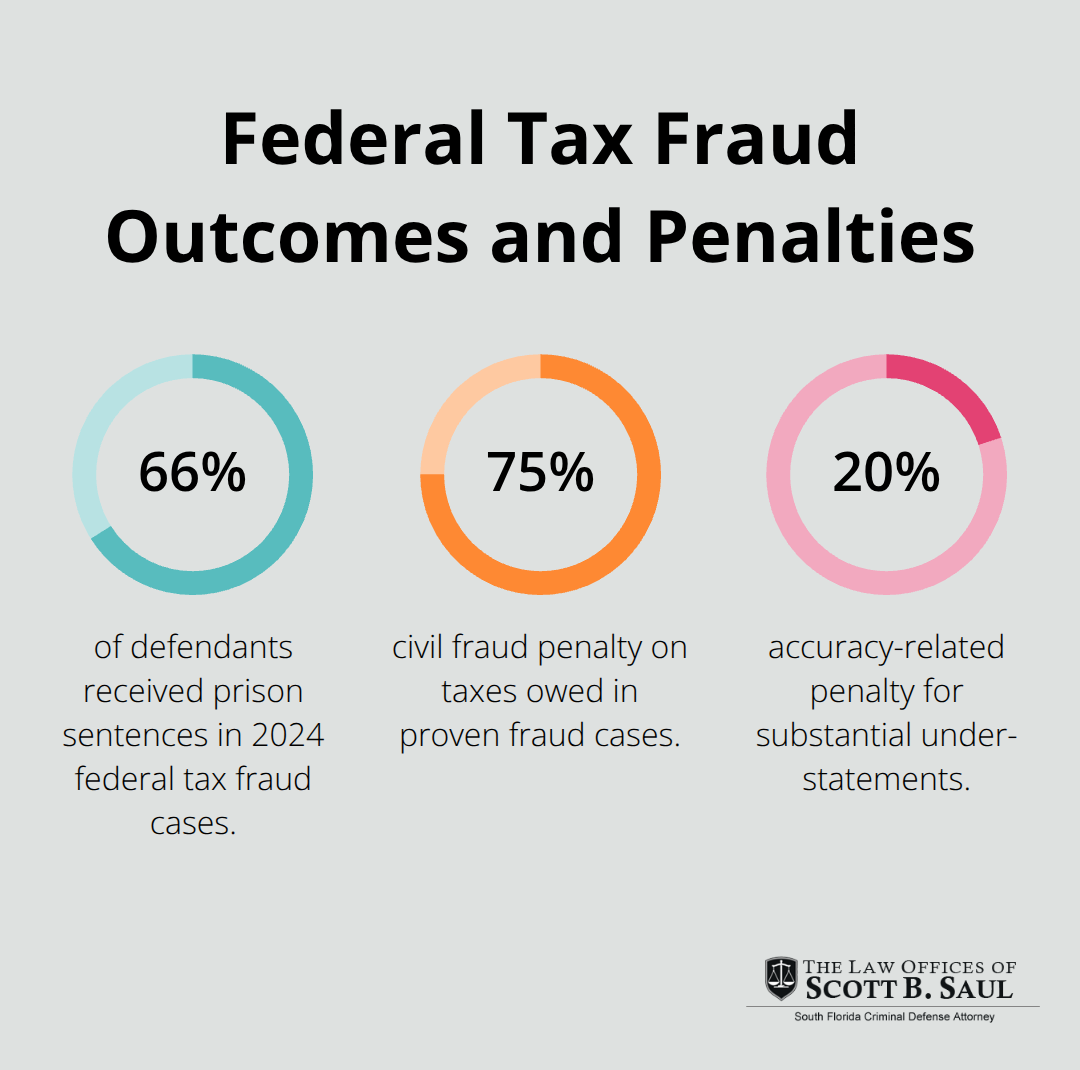
Federal convictions add another layer of punishment, with fines that reach $250,000 per count plus five years in federal prison. In 2024, 360 tax fraud cases were reported, with a median loss of $491,302 and an average sentence of 15 months, with 66% going to prison. The IRS imposes additional civil penalties that include a 75% fraud penalty on taxes owed, plus 5% monthly penalties for unfiled returns and 20% accuracy-related penalties.
These federal penalties often exceed state penalties and prosecutors frequently pursue both simultaneously.
Asset Seizure Destroys Financial Security
Asset forfeiture accompanies tax fraud convictions and allows authorities to seize property, bank accounts, and business assets used in the scheme or purchased with fraudulent proceeds. The IRS places liens on real estate and freezes financial accounts during investigations (often before formal charges). David Albert Fletcher paid $7,112,689 in restitution beyond his 30-month prison sentence, which demonstrates how financial penalties often exceed the original tax debt.
Professional Licenses Face Immediate Revocation
Professional licenses face immediate suspension or revocation upon conviction, which effectively ends careers in accounting, law, real estate, and financial services. Medical professionals lose hospital privileges, while contractors lose their ability to obtain bonds. These collateral consequences often prove more devastating than criminal penalties, as license restoration requires years of compliance monitoring and character hearings that rarely succeed.
The severity of these penalties makes immediate legal action essential when authorities begin their investigation, as early intervention can mean the difference between civil resolution and criminal prosecution.
How Can You Fight Tax Fraud Charges
Prosecutors Must Prove Intent Beyond Reasonable Doubt
Tax fraud convictions require prosecutors to prove willful intent to defraud, which creates your strongest defense opportunity. Courts demand evidence that the defendant knew of their legal obligation to pay taxes and made a deliberate choice to violate that obligation, not mere mistakes or negligence. Defense attorneys successfully protect clients by demonstrating good faith efforts to comply with tax laws, including maintenance of accurate business records, professional advice consultation, and amended return filings when errors surface. A history of timely tax filings strengthens your defense, as does evidence that you relied on professional accountants or tax preparers who provided incorrect guidance. The complexity of Florida tax law creates reasonable doubt when prosecutors cannot prove you understood specific requirements or intentionally violated them.
Early Intervention Preserves Your Best Options
Pre-arrest negotiations offer the best chance to avoid criminal prosecution entirely, as authorities often accept civil resolutions with payment plans before they file formal charges. Once arrest warrants issue, your options narrow significantly, which makes early legal intervention critical. Pre-Trial Intervention programs are primarily designed for first-time adult offenders who meet specific criteria and allow defendants to avoid court proceedings through negotiated payment plans. The Misdemeanor Intervention Program handles smaller sales tax fraud cases, while felony amounts require direct negotiations with prosecutors. Defense attorneys negotiate reduced charges by demonstrating client cooperation, voluntary disclosure of unreported income, and immediate efforts to become current on tax obligations.
Payment Plans Prevent Criminal Prosecution
Payment plan agreements often convince prosecutors to maintain cases as civil matters rather than pursue criminal prosecution. This approach saves clients from prison sentences and professional license revocation. Attorneys who act quickly can negotiate these arrangements before formal charges appear, which preserves clients’ reputations and careers. The Florida Department of Revenue accepts voluntary compliance when taxpayers demonstrate good faith efforts to resolve outstanding obligations.
Specialized Defense Expertise Makes the Difference
Tax fraud cases require attorneys who understand both criminal law and complex tax regulations, as these cases differ substantially from typical criminal defense work. Attorney-client privilege protects all communications during investigations, while accountant-client relationships offer no such protection under mandatory disclosure rules. Defense teams examine every aspect of the government’s case, from audit procedures to evidence collection methods, and identify constitutional violations that can suppress evidence or dismiss charges entirely. Forensic accountants assist in challenging the prosecution’s financial calculations and demonstrate legitimate business expenses or deductions which prosecutors often mischaracterize as fraudulent schemes. Criminal defense lawyers may be able to help negotiate an agreement in situations where individuals or businesses may not realize certain tax obligations.
Final Thoughts
Tax fraud Florida cases destroy lives through decades-long prison sentences, massive financial penalties, and permanent career devastation. First-degree felony convictions carry 30-year prison terms plus $10,000 fines, while federal charges add another $250,000 per count. Asset forfeiture strips away homes, businesses, and savings accounts (often exceeding the original tax debt by millions).
Time works against you once investigations begin. The Florida Department of Revenue and IRS move quickly to freeze assets and build criminal cases. Pre-arrest negotiations offer your best chance to avoid prosecution entirely through civil payment plans, but these opportunities vanish once formal charges appear.
We at Law Offices of Scott B. Saul understand that tax fraud defense requires specialized expertise in both criminal law and complex tax regulations. Our experienced criminal defense team brings unique prosecutorial insights to every defense strategy. The stakes are too high to face these charges alone, so contact us immediately for comprehensive consultation and aggressive representation that protects your rights and future.
Archives
- February 2026 (5)
- January 2026 (9)
- December 2025 (9)
- November 2025 (8)
- October 2025 (8)
- September 2025 (9)
- August 2025 (8)
- July 2025 (8)
- June 2025 (9)
- May 2025 (9)
- April 2025 (8)
- March 2025 (9)
- February 2025 (8)
- January 2025 (9)
- December 2024 (10)
- November 2024 (5)
- July 2024 (2)
- June 2024 (2)
- May 2024 (2)
- April 2024 (2)
- March 2024 (2)
- February 2024 (2)
- January 2024 (2)
- December 2023 (2)
- November 2023 (2)
- October 2023 (2)
- September 2023 (2)
- August 2023 (1)
- July 2023 (2)
- June 2023 (2)
- May 2023 (2)
- April 2023 (2)
- March 2023 (2)
- February 2023 (2)
- January 2023 (2)
- December 2022 (2)
- November 2022 (2)
- October 2022 (2)
- September 2022 (2)
- August 2022 (2)
- July 2022 (2)
- June 2022 (2)
- May 2022 (2)
- April 2022 (2)
- March 2022 (2)
- February 2022 (2)
- January 2022 (2)
- December 2021 (2)
- November 2021 (2)
- October 2021 (2)
- September 2021 (2)
- August 2021 (2)
- July 2021 (2)
- June 2021 (2)
- May 2021 (2)
- April 2021 (2)
- September 2020 (5)
- July 2020 (4)
- June 2020 (4)
- May 2020 (4)
- April 2020 (5)
- March 2020 (4)
- February 2020 (4)
- January 2020 (4)
- December 2019 (1)
- November 2019 (4)
- October 2019 (4)
- September 2019 (4)
- August 2019 (4)
- July 2019 (5)
- June 2019 (4)
- May 2019 (4)
- April 2019 (4)
- March 2019 (4)
- February 2019 (4)
- January 2019 (4)
- December 2018 (4)
- November 2018 (5)
- October 2018 (5)
- September 2018 (4)
- August 2018 (4)
- July 2018 (7)
- June 2018 (4)
- May 2018 (4)
- April 2018 (8)
- March 2018 (4)
- February 2018 (4)
- January 2018 (4)
- November 2017 (4)
- October 2017 (4)
- September 2017 (4)
- August 2017 (7)
- July 2017 (6)
- June 2017 (4)
- May 2017 (4)
- April 2017 (4)
- March 2017 (4)
- February 2017 (7)
- January 2017 (4)
- December 2016 (7)
- November 2016 (4)
- October 2016 (4)
- September 2016 (10)
- August 2016 (4)
- July 2016 (4)
- June 2016 (4)
- May 2016 (4)
- April 2016 (4)
- March 2016 (4)
- February 2016 (7)
- January 2016 (4)
- December 2015 (5)
- November 2015 (4)
- October 2015 (7)
- September 2015 (4)
- August 2015 (4)
- July 2015 (13)
- June 2015 (9)
- May 2015 (8)
- April 2015 (6)
- March 2015 (4)
- February 2015 (4)
- January 2015 (4)
- December 2014 (4)
- November 2014 (4)
- October 2014 (4)
- September 2014 (3)
Categories
- Adjudication (1)
- Bankruptcy (1)
- Burglary Crimes (3)
- calendar call (1)
- Car Accident (1)
- Criminal Defense (395)
- Cyber Crimes (7)
- DNA (1)
- Domestic Violence (9)
- Drug Crimes (5)
- DUI (12)
- Embezzlement (1)
- Environmental Crimes (4)
- Expungement Law (2)
- Federal Sentencing Law (3)
- Firearm (3)
- Forgery (4)
- General (82)
- Healthcare (3)
- Immigration (1)
- Indentity Theft (1)
- Insurance (5)
- judicial sounding (2)
- Juvenile Crimes (4)
- Manslaughter (4)
- Money Laundering (3)
- Organized Crime (1)
- Racketeering (1)
- Reckless Driving (3)
- RICO (3)
- Sealing and Expunging (2)
- Sex Offense (1)
- Shoplifting (1)
- Suspended Driver's License (1)
- Traffic (4)
- Trending Topics (1)
- White-collar Offenses (1)
