
What You Need to Know About Grand Theft Auto in Florida
By : saulcrim | Category : Criminal Defense | Comments Off on What You Need to Know About Grand Theft Auto in Florida
20th Nov 2025

Grand theft auto Florida charges carry severe penalties that can permanently alter your life. A single conviction can result in years behind bars and thousands in fines.
We at Law Offices of Scott B. Saul see clients facing these serious felony charges regularly. Understanding your rights and available defenses makes the difference between conviction and freedom.
What Counts as Grand Theft Auto in Florida
Legal Definition and Value Thresholds
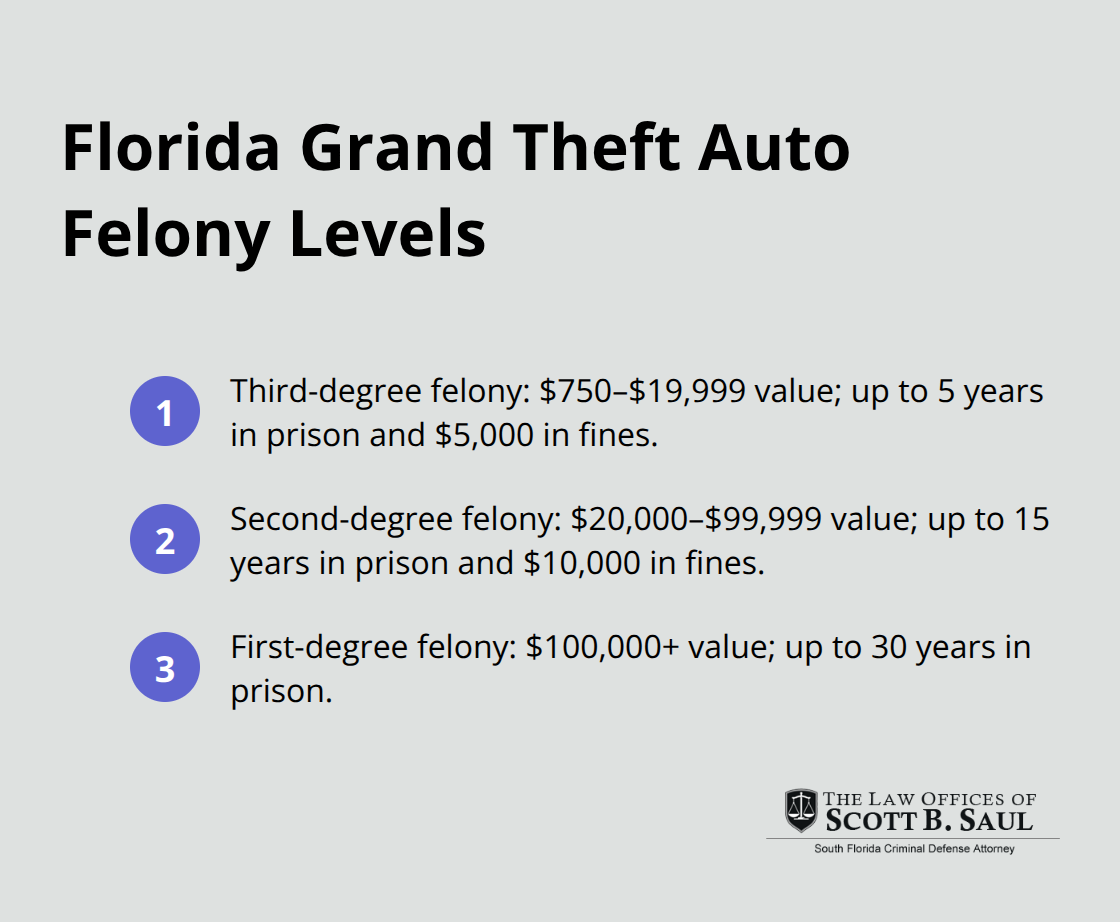
Florida law defines grand theft auto as the unlawful taking of a motor vehicle with intent to permanently deprive the owner of their property. The classification depends entirely on the vehicle’s value. Vehicles worth $750 to $19,999 result in third-degree felony charges, which carry up to five years in prison and $5,000 in fines. When the stolen vehicle’s value reaches $20,000 to $99,999, prosecutors file second-degree felony charges with penalties of up to 15 years imprisonment and $10,000 fines. Vehicles valued at $100,000 or more trigger first-degree felony charges, punishable by up to 30 years in prison.
How Grand Theft Auto Differs from Petty Theft
The $750 threshold separates grand theft auto from petty theft in Florida. Theft of a vehicle worth less than $750 results in petty theft charges, typically a misdemeanor with lighter penalties. However, most functional vehicles today exceed this threshold, which makes grand theft auto charges the standard outcome. Florida Statute 812.014 governs these distinctions and requires prosecutors to prove both the taking of the vehicle and the intent to permanently deprive the owner. Temporary joyriding can still result in felony charges if prosecutors demonstrate intent to steal rather than merely borrow the vehicle.
Florida’s Statutory Framework for Vehicle Theft
Florida Statute 812.014 establishes the legal framework for all theft offenses, including motor vehicle theft. The statute requires proof that defendants knowingly obtained or used another person’s property without permission. Courts examine factors like how long the defendant possessed the vehicle, whether they attempted to hide or sell it, and their statements about ownership. The Office of Program Policy Analysis and Government Accountability indicates that Florida’s $750 felony theft threshold amount is currently lower than 40 other states. This systematic approach means theft values and penalties can change over time.
Special Circumstances That Elevate Charges
Certain circumstances can escalate grand theft auto charges to more severe penalties. Theft that occurs during a riot or declared state of emergency automatically becomes a first-degree felony (regardless of vehicle value). Using a motor vehicle as an instrument to commit theft while causing property damage exceeding $1,000 also results in first-degree felony charges. These enhanced penalties reflect Florida’s stance on crimes that exploit emergency situations or cause additional harm to victims and communities.
Understanding these legal distinctions becomes vital when prosecutors file charges, as the penalties vary dramatically based on specific circumstances and vehicle values. Defendants facing grand theft charges need experienced legal representation to navigate these complex statutes effectively.
What Penalties Await Grand Theft Auto Convictions
Prison Terms That Destroy Lives
Third-degree felony convictions for vehicles valued $750 to $19,999 result in up to five years in state prison. Second-degree felonies for vehicles worth $20,000 to $99,999 carry maximum sentences of 15 years imprisonment. First-degree felony charges for vehicles over $100,000 in value can lead to 30 years behind bars.
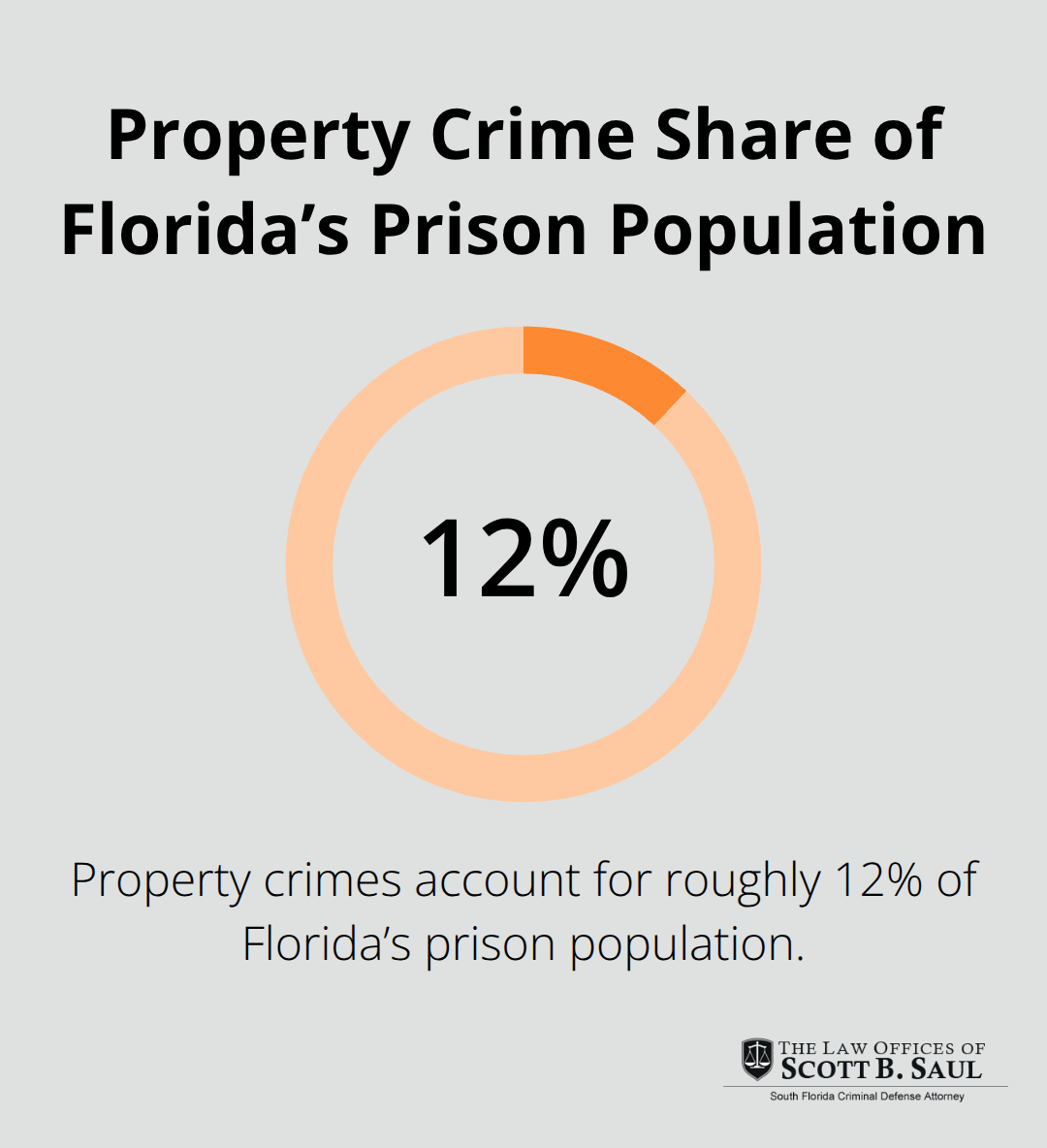
Florida’s prison system houses approximately 80,000 inmates, with property crimes that account for roughly 12% of the population according to the Florida Department of Corrections. Judges rarely show leniency for repeat offenders. Minimum mandatory sentences apply when firearms are involved during the theft.
Financial Devastation Beyond Prison
Courts impose fines up to $5,000 for third-degree felonies, $10,000 for second-degree felonies, and $10,000 for first-degree felonies. Restitution payments to victims often exceed the vehicle’s original value when they include tow costs, storage fees, and repair expenses.
Clients face restitution demands of $30,000 or more when vehicles suffer damage during theft. Court costs, probation fees, and attorney expenses typically add another $10,000 to $25,000 in total case expenses. Florida law requires full restitution payment before defendants complete their sentences, which creates long-term financial obligations that can last decades.
Career and Housing Destruction
Felony convictions appear on background checks forever in Florida and eliminate opportunities in healthcare, education, finance, and government employment. Professional licenses for real estate, insurance, and securities become impossible to obtain with theft convictions.
Landlords routinely reject rental applications from felony offenders and force many into substandard housing or homelessness. Certain felonies permanently bar individuals from professional licensure, while other felonies and misdemeanors require waiting periods. Employment applications that ask about criminal history legally exclude convicted felons from consideration and create permanent barriers to economic stability.
These severe consequences make it essential to understand the defense strategies that can protect your future and freedom when you face grand theft auto charges.
How Can You Fight Grand Theft Auto Charges
Intent Matters More Than Actions
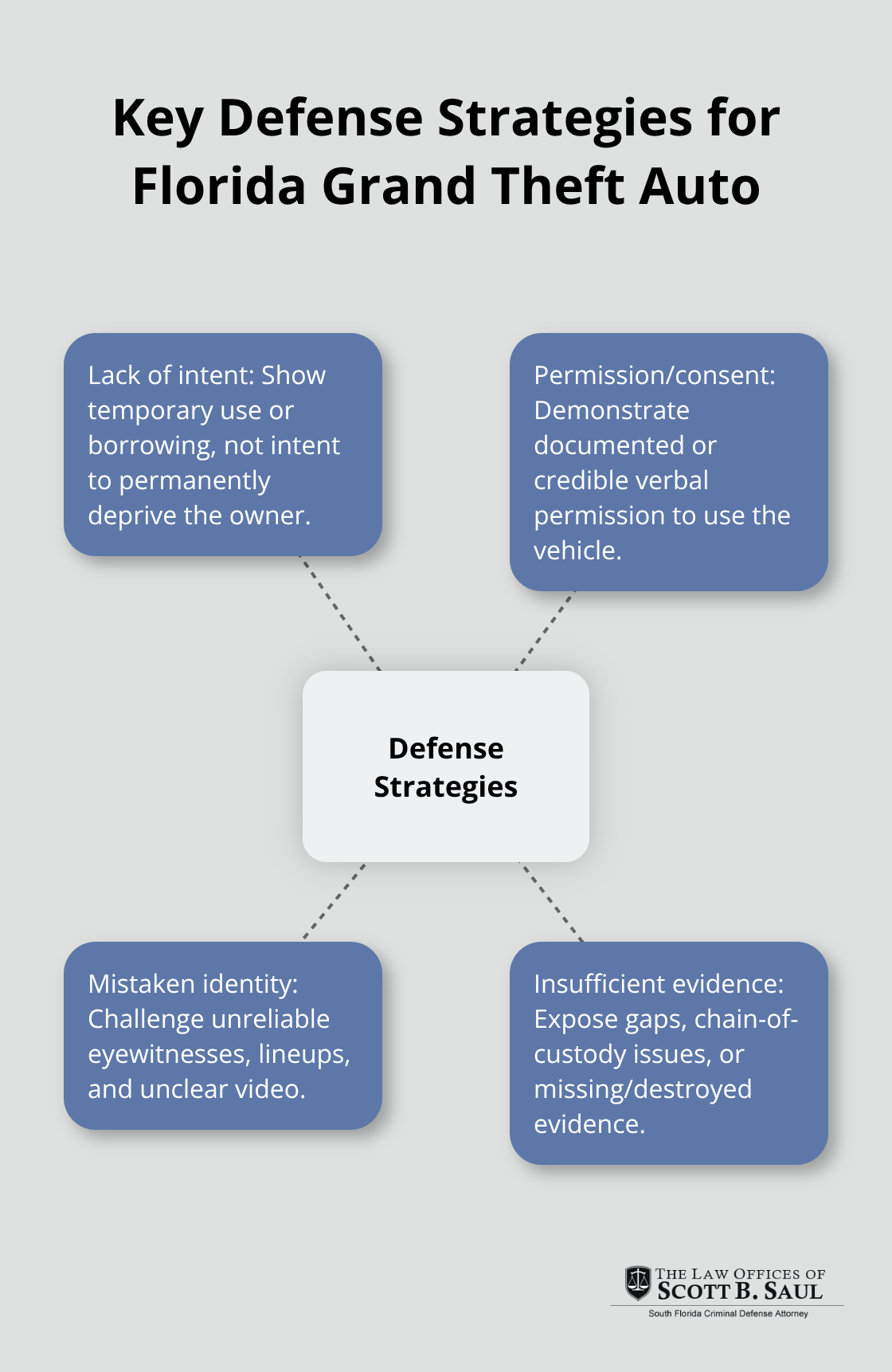
Florida prosecutors must prove you intended to permanently steal the vehicle, not just borrow it. Every theft case involves two essential elements: knowledge and intent, which the prosecution must prove beyond a reasonable doubt. Text messages that discuss borrowing the vehicle, short-distance travel patterns, or leaving the car in an accessible location all support lack of permanent intent.
Defense attorneys examine GPS data, cell phone records, and witness statements to demonstrate temporary use rather than theft. Courts consider how long you possessed the vehicle and whether you attempted to hide or sell it. Defendants who drive vehicles short distances and abandon them near the original location often avoid conviction.
Permission Defenses Work When Documented
Valid permission from the owner eliminates theft charges entirely. Verbal permission creates challenges without documentation, but text messages, emails, or witness testimony that proves consent defeats prosecution cases. Family members frequently lend vehicles without formal documentation, which creates confusion during arrests.
Emergency situations where you reasonably believed you had permission also provide viable defenses. Previous permission to use the vehicle establishes patterns that support current defense claims. Courts recognize that family dynamics and informal arrangements often lack written agreements.
Identification Errors Destroy Cases
Mistaken identity occurs frequently in vehicle theft cases, especially when multiple suspects flee the scene. Eyewitness identification accounts for most wrongful convictions, as careful studies have demonstrated. Police lineups, photo arrays, and cross-racial identifications produce unreliable results that experienced attorneys challenge successfully.
Fingerprint evidence rarely exists on vehicle surfaces, and DNA evidence requires proper collection and testing. Surveillance footage often shows unclear images that cannot definitively identify suspects. Alibi evidence that places you elsewhere during the theft time creates reasonable doubt that prevents conviction.
Insufficient Evidence Challenges
Prosecutors must prove every element of grand theft auto beyond reasonable doubt. Weak circumstantial evidence fails to meet this standard when defense attorneys expose gaps in the state’s case. Missing surveillance footage, destroyed physical evidence, or incomplete police reports create opportunities for dismissal.
Chain of custody issues with evidence can invalidate key prosecution exhibits. When police fail to properly document evidence collection or storage, defense attorneys file motions to suppress. These procedural violations often result in reduced charges or complete case dismissal.
Final Thoughts
Grand theft auto Florida charges demand immediate legal action. Every hour you wait gives prosecutors more time to build their case against you. Police interrogations without an attorney present often produce statements that destroy defense strategies later.
We at Law Offices of Scott B. Saul have defended hundreds of cases during our decades of criminal defense experience. Our background as former prosecutors provides unique insights into how the state builds theft cases. This prosecutorial experience helps us identify weaknesses in evidence collection and witness testimony that other attorneys miss.
The difference between conviction and freedom often depends on early intervention. Experienced defense attorneys preserve evidence, interview witnesses, and file motions that can result in reduced charges or complete dismissal. If you face grand theft auto charges in Miami-Dade or Broward County (or surrounding areas), contact our criminal defense team immediately for a comprehensive consultation.
Archives
- February 2026 (5)
- January 2026 (9)
- December 2025 (9)
- November 2025 (8)
- October 2025 (8)
- September 2025 (9)
- August 2025 (8)
- July 2025 (8)
- June 2025 (9)
- May 2025 (9)
- April 2025 (8)
- March 2025 (9)
- February 2025 (8)
- January 2025 (9)
- December 2024 (10)
- November 2024 (5)
- July 2024 (2)
- June 2024 (2)
- May 2024 (2)
- April 2024 (2)
- March 2024 (2)
- February 2024 (2)
- January 2024 (2)
- December 2023 (2)
- November 2023 (2)
- October 2023 (2)
- September 2023 (2)
- August 2023 (1)
- July 2023 (2)
- June 2023 (2)
- May 2023 (2)
- April 2023 (2)
- March 2023 (2)
- February 2023 (2)
- January 2023 (2)
- December 2022 (2)
- November 2022 (2)
- October 2022 (2)
- September 2022 (2)
- August 2022 (2)
- July 2022 (2)
- June 2022 (2)
- May 2022 (2)
- April 2022 (2)
- March 2022 (2)
- February 2022 (2)
- January 2022 (2)
- December 2021 (2)
- November 2021 (2)
- October 2021 (2)
- September 2021 (2)
- August 2021 (2)
- July 2021 (2)
- June 2021 (2)
- May 2021 (2)
- April 2021 (2)
- September 2020 (5)
- July 2020 (4)
- June 2020 (4)
- May 2020 (4)
- April 2020 (5)
- March 2020 (4)
- February 2020 (4)
- January 2020 (4)
- December 2019 (1)
- November 2019 (4)
- October 2019 (4)
- September 2019 (4)
- August 2019 (4)
- July 2019 (5)
- June 2019 (4)
- May 2019 (4)
- April 2019 (4)
- March 2019 (4)
- February 2019 (4)
- January 2019 (4)
- December 2018 (4)
- November 2018 (5)
- October 2018 (5)
- September 2018 (4)
- August 2018 (4)
- July 2018 (7)
- June 2018 (4)
- May 2018 (4)
- April 2018 (8)
- March 2018 (4)
- February 2018 (4)
- January 2018 (4)
- November 2017 (4)
- October 2017 (4)
- September 2017 (4)
- August 2017 (7)
- July 2017 (6)
- June 2017 (4)
- May 2017 (4)
- April 2017 (4)
- March 2017 (4)
- February 2017 (7)
- January 2017 (4)
- December 2016 (7)
- November 2016 (4)
- October 2016 (4)
- September 2016 (10)
- August 2016 (4)
- July 2016 (4)
- June 2016 (4)
- May 2016 (4)
- April 2016 (4)
- March 2016 (4)
- February 2016 (7)
- January 2016 (4)
- December 2015 (5)
- November 2015 (4)
- October 2015 (7)
- September 2015 (4)
- August 2015 (4)
- July 2015 (13)
- June 2015 (9)
- May 2015 (8)
- April 2015 (6)
- March 2015 (4)
- February 2015 (4)
- January 2015 (4)
- December 2014 (4)
- November 2014 (4)
- October 2014 (4)
- September 2014 (3)
Categories
- Adjudication (1)
- Bankruptcy (1)
- Burglary Crimes (3)
- calendar call (1)
- Car Accident (1)
- Criminal Defense (395)
- Cyber Crimes (7)
- DNA (1)
- Domestic Violence (9)
- Drug Crimes (5)
- DUI (12)
- Embezzlement (1)
- Environmental Crimes (4)
- Expungement Law (2)
- Federal Sentencing Law (3)
- Firearm (3)
- Forgery (4)
- General (82)
- Healthcare (3)
- Immigration (1)
- Indentity Theft (1)
- Insurance (5)
- judicial sounding (2)
- Juvenile Crimes (4)
- Manslaughter (4)
- Money Laundering (3)
- Organized Crime (1)
- Racketeering (1)
- Reckless Driving (3)
- RICO (3)
- Sealing and Expunging (2)
- Sex Offense (1)
- Shoplifting (1)
- Suspended Driver's License (1)
- Traffic (4)
- Trending Topics (1)
- White-collar Offenses (1)
