
Reckless Driving in Florida What You Need to Know
By : saulcrim | Category : Criminal Defense | Comments Off on Reckless Driving in Florida What You Need to Know
30th Oct 2025

Reckless driving in Florida carries serious legal consequences that can impact your life for years. The state defines this offense with specific criteria that go beyond simple traffic violations.
At Law Offices of Scott B. Saul, we see how these charges affect drivers across the state. Understanding Florida’s reckless driving laws helps you protect your rights and make informed decisions if facing these allegations.
What Constitutes Reckless Driving in Florida
Legal Definition Under Florida Statute 316.192
Florida Statute 316.192 defines reckless driving as the operation of a vehicle with willful or wanton disregard for the safety of persons or property. This legal standard requires prosecutors to prove you acted deliberately and consciously ignored obvious risks. The Barnes Firm study ranks Florida fourth nationwide for reckless drivers, which makes these charges increasingly common across the state. When you flee from law enforcement, the law automatically classifies this as reckless driving per se (meaning no additional proof of dangerous behavior is needed).
Examples of Reckless Driving Behaviors
Excessive speed beyond reasonable limits constitutes reckless driving, especially when you combine it with other dangerous actions. Courts frequently convict drivers who tailgate at high speeds, weave through traffic without signals, and run red lights. Street racing and aggressive lane changes in heavy traffic consistently lead to convictions. The National Highway Traffic Safety Administration reports that aggressive driving behaviors significantly contribute to Florida’s accident rates. In Florida, texting while driving is a primary offense, with distracted driving citations growing on average each year from 2019 to 2023.
Difference Between Reckless Driving and Careless Driving
Careless driving is a civil infraction that involves lack of due care without criminal intent, which results in fines and points but no criminal record. Reckless driving is a second-degree misdemeanor that carries up to 90 days jail time, $500 fines, and six months license suspension. The willful disregard element separates these charges – careless driving involves unintentional mistakes while reckless driving requires deliberate dangerous behavior. Insurance companies treat reckless driving convictions as high-risk behavior, which causes premium increases that last years. Employers often view reckless driving convictions negatively, particularly for positions that require driving responsibilities.
These legal distinctions become critical when you face charges, as the penalties and long-term consequences vary dramatically between the two offenses.
Penalties and Consequences of Reckless Driving
Criminal Penalties Hit Hard and Fast
First-time reckless driving convictions in Florida carry fines between $25 and $500 plus up to 90 days in jail. Second offenses escalate dramatically with fines that reach $1,000 and jail time that extends to six months. Property damage elevates the charge to a first-degree misdemeanor with penalties up to $1,000 and one year imprisonment.
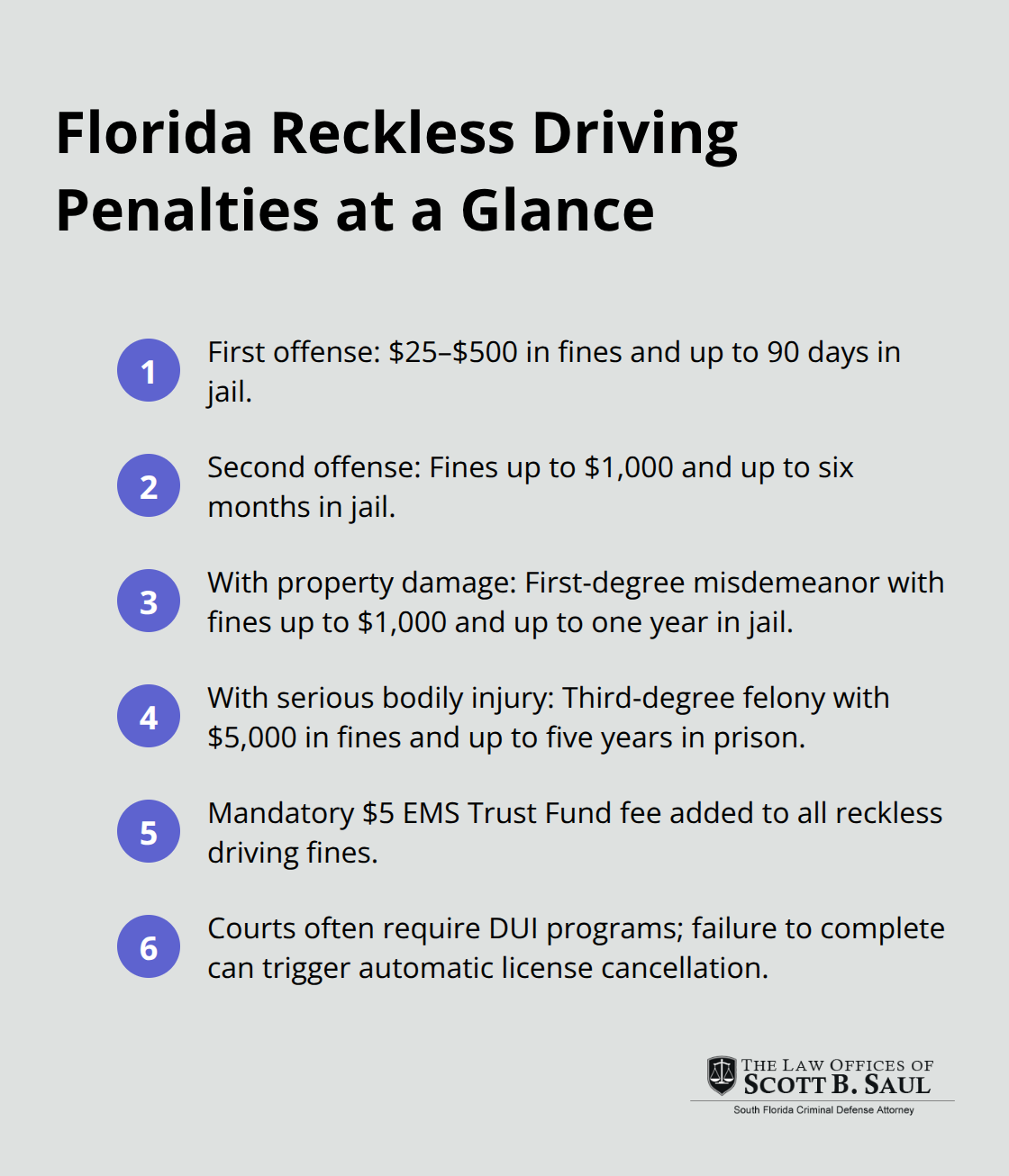
When reckless drivers cause serious bodily injury, prosecutors file third-degree felony charges that carry $5,000 fines and five years in prison. Florida adds a mandatory $5 fee to all reckless fines for the Emergency Medical Services Trust Fund. Courts often mandate DUI programs when alcohol or drugs contribute to the offense, and failure to complete these programs results in automatic license cancellation.
License Points and Suspension Destroy Mobility
Reckless convictions add four points to your Florida record and trigger automatic license suspension for up to six months. The Florida Department of Highway Safety and Motor Vehicles tracks these violations permanently, which affects future violations and penalties. Accumulation of too many points from multiple violations leads to extended license suspension periods (ranging from 30 days to one year depending on total points). The state may reinstate privileges on a restricted basis for those who participate in treatment programs, but full restoration requires completion verification.
Insurance and Employment Consequences End Careers
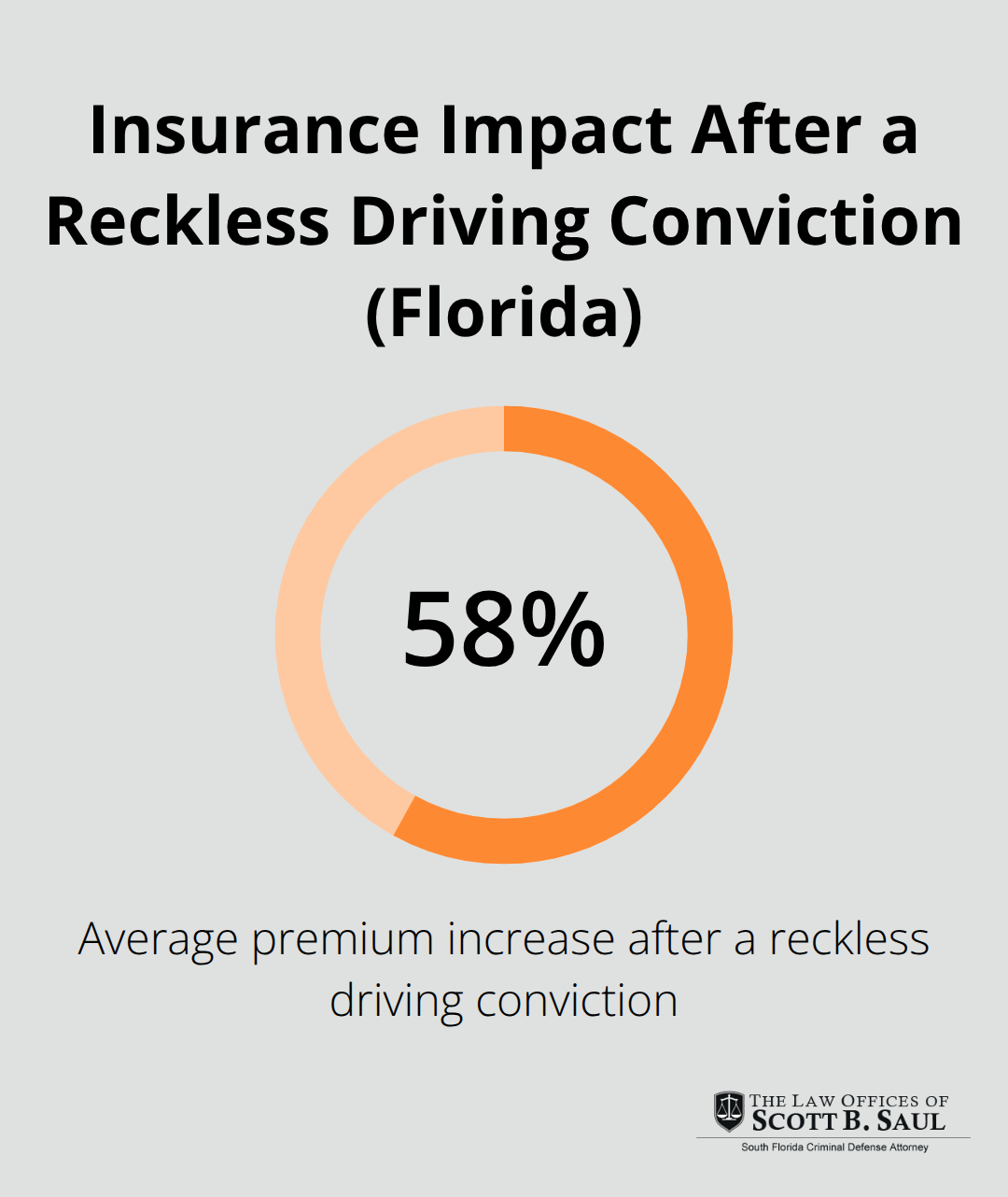
Insurance premiums increase by 58% after reckless convictions according to industry data, with some carriers that drop coverage entirely. Losing your auto insurance and facing higher insurance rates creates long-term financial burdens. Employers who conduct background checks view reckless behavior as criminal conduct, not traffic violations.
Commercial drivers face immediate disqualification for many positions, while ride-share companies like Uber and Lyft permanently ban drivers with reckless convictions. Professional licenses in healthcare, finance, and law enforcement often require disclosure of criminal convictions, which potentially ends careers before they start.
These severe penalties make professional legal representation essential when you face reckless charges, as experienced attorneys can explore defense strategies that protect your future.
Legal Defenses Against Reckless Driving Charges
Challenge the Evidence Foundation
Police testimony forms the backbone of most reckless driving cases, but officers make critical mistakes that skilled attorneys exploit. Dashcam footage can reveal speeding, reckless driving, distracted driving, failure to yield, or running red lights, often contradicting officer observations.

Radar calibration records frequently show equipment malfunctions or improper maintenance. Defense attorneys examine whether officers followed proper procedures during traffic stops and whether their field sobriety tests met legal standards. Traffic accident reconstruction experts can demonstrate that road conditions, weather, or mechanical failures caused the behavior rather than willful disregard. Emergency circumstances provide powerful defenses when drivers swerve to avoid accidents or speed to reach hospitals during medical emergencies.
Prove Intent Was Missing
Prosecutors must prove you acted with willful or wanton disregard for the safety of persons or property, which means they need evidence of deliberate dangerous behavior rather than simple mistakes or poor judgment. Medical conditions like diabetic episodes, seizures, or medication side effects can explain erratic behavior without criminal intent. Mechanical failures such as brake problems, steering issues, or tire blowouts create reasonable doubt about your mental state during the incident (especially when maintenance records support the claim). Defense attorneys challenge cases where drivers responded reasonably to unexpected situations like pedestrians or debris in roadways.
Negotiate Strategic Plea Agreements
Experienced criminal defense attorneys negotiate reckless charges down to careless violations, which eliminates jail time and criminal records while reduces fines to civil infractions. Prosecutors often accept these agreements when evidence problems exist or when defendants have clean records. First-time offenders can qualify for pretrial diversion programs that dismiss charges upon completion of courses or community service. Some courts allow withholding of adjudication, which prevents convictions from appearing on background checks while still requires compliance with court conditions (though this option depends on the specific circumstances of your case).
Final Thoughts
Reckless driving Florida charges create permanent criminal records that affect employment, insurance, and professional licenses for years. The difference between a misdemeanor conviction and a reduced civil infraction determines whether you face jail time or simply pay a fine. Professional legal representation provides access to defense strategies that most drivers never consider.
Experienced attorneys challenge evidence, question police procedures, and negotiate plea agreements that protect your future. We at Law Offices of Scott B. Saul examine every detail of your case to build the strongest possible defense. Our team understands how prosecutors approach these cases and what strategies work best in Florida courts.
Contact an attorney immediately before you speak to prosecutors or accept any plea offers when you face reckless charges. Document the incident details while they remain fresh in your memory and gather witness information that supports your version of events (avoid discussing your case on social media or with anyone except your attorney). Contact our experienced criminal defense team today to protect your rights and explore all available defense options.
Archives
- February 2026 (5)
- January 2026 (9)
- December 2025 (9)
- November 2025 (8)
- October 2025 (8)
- September 2025 (9)
- August 2025 (8)
- July 2025 (8)
- June 2025 (9)
- May 2025 (9)
- April 2025 (8)
- March 2025 (9)
- February 2025 (8)
- January 2025 (9)
- December 2024 (10)
- November 2024 (5)
- July 2024 (2)
- June 2024 (2)
- May 2024 (2)
- April 2024 (2)
- March 2024 (2)
- February 2024 (2)
- January 2024 (2)
- December 2023 (2)
- November 2023 (2)
- October 2023 (2)
- September 2023 (2)
- August 2023 (1)
- July 2023 (2)
- June 2023 (2)
- May 2023 (2)
- April 2023 (2)
- March 2023 (2)
- February 2023 (2)
- January 2023 (2)
- December 2022 (2)
- November 2022 (2)
- October 2022 (2)
- September 2022 (2)
- August 2022 (2)
- July 2022 (2)
- June 2022 (2)
- May 2022 (2)
- April 2022 (2)
- March 2022 (2)
- February 2022 (2)
- January 2022 (2)
- December 2021 (2)
- November 2021 (2)
- October 2021 (2)
- September 2021 (2)
- August 2021 (2)
- July 2021 (2)
- June 2021 (2)
- May 2021 (2)
- April 2021 (2)
- September 2020 (5)
- July 2020 (4)
- June 2020 (4)
- May 2020 (4)
- April 2020 (5)
- March 2020 (4)
- February 2020 (4)
- January 2020 (4)
- December 2019 (1)
- November 2019 (4)
- October 2019 (4)
- September 2019 (4)
- August 2019 (4)
- July 2019 (5)
- June 2019 (4)
- May 2019 (4)
- April 2019 (4)
- March 2019 (4)
- February 2019 (4)
- January 2019 (4)
- December 2018 (4)
- November 2018 (5)
- October 2018 (5)
- September 2018 (4)
- August 2018 (4)
- July 2018 (7)
- June 2018 (4)
- May 2018 (4)
- April 2018 (8)
- March 2018 (4)
- February 2018 (4)
- January 2018 (4)
- November 2017 (4)
- October 2017 (4)
- September 2017 (4)
- August 2017 (7)
- July 2017 (6)
- June 2017 (4)
- May 2017 (4)
- April 2017 (4)
- March 2017 (4)
- February 2017 (7)
- January 2017 (4)
- December 2016 (7)
- November 2016 (4)
- October 2016 (4)
- September 2016 (10)
- August 2016 (4)
- July 2016 (4)
- June 2016 (4)
- May 2016 (4)
- April 2016 (4)
- March 2016 (4)
- February 2016 (7)
- January 2016 (4)
- December 2015 (5)
- November 2015 (4)
- October 2015 (7)
- September 2015 (4)
- August 2015 (4)
- July 2015 (13)
- June 2015 (9)
- May 2015 (8)
- April 2015 (6)
- March 2015 (4)
- February 2015 (4)
- January 2015 (4)
- December 2014 (4)
- November 2014 (4)
- October 2014 (4)
- September 2014 (3)
Categories
- Adjudication (1)
- Bankruptcy (1)
- Burglary Crimes (3)
- calendar call (1)
- Car Accident (1)
- Criminal Defense (395)
- Cyber Crimes (7)
- DNA (1)
- Domestic Violence (9)
- Drug Crimes (5)
- DUI (12)
- Embezzlement (1)
- Environmental Crimes (4)
- Expungement Law (2)
- Federal Sentencing Law (3)
- Firearm (3)
- Forgery (4)
- General (82)
- Healthcare (3)
- Immigration (1)
- Indentity Theft (1)
- Insurance (5)
- judicial sounding (2)
- Juvenile Crimes (4)
- Manslaughter (4)
- Money Laundering (3)
- Organized Crime (1)
- Racketeering (1)
- Reckless Driving (3)
- RICO (3)
- Sealing and Expunging (2)
- Sex Offense (1)
- Shoplifting (1)
- Suspended Driver's License (1)
- Traffic (4)
- Trending Topics (1)
- White-collar Offenses (1)
