
Understanding Petit Theft in Florida
By : saulcrim | Category : Criminal Defense | Comments Off on Understanding Petit Theft in Florida
13th Nov 2025

Petit theft Florida charges affect thousands of residents each year, with penalties ranging from fines to jail time. Even seemingly minor theft accusations can result in permanent criminal records that impact employment opportunities for decades.
We at Law Offices of Scott B. Saul see how these charges devastate lives when defendants lack proper legal representation. The state’s theft laws contain complex value thresholds and intent requirements that experienced attorneys can challenge effectively.
What Exactly Qualifies as Petit Theft in Florida
Legal Elements That Define Petit Theft
Florida Statute 812.014 establishes petit theft as knowingly obtaining or using another person’s property with intent to permanently deprive the owner of that property. The prosecution must prove three specific elements: the defendant took property belonging to another person, the property had some value, and the defendant intended to deprive the owner permanently. The Florida Department of Law Enforcement reports theft ranks as the third most common arrest category statewide, which makes these cases frequent in Florida courts.
The $750 Threshold That Changes Everything
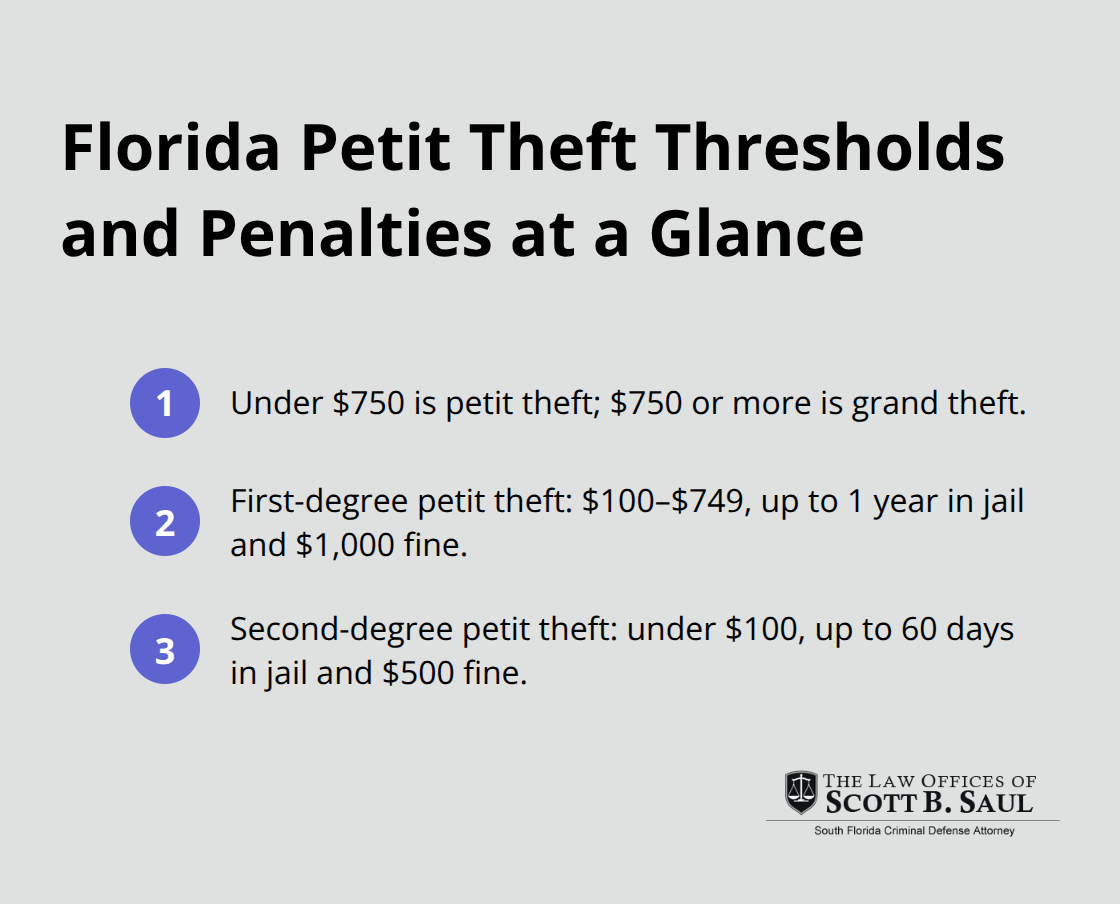
Property value determines whether charges become petit theft or grand theft in Florida. Petit theft applies when stolen property values less than $750, while grand theft begins at $750 or more. First-degree petit theft covers property valued between $100 and $749, which carries penalties up to one year in jail and $1,000 fines. Second-degree petit theft involves property under $100, with maximum penalties of 60 days jail time and $500 fines.
The Office of Program Policy Analysis and Government Accountability reviews these thresholds every five years to account for inflation and economic changes.
Common Scenarios That Trigger Charges
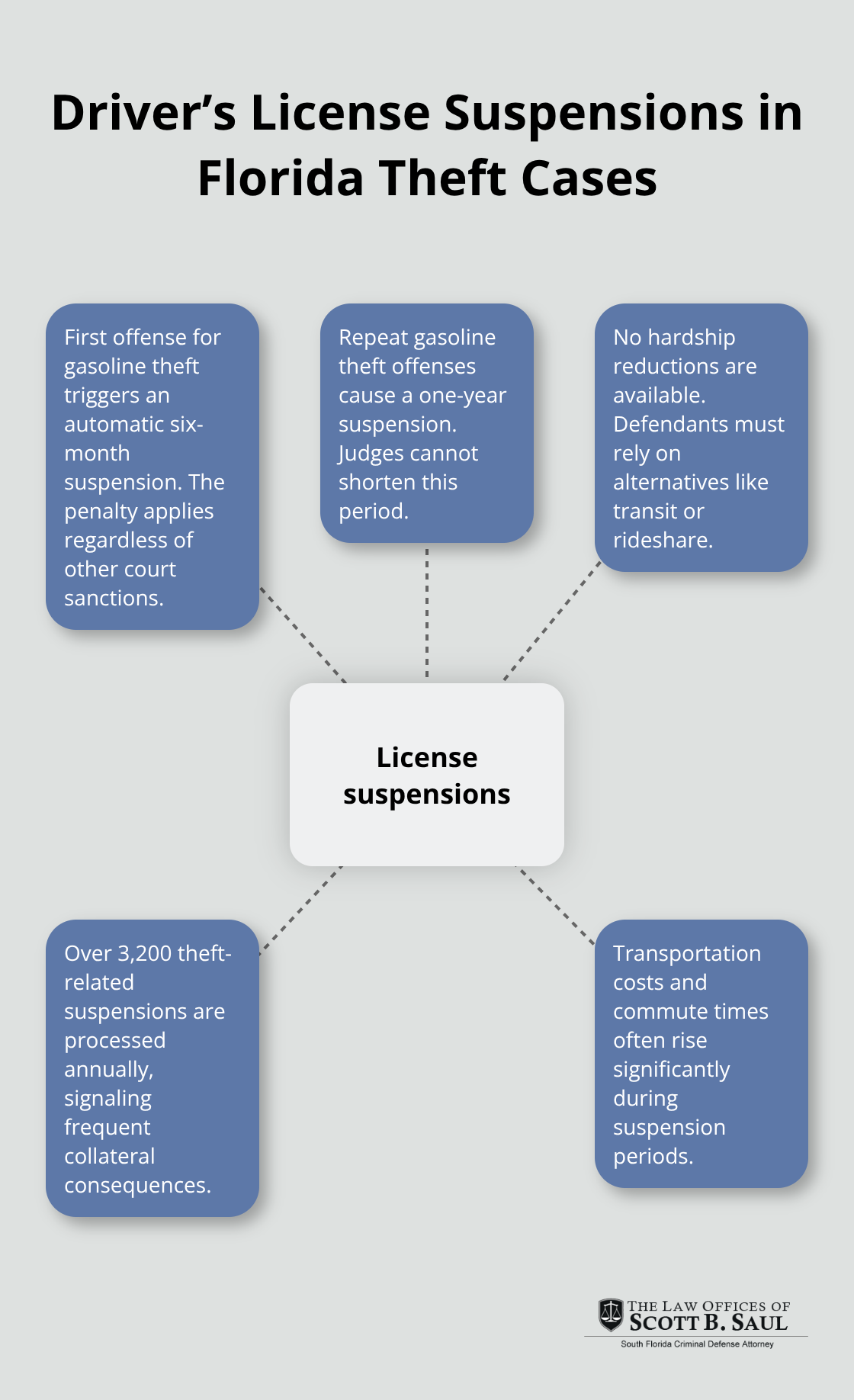
Shoplifters who steal merchandise from retail stores face the most common petit theft scenario, particularly when items total under $750. Defendants who take gasoline without payment face special penalties that include automatic six-month driver’s license suspension for first offenses and one-year suspension for repeat violations. Theft from dwellings automatically elevates to third-degree felony charges regardless of property value.
How Prior Convictions Escalate Penalties
Previous theft convictions drastically change penalties for new charges. Defendants with one prior theft conviction face first-degree misdemeanor charges even for property under $100, while two or more prior convictions result in third-degree felony charges. This escalation system means repeat offenders face increasingly severe consequences that can transform minor theft accusations into serious felony cases.
The severity of these penalties makes understanding your defense options essential when facing any theft charge in Florida.
What Penalties Follow Petit Theft Convictions
Jail Time and Financial Consequences Hit Hard
First-degree petit theft convictions carry maximum sentences of one year in county jail and fines up to $1,000, while second-degree convictions result in up to 60 days jail time and $500 fines. Florida courts impose these penalties frequently, with judges who show little mercy for repeat offenders. Additional consequences include probation periods up to one year, mandatory community service hours, and restitution payments to victims that often exceed the original property value.
Criminal Records Destroy Career Prospects Permanently
Petit theft convictions create permanent criminal records that appear on background checks for decades, which effectively blocks employment opportunities in retail, healthcare, education, and finance industries. Employers conduct criminal background checks regularly, with theft convictions that rank among the most disqualified factors for decisions to hire. Professional licenses face automatic review and potential suspension in fields like medical care, real estate, and finance (particularly for positions that handle money). Immigration consequences prove severe for non-citizens, with theft convictions that trigger deportation proceedings and prevent naturalization applications.
Driver’s License Suspensions Add Transportation Problems
Special penalties target specific theft scenarios that create additional hardships. Gasoline theft convictions trigger automatic six-month driver’s license suspensions for first offenses and one-year suspensions for subsequent violations, regardless of other penalties imposed. These suspensions cannot be reduced through hardship applications, which forces defendants to rely on public transportation or rideshare services that dramatically increase daily costs. The Florida Department of Highway Safety reports that it processes over 3,200 theft-related license suspensions annually, which demonstrates how frequently these collateral consequences affect defendants beyond traditional criminal penalties.
How Repeat Offenses Escalate Consequences
Prior theft convictions transform future charges into more serious offenses with harsher penalties. Defendants with one previous theft conviction face first-degree misdemeanor charges even for property under $100, while two or more prior convictions result in third-degree felony charges. This escalation system means that what appears as minor shoplifting can become a felony case with potential prison time (up to five years for third-degree felonies).
These severe consequences make it essential to understand your defense options and the strategies that can protect your future when you face theft charges. Early attorney involvement makes the difference between conviction and dismissal in these cases.
How Can You Build a Strong Defense Against Petit Theft Charges
Challenge the Intent Element
The prosecution must prove beyond reasonable doubt that you intended to permanently deprive the owner of their property, which creates the strongest defense opportunity in petit theft cases. Defense attorneys challenge intent when they demonstrate that defendants planned to return items, believed they had permission to take property, or acted under mistaken ownership assumptions. Florida courts require specific evidence of intent, not mere speculation, which means prosecutors often struggle with this element when defendants provide reasonable explanations for their actions. Documentation like text messages about borrowed items, receipts that show previous purchases of similar products, or witness testimony about permission can completely undermine the state’s case. Petit theft involves stolen property valued at less than $750 and is typically considered a misdemeanor.
Expose Weak Evidence and Unreliable Witnesses
Retail theft cases frequently rely on security footage that fails to clearly show defendants who conceal merchandise or leave stores without payment, while witness testimony from store employees often contains inconsistencies under cross-examination. Defense teams examine surveillance video frame-by-frame to identify gaps, poor angles, or timestamp discrepancies that create reasonable doubt about what actually occurred. Store security personnel regularly make identification errors, particularly when multiple people wear similar clothes or when poor conditions obscure facial features. Police reports often contain factual errors about property values, with officers who accept inflated retail prices rather than actual market values.
Secure Alternative Resolutions
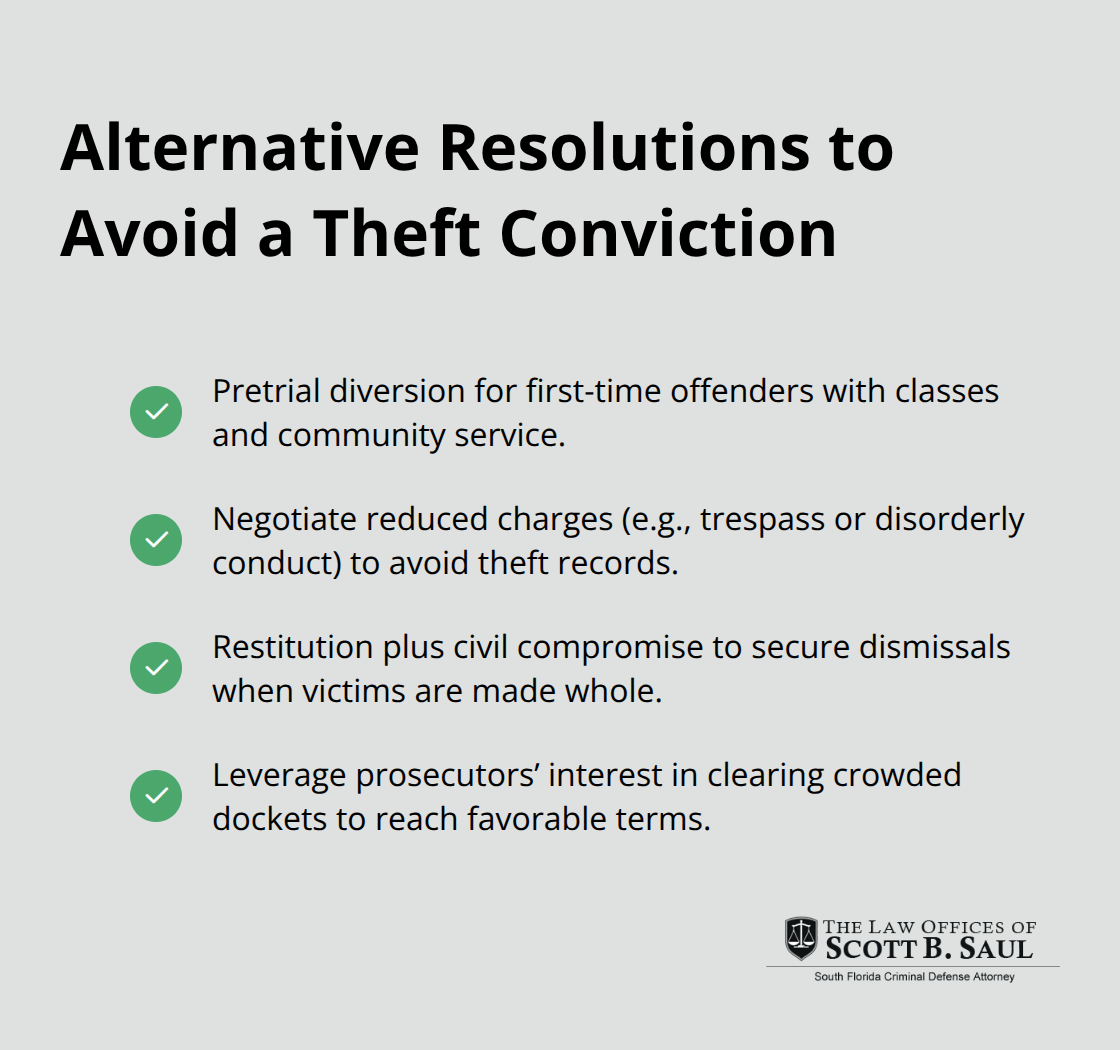
Florida prosecutors handle thousands of petit theft cases annually, which makes them receptive to plea negotiations that clear dockets efficiently while they avoid trial costs. Pretrial diversion programs allow first-time offenders to complete community service and theft education classes in exchange for charge dismissals, though eligibility requirements vary by county. Defense attorneys negotiate reduced charges that avoid theft convictions entirely, such as trespass or disorderly conduct pleas that prevent the employment consequences associated with theft records. Restitution agreements combined with civil compromise motions can lead to complete charge dismissals when victims receive full compensation and formally request case closure (particularly effective in shoplifting cases where stores recover merchandise).
Final Thoughts
Petit theft Florida charges create serious consequences that reach far beyond initial fines and jail time. Property valued under $750 triggers misdemeanor charges, while prior convictions escalate penalties to felony levels with potential prison sentences. These convictions create permanent criminal records that destroy employment opportunities across multiple industries and trigger automatic driver’s license suspensions for specific theft scenarios.
The prosecution must prove intent to permanently deprive property owners, which creates defense opportunities that experienced attorneys exploit effectively. Attorneys challenge evidence quality and witness reliability while they negotiate alternative resolutions like pretrial diversion programs. These strategies can prevent devastating long-term consequences that follow theft convictions.
We at Law Offices of Scott B. Saul defend theft charges with aggressive representation throughout Miami-Dade and Broward County. Our firm focuses on protection of clients’ rights and personalized attention that makes the difference between conviction and freedom. Contact our experienced criminal defense team today for comprehensive consultation about your case (we provide the strategic defense you need when you face these serious charges).
Archives
- February 2026 (5)
- January 2026 (9)
- December 2025 (9)
- November 2025 (8)
- October 2025 (8)
- September 2025 (9)
- August 2025 (8)
- July 2025 (8)
- June 2025 (9)
- May 2025 (9)
- April 2025 (8)
- March 2025 (9)
- February 2025 (8)
- January 2025 (9)
- December 2024 (10)
- November 2024 (5)
- July 2024 (2)
- June 2024 (2)
- May 2024 (2)
- April 2024 (2)
- March 2024 (2)
- February 2024 (2)
- January 2024 (2)
- December 2023 (2)
- November 2023 (2)
- October 2023 (2)
- September 2023 (2)
- August 2023 (1)
- July 2023 (2)
- June 2023 (2)
- May 2023 (2)
- April 2023 (2)
- March 2023 (2)
- February 2023 (2)
- January 2023 (2)
- December 2022 (2)
- November 2022 (2)
- October 2022 (2)
- September 2022 (2)
- August 2022 (2)
- July 2022 (2)
- June 2022 (2)
- May 2022 (2)
- April 2022 (2)
- March 2022 (2)
- February 2022 (2)
- January 2022 (2)
- December 2021 (2)
- November 2021 (2)
- October 2021 (2)
- September 2021 (2)
- August 2021 (2)
- July 2021 (2)
- June 2021 (2)
- May 2021 (2)
- April 2021 (2)
- September 2020 (5)
- July 2020 (4)
- June 2020 (4)
- May 2020 (4)
- April 2020 (5)
- March 2020 (4)
- February 2020 (4)
- January 2020 (4)
- December 2019 (1)
- November 2019 (4)
- October 2019 (4)
- September 2019 (4)
- August 2019 (4)
- July 2019 (5)
- June 2019 (4)
- May 2019 (4)
- April 2019 (4)
- March 2019 (4)
- February 2019 (4)
- January 2019 (4)
- December 2018 (4)
- November 2018 (5)
- October 2018 (5)
- September 2018 (4)
- August 2018 (4)
- July 2018 (7)
- June 2018 (4)
- May 2018 (4)
- April 2018 (8)
- March 2018 (4)
- February 2018 (4)
- January 2018 (4)
- November 2017 (4)
- October 2017 (4)
- September 2017 (4)
- August 2017 (7)
- July 2017 (6)
- June 2017 (4)
- May 2017 (4)
- April 2017 (4)
- March 2017 (4)
- February 2017 (7)
- January 2017 (4)
- December 2016 (7)
- November 2016 (4)
- October 2016 (4)
- September 2016 (10)
- August 2016 (4)
- July 2016 (4)
- June 2016 (4)
- May 2016 (4)
- April 2016 (4)
- March 2016 (4)
- February 2016 (7)
- January 2016 (4)
- December 2015 (5)
- November 2015 (4)
- October 2015 (7)
- September 2015 (4)
- August 2015 (4)
- July 2015 (13)
- June 2015 (9)
- May 2015 (8)
- April 2015 (6)
- March 2015 (4)
- February 2015 (4)
- January 2015 (4)
- December 2014 (4)
- November 2014 (4)
- October 2014 (4)
- September 2014 (3)
Categories
- Adjudication (1)
- Bankruptcy (1)
- Burglary Crimes (3)
- calendar call (1)
- Car Accident (1)
- Criminal Defense (395)
- Cyber Crimes (7)
- DNA (1)
- Domestic Violence (9)
- Drug Crimes (5)
- DUI (12)
- Embezzlement (1)
- Environmental Crimes (4)
- Expungement Law (2)
- Federal Sentencing Law (3)
- Firearm (3)
- Forgery (4)
- General (82)
- Healthcare (3)
- Immigration (1)
- Indentity Theft (1)
- Insurance (5)
- judicial sounding (2)
- Juvenile Crimes (4)
- Manslaughter (4)
- Money Laundering (3)
- Organized Crime (1)
- Racketeering (1)
- Reckless Driving (3)
- RICO (3)
- Sealing and Expunging (2)
- Sex Offense (1)
- Shoplifting (1)
- Suspended Driver's License (1)
- Traffic (4)
- Trending Topics (1)
- White-collar Offenses (1)
